Autor: Bernd Kuhlenkötter

Digitization in Engineering

Digitization in Engineering

A procedure for the continuous, work-sharing modelling using the example of automation
Eike Schäffer, Lars Penczek, Andreas Mayr, Jupiter Bakakeu, Jörg Franke, Bernd Kuhlenkötter ORCID Icon
Digitization in engineering promises automated workflows, higher speed and lower costs in the development of automation solutions. The prerequisite for this is not only modularization based on a structured description language, but also uniform, interdependent modeling that ensures automated data exchange across system boundaries. In order to achieve a broad application, the underlying ontology should be based on existing norms and standards and be available in open source applications. However, the collaborative and consistent development of such an ontology requires a structured, methodical procedure and an associated modelling map that serves as an orientation for standardized, work-sharing modelling. A possible approach for the required procedure model and the related map will be presented in this article and validated using AutomationML. The presented approach should point out a possible direction and stimulate further process-controlled modelling efforts of ontologies.
Industrie 4.0 Management | Volume 35 | 2019 | Edition 1 | Pages 61-66 | DOI 10.30844/I40M_19-1_S61-66
Blockchain in Production

Blockchain in Production

Ein Ansatz zur manipulationsfreien sowie dezentralen Speicherung von Daten in der Montage von Morgen
Christian Block, Bernd Kuhlenkötter ORCID Icon
The increasing digitization of production is leading to new requirements and an increase in complexity in data management. Data and applications will become even more decentralized in the future, while ensuring data security and data validity. These requirements are difficult to implement with traditional databases. One promising technology is the Blockchain, which has been used in the context of crypto currencies like bitcoins for several years. In this article, the blockchain is presented in an industrial application in the context of a quality data acquisition in assembly.
Industrie 4.0 Management | Volume 34 | 2018 | Edition 2 | Pages 21-24
Holistic Resource Efficiency through Industry 4.0

Holistic Resource Efficiency through Industry 4.0

Thom Wienbruch, Dieter Kreimeier, Bernd Kuhlenkötter ORCID Icon
This article deals with the presentation of a concept that shows new possibilities for a holistic improvement in the company’s internal resource efficiency by using Industry 4.0. Subsequently, the structure of a resource management system will be shown. To attain a holistic improvement of the resource efficiency, the viewing frame will be extended to the whole product lifecycle to show which potentials a coupling along the entire value-added chain provides.
Industrie 4.0 Management | Volume 33 | 2017 | Edition 1 | Pages 62-66
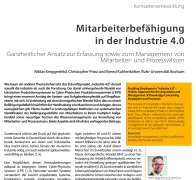
Enabling Employees in “Industry 4.0”

Enabling Employees in “Industry 4.0”

Holistic Approach for the Acquisition and Management of Knowledge Concerning Employees and Processes
Niklas Kreggenfeld, Christopher Prinz ORCID Icon, Bernd Kuhlenkötter ORCID Icon
The increase of complexity in the field of production due to “Industrie 4.0” causes also a rapid increase of the complexity of tasks on the shopfloor level. Thus, efficient methods for the systematic identification of the competence deficits of the employees as well as new forms of knowledge management for an adequate administration of knowledge have to be established.
Industrie 4.0 Management | Volume 32 | 2016 | Edition 3 | Pages 31-34
Individualized Work Assistance

Individualized Work Assistance

Ensuring healthy, safe and competitive work in industrial production
Felix Busch, Jochen Hartung, Carsten Thomas, Sascha Wischniewski, Jochen Deuse ORCID Icon, Bernd Kuhlenkötter ORCID Icon
Ensuring healthy, safe and competitive work is a major challenge in industrial production particularly regarding the demographic change in Germany. Especially work systems with a high amount of manual tasks require appropriate solutions. The article discusses the potential of hybrid human-robot work systems in manufacturing focusing assembly tasks.
Industrie Management | Volume 29 | 2013 | Edition 3 | Pages 7-10
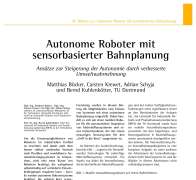
Autonomous Robots with Sensor-Based Path Planning

Autonomous Robots with Sensor-Based Path Planning

Approaches to Increase the Autonomy through Improved Environmental Perception
Matthias Bücker, Carsten Krewet, Adrian Schyja, Bernd Kuhlenkötter ORCID Icon
To expand capabilities of robots in manufacturing and service but also to meet needs in the ever-increasing desire for a flexible and changeable production, a new class of robots is required. These robots have to be able to independently react to changes - so called autonomous systems which do not have to be programmed for any task, butreact to the changed situation and new tasks autonomously, according to their sensory perception .On the basis of two current examples from industry-related research in this paper the possibilities for the use of systems with an autonomous path planning are presented. This is a mobile robot for automated inspection of material flow systems and an industrial robot, equipped with a new sensor system for bin picking.
Industrie Management | Volume 27 | 2011 | Edition 1 | Pages 21-24
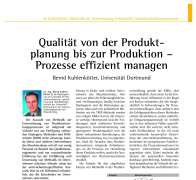
Selection of Methodology Aimed at Supporting Product Creation Processes

Selection of Methodology Aimed at Supporting Product Creation Processes

Prozesse effizient managen
Bernd Kuhlenkötter ORCID Icon
For increasing their product development and production efficiency, large-scale enterprises, mainly the automotive industry and their suppliers, more and more often make use of methodological instruments. A few of these methods have already made their way to the small and medium sized enterprises (SME), mainly of the mechanical engineering branch. The most important among these instruments are: Concurrent Engineering, Design for X, Failure mode and effect analysis, Quality Function Deployment and Value Analysis. And even more recent methods like TRIZ Method or Scenario Management are already observed with great interest by some of the SME because of their need for shorter development times, cost minimisation, increase of product quality, and, in consequence, their efforts for restructuring product development processes.
Industrie Management | Volume 20 | 2004 | Edition 4 | Pages 53-56
1 2