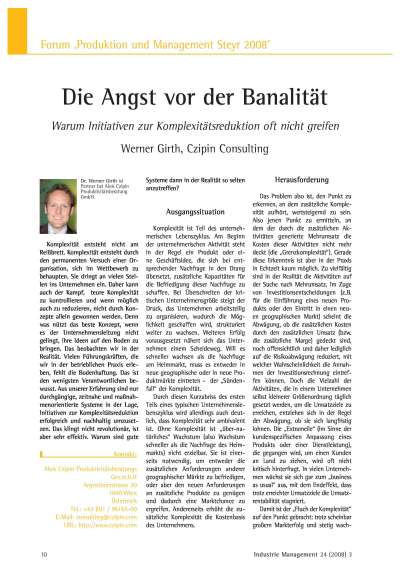
Fear of Banality

Warum Initiativen zur Komplexitätsreduktion oft nicht greifen

JournalIndustrie Management
Issue Volume 24, 2008, Edition 3, Pages 10-12
Share Cite Download

Abstract

Complexity does not emerge from the drawing-board. Complexity evolves through the permanent attempt of an organization to emerge and distinguish itself from the competition. Complexity penetrates a company on many different levels. The battle to control and, if possible, reduce expensive complexity can not be won by just putting up concepts. What is the best concept good for if the corporate management can not realize it? In practice we observe many executives lacking in pragmatic, down to earth approaches. Most managers are not aware of that. Our experience taught us the following: Initiatives for complexity-reduction are successful when continuous, real-time and action-oriented management information-systems are in use during and after the transformation process. The relevant complexity indicators have to be transferred to management and staff. Both must work proactively to reach the goal of complexity reduction. Last but not least all assigned actions for complexity-reduction have to be performed consequently. All of that does not sound new or revolutionary but is highly effective.

Keywords

Access limited

You are currently not logged in / not yet registered.

In order to download the desired file(s), you must be logged in and have an appropriate inclusive subscription. Alternatively, you can also obtain access by paying a one-off fee.

Subscription included Purchase
without 29,00 €
Digital 0,00 €
Expert 0,00 €
Professional 0,00 €

Download for one time 29,00 €

All prices include 7% VAT

After purchasing access rights, you will automatically be redirected back to this page.


You might also be interested in

Enabling Digital Trust in Green Hydrogen Markets

Enabling Digital Trust in Green Hydrogen Markets

Trust-Building Information Systems and Mechanisms
Johanna Voß, Jens Pöppelbuß ORCID Icon
Building a global hydrogen economy requires more than technology and investment; it requires trust. As information systems (IS) increasingly mediate collaboration among unfamiliar, distributed actors, the question of how trust can be deliberately built becomes critical. This study systematically maps how IS enable different types of trust and reveals how these mechanisms can support trusting collaboration in emerging hydrogen value chains.
Industry 4.0 Science | Volume 42 | 2026 | Edition 4 | Pages 82-90
Platform Adoption as a Dynamic Capability

Platform Adoption as a Dynamic Capability

How SMEs overcome barriers to adoption of B2B collaboration platforms
Nikolai Schäfer ORCID Icon, Marcel Hülsbeck ORCID Icon
Digital collaboration and innovation platforms offer SMEs significant potential to compensate for structural resource weaknesses and to participate in innovation ecosystems. Nevertheless, adoption in the B2B context remains low. This paper examines adoption barriers based on a systematic literature review using Teece’s dynamic capabilities approach. The analysis suggests that recurring obstacles can be structured along three dimensions: Sensing—lack of ecosystem awareness, absence of scanning routines; Seizing—IP concerns, governance uncertainty, adoption fatigue; Reconfiguring—closed-innovation culture, lack of absorptive capacity. Building on this, a practice-oriented capability-building framework is developed with recommendations for action.
Industry 4.0 Science | Volume 42 | 2026 | Edition 4 | Pages 42-48 | DOI 10.30844/I4SE.26.4.5
Industry 4.0—Progress and Digitalization in Limbo

Industry 4.0—Progress and Digitalization in Limbo

Status of sustainable transformation and digitalization in production engineering
Christian Donhauser ORCID Icon, Daniel Riepl
Digitalization projects help users represent complex processes more simply and efficiently. However, there are many obstacles to implementation. Reluctance to implement these projects is palpable. This affects, among others, employers and employees, who may fall behind economically by waiting or avoiding change. These observations can be traced back to an overarching research question: What barriers and systemic challenges hinder sustainable transformation within the context of Industry 4.0, particularly when considering human labor in production engineering? What questions are the affected stakeholders asking? The primary goal of this long-term research project is to define these questions decisively and in detail in order to develop a conceptual foundation that integrates research, teaching, and technological development and thus combines the potential of digital technologies with the experiential and practical knowledge of production workers.
Industry 4.0 Science | Volume 42 | 2026 | Edition 3 | Pages 56-60
Digital Twins for Emission Reduction

Digital Twins for Emission Reduction

Ex-ante case study on a pump test bench in industrial production
Felix Bischoff, Ingela Tietze ORCID Icon, Peter Hertweck, Nina van Hasz
Digital twins are frequently referred to as a promising approach for reducing greenhouse gas (GHG) emissions in industrial production; however, robust empirical evidence of their benefits under real-world conditions is largely lacking. In this case study, the emission reduction potential of a digital twin—as a conceptually described target system—is quantified ex-ante via the example of a test bench for hydraulic pumps. To this end, the GHG emissions of the original test plan for the year 2025 are determined based on actual measured energy consumption of the tested pumps and time-resolved grid electricity emission intensities. This is followed by a rule-based rescheduling, in which energy-intensive test processes are shifted to time intervals with lower emissions. The rescheduling takes operational constraints into account so that processes and equipment remain unchanged. The savings potential is determined by comparing the GHG emissions of the reference and the optimized case.
Industry 4.0 Science | Volume 42 | 2026 | Edition 3 | Pages 16-24 | DOI 10.30844/I4SE.26.3.2
Serious Gaming and the Energy Transition

Serious Gaming and the Energy Transition

Collaborative knowledge generation and interactive understanding of complex interrelationships
Janine Gondolf ORCID Icon, Gert Mehlmann, Jörn Hartung, Bernd Schweinshaut, Anne Bauer
Conveying the complexity and multifaceted nature of the energy transition to a broad audience is a challenge. This article demonstrates how interactive serious games on a multitouch table can help make connections tangible and comprehensible. The games and the table were used in various conversational contexts. These are presented here in three case vignettes based on participant observation of the different applications, as well as situated and shared reflection. The vignettes demonstrate how interaction can trigger epistemic processes, enable shifts in perspective, and foster collective thinking, all of which are necessary for shaping the future of society as a whole.
Industry 4.0 Science | Volume 42 | 2026 | Edition 2 | Pages 62-69
Industrial Transformation via a Machining Learning Factory

Industrial Transformation via a Machining Learning Factory

A learning module to foster competencies for a sustainability-driven transformation
Oskay Ozen ORCID Icon, Victoria Breidling ORCID Icon, Matthias Weigold, Stefan Seyfried ORCID Icon
Sustainability-enhancing transformation processes are necessary in all sectors if we are to remain within planetary boundaries. This also applies to the industrial sector as a significant emitter of greenhouse gases. Employees need new competencies to master this complex task of industrial transformation. These range from CO2 equivalents accounting to the development and evaluation of transformation scenarios, including technical measures. The learning module developed here addresses these competency requirements and uses the example of the ETA factory to show how a competency-oriented learning module for industrial transformation can be structured. It essentially comprises four phases: data collection and CO2 equivalents accounting, cause analysis, development of measures and evaluation of measures.
Industry 4.0 Science | Volume 42 | Edition 2 | Pages 38-47 | DOI 10.30844/I4SE.26.2.38