Control of Adaptive Systems Using a Digital Twin

Human-machine interaction during the product life cycle with the example of container unloading

JournalIndustrie 4.0 Management
Issue Volume 36, 2020, Edition 5, Pages 15-19
Share Cite Download

Abstract

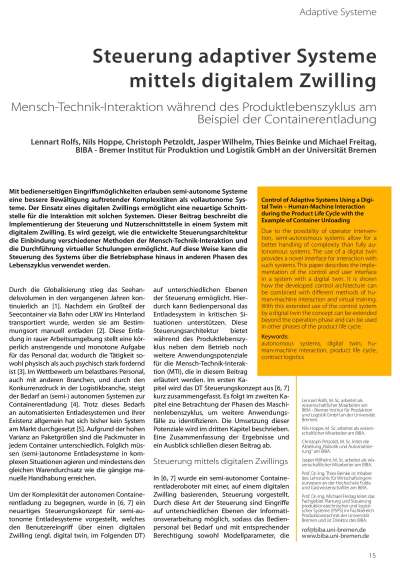
Due to the possibility of operator intervention, semi-autonomous systems allow for a better handling of complexity than fully autonomous systems. The use of a digital twin provides a novel interface for interaction with such systems. This paper describes the implementation of the control and user interface in a system with a digital twin. It is shown how the developed control architecture can be combined with different methods of human-machine interaction and virtual training. With this extended use of the control system by a digital twin the concept can be extended beyond the operation phase and can be used in other phases of the product life cycle.

Keywords

Access limited

You are currently not logged in / not yet registered.

In order to download the desired file(s), you must be logged in and have an appropriate inclusive subscription. Alternatively, you can also obtain access by paying a one-off fee.

Subscription included Purchase
without 29,00 €
Digital 27,55 €
Expert 26,10 €
Professional 0,00 €

Download for one time 29,00 €

All prices include 7% VAT

After purchasing access rights, you will automatically be redirected back to this page.


Solutions: Logistics Product Development

You might also be interested in
AI-Powered Lubrication Strategies for Thread Forming

AI-Powered Lubrication Strategies for Thread Forming

Adaptive spray jet control to increase process reliability and tool life
Reinhard Schmied, Marco Susic, Christian Donhauser ORCID Icon
Thread forming requires precise lubricant application because high contact pressures and process temperatures strongly influence tool loading, friction, and process stability. Although minimum quantity lubrication (MQL) systems are widely used, current spray-based approaches can still suffer from spray losses, insufficient wetting of the thread grooves, and unstable droplet transport. This article presents a concept for adaptive precision lubrication in thread forming based on computational fluid dynamics (CFD)-supported flow analysis, experimental validation, and artificial intelligence (AI)-assisted optimization. The focus is on droplet size, spray jet geometry, nozzle position, ambient flow conditions, and their influence on wetting intensity. Preliminary simulation-based investigations indicate that data-driven optimization can help identify wetting deficiencies and support the development of future control strategies for resource-efficient lubricant application.
Industry 4.0 Science | Volume 42 | 2027 | Edition 3 | Pages 76-83
Digital Twin Technology and Architecture

Digital Twin Technology and Architecture

A synthesis of concept and practice
Arka Mukherjee ORCID Icon, Shibaji Chandra ORCID Icon
Digital twins are a key enabling technology of the fourth industrial revolution, integrating physical systems with their digital counterparts to create intelligent, data-driven environments. This conceptual/practice-oriented paper examines how to establish a modern architectural framework for digital twins leverages modern tech-stack like IoT, Data Fabric, AI/ML, seamless integration and enterprise grade security. The paper is grounded in an abundance of literature by leading vendors and analysts in space. It offers a comparative study of different vendors implementing the solution stack in the proposed architecture.
Industry 4.0 Science | Volume 42 | 2026 | Edition 3 | Pages 114-122
Developing Virtual Reality in Learning Contexts

Developing Virtual Reality in Learning Contexts

Navigating efficiency, content relevance and scalability
Stella Kanatouri ORCID Icon, Oliver Sosna ORCID Icon, Alexander Kulik, Sina C. Truckenbrodt ORCID Icon, Friederike Klan ORCID Icon, Christian Erfurth ORCID Icon
While virtual reality can facilitate hands-on learning, its development faces barriers, including high costs and time demands and scalability challenges. This article presents two case studies that illustrate strategies for overcoming such barriers when training the next generation of skilled workers in environmental technologies. By examining approaches for streamlining development and increasing content relevance and scalability, we highlight lessons learned for future practice. We conclude by envisioning a future in which educational institutions can flexibly and cost-effectively prototype virtual reality in learning contexts, ensuring alignment with curricular goals and learners’ needs.
Industry 4.0 Science | Volume 42 | Edition 3 | Pages 26-34 | DOI 10.30844/I4SE.26.3.3
Immersive Human Digital Twins for Industry 4.0

Immersive Human Digital Twins for Industry 4.0

Supporting adaptive human-centric production by integrating cognitive and physical states
Tajbeed A. Chowdhury ORCID Icon, Eric Wagner ORCID Icon, Paul Motzki ORCID Icon, Martina Lehser ORCID Icon
The rapid advancement of immersive technologies has created new opportunities to transform human-machine collaboration in industry. This paper presents an immersive platform with a digital twin that combines both physical and cognitive characteristics of human dynamics. By integrating multimodal sensing, human biomechanics, and cognitive state into digital twin technology, the proposed system enhances operational safety and ensures better ergonomics. The main argument is that human digital twins are not only desirable but essential for next-generation industrial systems. We discuss the limitations of existing human modeling approaches, outline the conceptual foundations of human digital twins, and demonstrate their industrial relevance across safety, productivity, ergonomics and sustainability.
Industry 4.0 Science | Volume 42 | 2026 | Edition 3 | Pages 6-13 | DOI 10.30844/I4SE.26.3.1
Industrial Application of Immersive Technologies

Industrial Application of Immersive Technologies

Exploring XR solutions for training, instruction, design review, and assembly planning
Andreas Straube ORCID Icon, Faikar Zakky Haidar ORCID Icon, Matheus Lenzi dos Santos ORCID Icon, Kussai AI Jairoud ORCID Icon, Eduardo Koscianski ORCID Icon
In recent years, the decreasing cost and improved usability of immersive hardware and software have made extended reality (XR) increasingly attractive for industrial applications. Stand-alone systems with inside-out tracking and camera-based pass-through enable accessible mixed reality (MR) solutions. At the same time, emerging no-code software platforms allow engineers to create XR environments without programming expertise, broadening adoption across production settings. This paper explores key industrial application areas of immersive technologies through selected commercially available XR software solutions for product and process training, spatial instructions and guides, collaborative design review, and assembly and production planning.
Industry 4.0 Science | Volume 42 | 2026 | Edition 3 | Pages 38-47 | DOI 10.30844/I4SE.26.3.4
Digital Twins for Emission Reduction

Digital Twins for Emission Reduction

Ex-ante case study on a pump test bench in industrial production
Felix Bischoff, Ingela Tietze ORCID Icon, Peter Hertweck, Nina van Hasz
Digital twins are frequently referred to as a promising approach for reducing greenhouse gas (GHG) emissions in industrial production; however, robust empirical evidence of their benefits under real-world conditions is largely lacking. In this case study, the emission reduction potential of a digital twin—as a conceptually described target system—is quantified ex-ante via the example of a test bench for hydraulic pumps. To this end, the GHG emissions of the original test plan for the year 2025 are determined based on actual measured energy consumption of the tested pumps and time-resolved grid electricity emission intensities. This is followed by a rule-based rescheduling, in which energy-intensive test processes are shifted to time intervals with lower emissions. The rescheduling takes operational constraints into account so that processes and equipment remain unchanged. The savings potential is determined by comparing the GHG emissions of the reference and the optimized case.
Industry 4.0 Science | Volume 42 | 2026 | Edition 3 | Pages 16-24 | DOI 10.30844/I4SE.26.3.2