
The Advantages of Microservices |
An examination of current literature on its application in companies

| Journal | Industry 4.0 Science |
| Issue | Volume 41, 2025, Edition 1, Pages 50-59 |
| Bibliography | Share | Cite | Download |
Abstract
Keywords
Article
Microservices as a software architecture concept are receiving a great deal of attention in computer science and business administration [1, 2, 3]. They are frequently the object of publications and searches and have been successfully used at some large and well-known companies such as Netflix and Amazon [4]. An architecture paradigm such as that of microservices must ultimately also pass a business assessment before being widely used in the productive economy.
Scientific publications cite an economic advantage, although empirical studies to prove this and some of its other advantages are still lacking [5, 6, 7]. A first step in this direction is to explore and classify the potential advantages of microservice architecture. This article questions which of the operating principles previously defined by research justify the productive use of microservices. The aim is to create a list of the operating principles of microservice architecture that prove to be advantageous. Subsequently, further research can provide a qualified assessment of the aforementioned operating principles.
Microservices are understood as a software architecture. At the center of this architecture is a software complex that appears as one single unit from a business perspective. Technically, however, the individual functions of the software are mapped in individual, functionally self-contained service units. These units or services are distributed across various infrastructure facilities [8]. The services are addressed via API interfaces and are thus connected and available in a network [9, 10]. It makes sense to operate the infrastructure in the form of shared computer resources, known as the “cloud”, instead of local, dedicated computers [11].
Software architecture describes a bundle of rules and properties that are used to build a software structure [12]. The term ‘operating principle’ describes a technical process that is suitable for achieving an objective, including the way in which the objective is achieved [13]. The advantage results from the correspondence between technical objectives and business requirements.
Questions
The advantages of distributed systems, which include microservice architecture, must always be measured against the disadvantages, such as latency. Only when the advantages outweigh the disadvantages can we speak of a particular advantage of microservices. Therefore, an overview of possible advantages is required. There are only a few approaches to this in the literature: in [14], for example.
The following questions thus arise for this article:
- Which operating principles are known regarding the benefits of microservice architecture?
- Is there a quantitative assessment of the operating principles?
- How can the as yet unevaluated operating principles of microservices be quantitatively assessed?
Methods and approach
To examine this article’s hypotheses and questions, a structured literature analysis is carried out. This involves counting how often each operating principle is mentioned, followed by an evaluation with regard to quantitative measured values. The subsequent discussion serves as an impetus for further considerations regarding feasibility and practicability. The guidelines of the Preferred Reporting Items for Systematic Reviews and Meta-Analysis (PRISMA) statement were followed when conducting the structured literature analysis. The PRISMA statement replaced the QUOROM statement in 2009 and has established itself as the recommendation for expert methodology [15]. Authors such as Jan vom Brocke also recommend a structured literature analysis [16].
Published specialist articles with the term “microservices” in their title are taken into account. The following restrictions are applied:
- Actuality: Only articles published in 2022 will be considered. The evaluation should primarily include reports of practical experience with systems that have already been implemented.
- Relevance: Only articles in the field of computer science or business administration will be considered.
- Scientific practice: Only articles that have undergone peer review or an alternative review process, such as editing, will be considered.
- Language: Only articles written in English, French, German or Spanish can be considered.
- Access: Only articles that were available in the relevant databases at the time of study can be analyzed. These are: ACM Digital Library, IEEE Xplorer, SpringerLink, Scopus, Science Direct, Wiley.
In order to be able to summarize advantages that are described in different ways, an overview is compiled in advance from selected specialist literature, namely that which has a high number of reviews or a high rating [8, 17, 18]. The microservice advantages described there are recorded in a white list. These principles are those considered safe to be assigned to microservice architecture. Additional principles mentioned in the specialist literature are included in a gray list. A syntactic summary was made here.
The procedure can be broken down and described as follows:
- Selection of dedicated specialist literature
- Creation of the white list
- Comparison of the articles with the white list
- Creation of the gray list
Using the keywords “Microservice”, “microservice”, “micro-service”, “Micro Service”, “Micro-Service”, “Microservice-Architecture”, “Microservice architecture”, and “Microservice Architecture”, the publications in the aforementioned databases were evaluated. In total, 85 articles were identified to which the keywords applied, considering the restrictions mentioned. These articles were subject to a more detailed analysis. The procedure of the present systematic literature analysis takes into account the PRISMA standard [19].
The following search criteria were used to select the published articles:
- Term in the title and/or content: “Microservice”, as well as “Microservice architecture”, and similar spellings
- Date of publication: 2022
- Language: English, German, French, Spanish
- Type of publication: Technical article
- Discipline: Computer Science, Business Administration
- The selection resulted in a total of 79 specialist articles.
The white list contains the following benefits and active principles:
- Software is easier to create [17].
- Software is easier to understand [17].
- Software is easier to develop further [17].
- Microservices allow different technologies and program versions (e.g. in Java) [8].
- Changing a microservice has no influence on other microservices [17].
- Microservices have their own data management sovereignty [8].
- The microservice can be installed or distributed independently of other services [17].
- Microservices are easier to replace [18].
- The integration of old systems (legacy systems) does not require any adjustments to the command lines [18].
- A microservice can be scaled independently of other microservices [18].
Results: Individual scalability stands out as an advantage of microservices
Which operating principles are relevant with regard to the benefits of microservice architecture?
Of the 79 remaining specialist articles [21-100], 28 advantages were mentioned. Individual scalability was listed most frequently as an advantage of using microservices. Figure 1 shows the distribution of the frequency with which the advantages were listed.
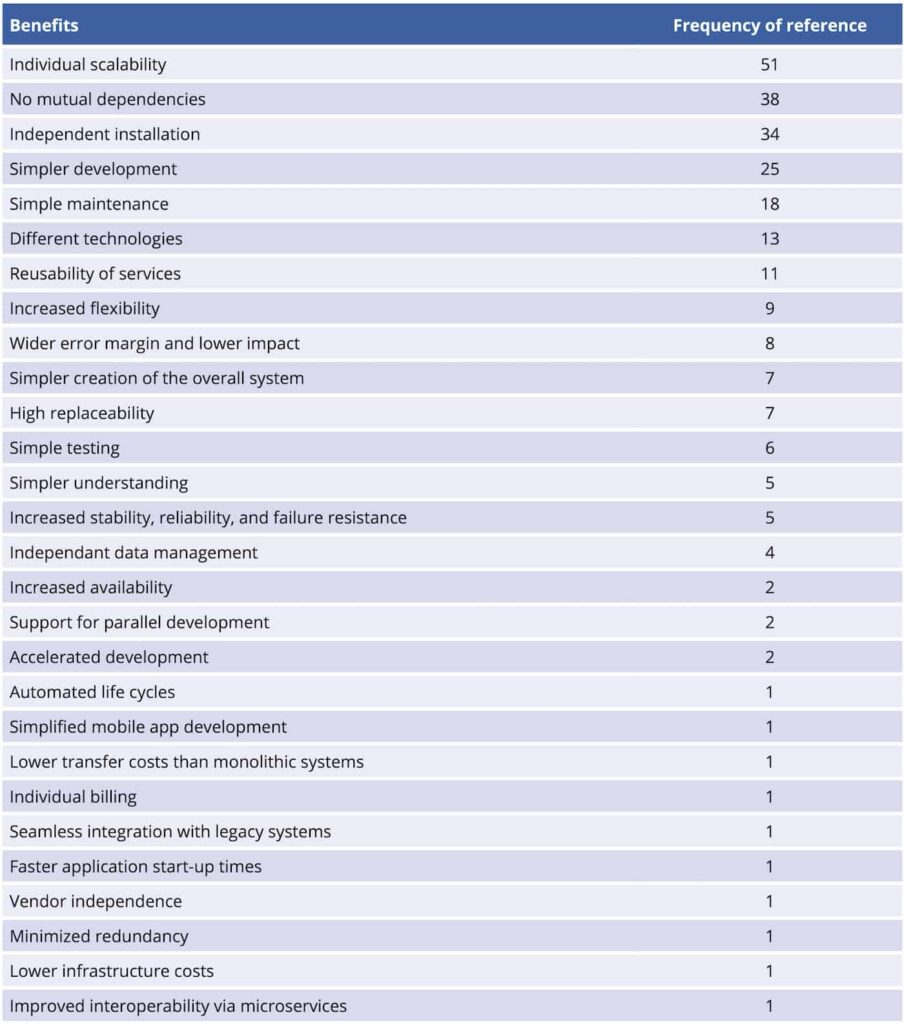
The operating principles already listed in the literature could be found to a large extent in the selected specialist articles. Furthermore, the articles listed additional benefits that had not yet been addressed in the previously analyzed specialist literature.
It is noticeable that in most cases no conclusive list of the advantages of microservice architecture was included in the specialist articles. As a result, it is unclear whether the authors only listed the advantages relevant to the article or all those known to the authors.
Quantitative assessment of the operating principles
The following operating principles were described in the analyzed literature and in some cases quantitative assessments were made. These are shown in Figure 2.
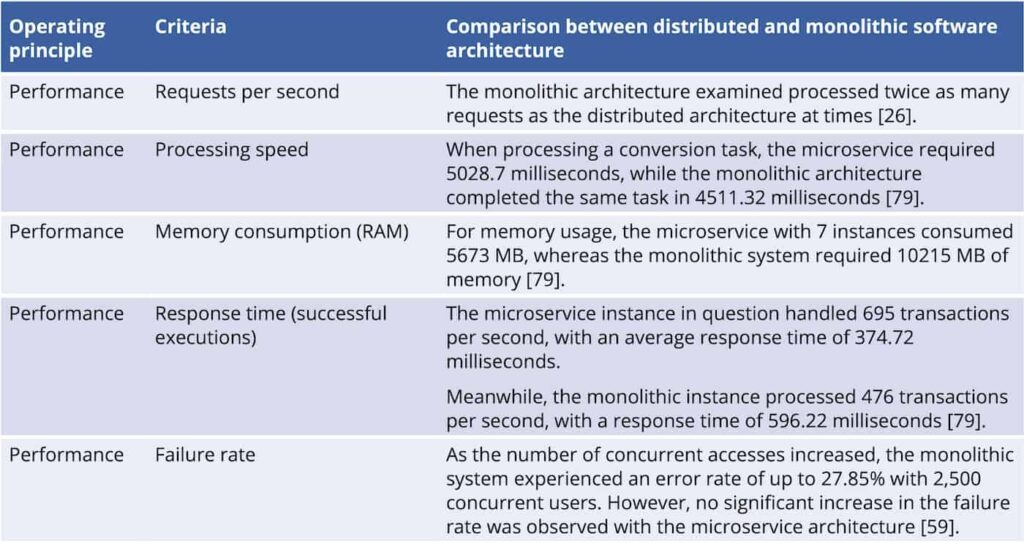
As 28 advantages were listed, the quantitative evaluation is low, with only 5 key figures across all the specialist articles evaluated. Some benefits are not represented at all. Furthermore, not all of the key figures collected are congruent with the benefits listed above.
How can the unevaluated operating principles attributed to the microservice be quantitatively assessed?
The analyzed literature offered some clues on how to quantitatively evaluate and compare the other named benefits:
- Maximum number of requests per minute [27]
- Response time of a request (processing time) [27]
- Number of queries answered [27]
- Availability in time units of one hundred in which the application is responsive [27]
- Memory consumption [81]
- Resource allocation [81]
- Accuracy of responses to queries [81]
- Compilation time [70]
- Execution time for database operations [70]
However, there are still benefits that have not been substantiated by key figures.
For a conclusive comparison of the advantages of microservice architectures and of monolithic systems, the criteria listed so far are not sufficiently described and backed up with key figures. This applies to specific, described comparison programs as well as to general assessments.
Quantitative methods to further investigate the benefits needed
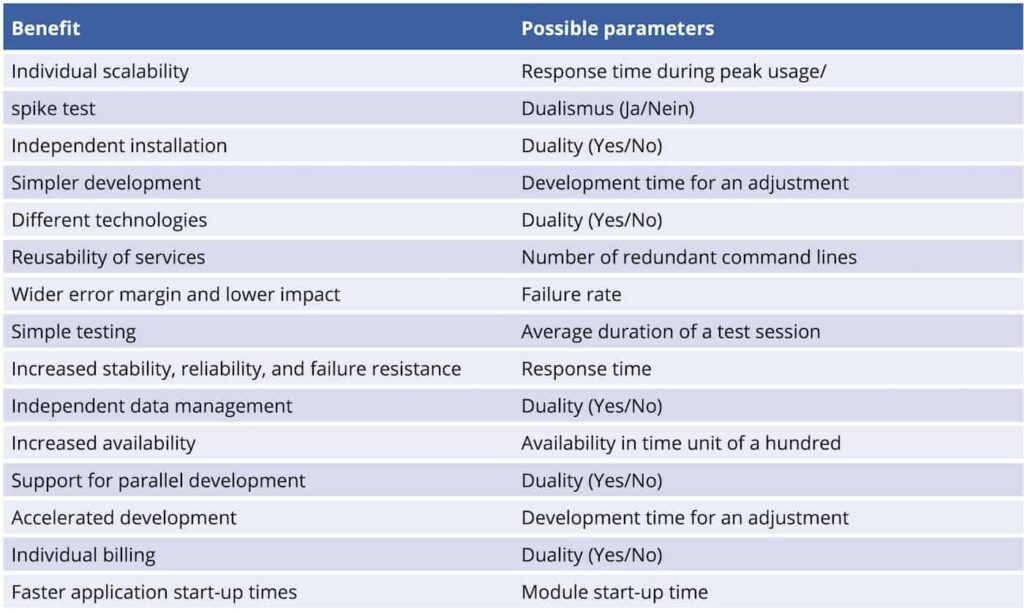
In order to close the evaluation gap, it is advisable to collect further key figures. Figure 3 could make the advantages of microservices listed so far measurable. However, the effectiveness of these key figures has not been proven or tested by the literature examined.
As the advantages of microservice architecture have only been named, there is room for various interpretations (Figure 4).
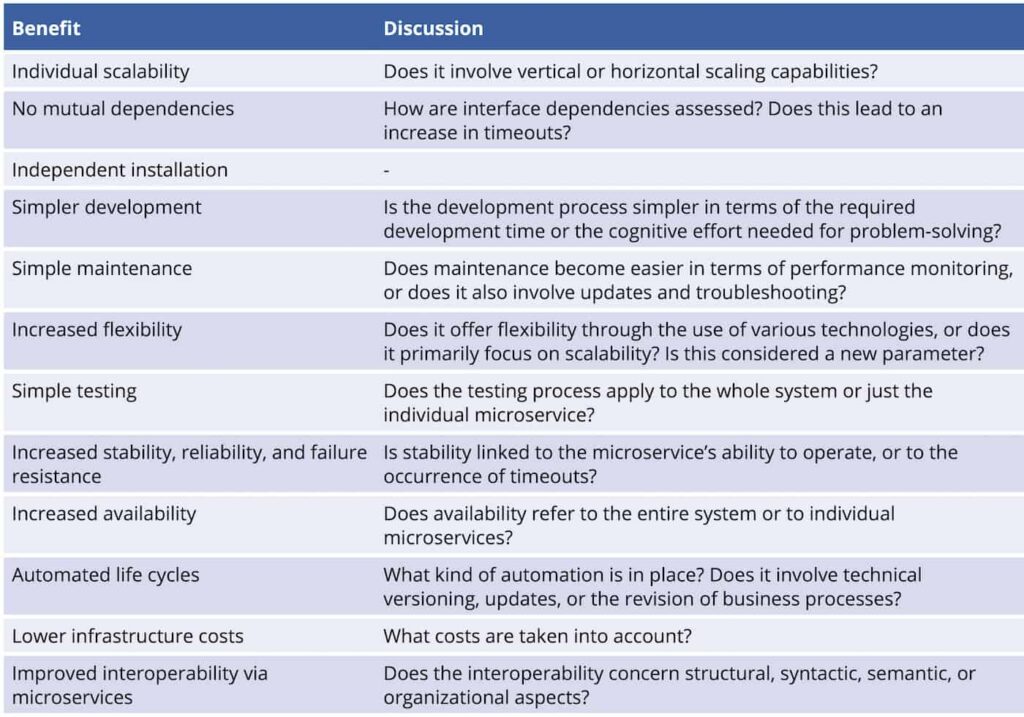
This results in the need for a clear description of the advantages of microservice architecture. Furthermore, quantitative measurement methods are required to justify the advantages over other software architectures. This study only used the specialist articles examined as a basis for evaluation. It cannot therefore be ruled out that other advantages exist that justify the introduction of a microservice architecture.
Nevertheless, further research is required before well-founded decisions can be made. For example, the disadvantages of microservice architecture must also be identified. Furthermore, the authors believe that a literature analysis is not sufficient for identifying the advantages associated with microservice architectures. Empirical analyses (surveys, interviews, etc.) should also be carried out.
Bibliography
[1] Larrucea, X.; Santamaria, I.; Colomo-Palacios, R.; Ebert, C.: Microservices. In: Software Technology (2018) June 1, pp. 96-100.[2] Balalaie, A.; Heydarnoori, A.; Jamshidi, P.: Microservices Architecture Enables DevOps An Experience Report on a Migration to a Cloud-Native Architecture. In: IEEE Software (2016) June 1, pp. 42-52.
[3] Liu, Z.; Fan, G. Y.; Chen, L.: Modelling and analysing the reliability for microservice-based cloud application based on predicate Petri net. In: Expert Systems (2021) November 22, pp. 1-23.
[4] Di Francesco, P.: Architecting Microservices. In: IEEE (2017), pp. 224-229.
[5] Guney, S.; Koyuncu, M.; Vural, H.: A Systematic Literature Review on Microservices. In: Computational Science and Its Applications (2017) July 1, pp. 203-217.
[6] Flores, P.; Velepucha, V.: A Survey on Microservices Architecture: Principles, Patterns and Migration Challenges. In: IEEE Access (2023) August 15, pp. 88339-88358.
[7] Anggreainy, M. S.; Afdhal Kurniawan, J. C.: Analyzing Microservices and Monolithic Systems: Key Factors in Architecture, Development and Operations. In: IEEE Explore (2023) September 1, pp. 64-69.
[8] Newman, S.: Building Microservices. Sebastopol (CA), United States of America 2015.
[9] Zimmermann, O.; Stocker, M.; Lübke, D.: Patterns for API Design. Stuttgart 2022.
[10] Gruhn, V.: The organization of the future: Microservices. In: Wirtschaftsinformatik & Management (2018) February 9, pp. 52-67.
[11] Harkut, D.; Kasat, K.; Shah, S.: Cloud Computing – Technology and Practices. London, United Kingdom (2019).
[12] Tremp, H.: Architekturen Verteilter Softwaresysteme. St. Gallen; Switzerland 2021.
[13] Lindemann, U.; Ponn, J.: Konzeptentwicklung und Gestaltung technischer Produkte. Heidelberg 2011.
[14] Taibi, D.; Lenarduzzi, V.; Pahl, C.: Continuous Architecting with Microservices and DevOps: A Systematic Mapping Study. In: Cloud Computing and Services Science (2019) August 10, pp. 126-151.
[15] Antes, G.: The PRISMA statement – was sollte über systematische Übersichtarbeiten berichtet werden? In: DMW – Deutsche Medizinische Wochenzeitschrift (2009) August 1, pp. 1619-1619.
[16] Brocke, J.; Simons, A.; Niehaves, B.; Riemer, K.; Plattfaut, R.; Cleven, A.: Reconstructing the Giant: On the Importance of Rigour in Documenting the Literature Search Process. In: Proceedings of the 17th European Conference on Information Systems (2009) June 10, pp. 2206-2217.
[17] Kleppmann, M.: Designing Data-Intensive Applications. Sebastopol (CA), United States of America 2017.
[18] Wolff, E.: Microservices: Grundlagen flexibler Softwarearchitekturen. Heidelberg 2018.
[19] Aromataris, E.; Catalá-López, F.; Lockwood, C.; Sarkis-Onofre, R.: How to properly use the PRISMA Statement. In: Systematic Reviews (2021) April 19, pp. 1-3.
[20] Abdullah, M.; Iqbal, W.; Berral, J. L.; Polo, J.; Carrera, D.: Burst-Aware Predictive Autoscaling for Containerized Microservices. In: IEEE Transactions on Services Computing (2022) January 1, pp. 1448-1460.
[21] Al-Doghman, F.; Moustafa, N.; Khalil, I.; Tari, Z.; Zomaya, A.: AI-enabled Secure Microservices in Edge Computing: Opportunities and Challenges. In: IEEE Transactions on Services Computing (2022) January 1, pp. 1-20.
[22] Alyas, T.; Ali, S.; Khan, H. U.; Samad, A.; Alissa, K.; Saleem, M. A.: Container Performance and Vulnerability Management for Container Security Using Docker Engine. In: Security and Communication Networks (2022) August 10, pp. 1-11.
[23] Amar, Ć.; Nevzudin, B.; Samir, L.: Microservice development using RabbitMQ message broker. In: Science, Engineering and Technology (2022) April 30, pp. 30-37.
[24] Asri, S. A.; Astawa, I. N.; Sunaya, I. G.; Adi Nugroho, I. M.; Setiawan, W.: Implementation of Asynchronous Microservices Architecture on Smart Village Application. In: International Journal on Advanced Science, Engineering and Information Technology (2022) June 30, pp. 1236-1244.
[25] Avasalcai, C.; Tsigkanos, C.; Dustdar, S.: Adaptive Management of Volatile Edge Systems at Runtime With Satisfiability. In: ACM Transactions on Internet Technology (2022) January 1, pp. 1-21.
[26] Berardi, D. a.; Mauro, J.; Melis, A.; Montesi, F.; Prandini, M.: Microservice security: a systematic literature review. In: PeerJ Computer Science (2022) May 25, pp. 1-66.
[27] Blinowski, G.; Ojdowska, A.; Przybylek, A.: Monolithic vs. Microservice Architecture: A Performance and Scalability Evaluation. In: Institute of Electrical and Electronics Engineers (IEEE) (2022) February 28, pp. 20357-20374.
[28] Carrión, C.: Kubernetes Scheduling: Taxonomy, ongoing issues and challenges. In: ACM Computing Surveys (2022) December 1, pp. 138-176.
[29] Chatterjee, A.; Gerdes, M. W.; Khatiwada, P.; Prinz, A.: SFTSDH: Applying Spring Security Framework With TSD-Based OAuth2 to Protect Microservice Architecture APIs. In: IEEE Access (2022) April 26, pp. 41914-41934.
[30] Cheng, X.; Bi, Y.; Chen, X.: Dynamic Service Migration and Request Routing for Microservice in Multicell Mobile-Edge Computing. In: IEEE (2022) August 1, pp. 13126-13143.
[31] Chi, S.; He, Z.; Xingsheng, Y.; Xia, W.: An Automatic Performance Profiling Method Based on Microservice Monitoring System in Cloud Computing. In: Computer Science and Application (2022) June 30, pp. 1685-1699.
[32] Cinque, M.; Corte, R. D.; Pecchia, A.: Microservices Monitoring with Event Logs and Black Box Execution Tracing. In: IEEE Transactions on Services Computing (2022) February 4, pp. 294-308.
[33] Correia, J.; Rito Silva, A.: Identification of monolith functionality refactorings for microservices migration. In: Software: Practice and Experience (2022) July 21, pp. 2664-2684.
[34] Dai, F.; Liu, G.; Xu, X.; Mo, Q.; Qiang, Z.; Liang, Z.: Compatibility checking for cyber-physical systems based on microservices. In: Software: Practice and Experience (2022) July 14, pp. 2393-2411.
[35] Ding, Z.; Wang, S.; Jiang, C.: Kubernetes-Oriented Microservice Placement with Dynamic Resource Allocation. In: IEEE Transactions on Cloud Computing (2022) January 1, pp. 1-17.
[36] Dressler, F.; Chiasserini, C. F.; Fitzek, F. H.; Karl, H.; Cigno, R. L.; Capone, A.; Rizzo, G.: V-Edge: Virtual Edge Computing as an Enabler for Novel Microservices and Cooperative Computing. In: IEEE Network (2022) January 1, pp. 1-7.
[37] Dzyubanenko, A.; Rabin, A.: Hybrid client-server implementation and microservice architecture of automatic documentation analysis software. In: Information Processing and Computing (MIP: Computing-V-2022) (2022) January 25, pp. 93-101.
[38] Elyyani, Andrian, Y.; Utama, A.; Eko Saputro, M.; Fatimah, S.: Design of decision support system service in the Space Science Center using microservices approach. In: Journal of Physics: Conference Series (2022) January 1, pp. 1-11.
[39] Etherington, N.; Evans, A.; Laing, M.: Bio-Aurac – an open-source browser plugin to better navigate literature content. In: Medicines Discovery Catapult (2022) September 22, pp. 1-3.
[40] Ferreira, L. C.; Andreza Da Rosa, B.; Gustavo, D. S.; Dimas, A. M.; Gabriel, R. D.; Fernando Bauer, N.; Paulo, C. a.: Edge computing and microservices middleware for home energy management systems. In: IEEE Access (2022) October 13, pp. 109663-109676.
[41] Fukuzaki, T.; Liu, S.; Butler, M.: DevFemOps: enhancing maintainability based on microservices using formal engineering methods. In: Connection Science (2022) August 8, pp. 2125-2138.
[42] Furda, A.; van den Berg, L.; Reid, G.; Camera, G.; Pinasco, M.: Developing a Microservices Integration Layer for Next-Generation Rail Operations Centers. In: IEEE Software (2022) August 22, pp. 9-17.
[43] Gan, Y.; Liang, M.; Dev, S.; Lo, D.; Delimitrou, C.: Enabling Practical Cloud Performance Debugging with Unsupervised Learning. In: ACM SIGOPS Operating Systems Review (2022) January 1, pp. 34-41.
[44] Gazis, A.; Katsiri, E.: Middleware 101: What to know now and for the future. In: acmqueue (2022) February 1, pp. 1-14.
[45] Gazzola, L.; Goldstein, M.; Mariani, L.; Mobilio, M.; Segall, I.; Tundo, A.; Ussi, L.: ExVivoMicroTest: ExVivo Testing of Microservices. In: Journal of Software: Evolution and Process (2022) March 9, pp. 1-23.
[46] Giallorenzo, S.; Montesi, F.; Safina, L.; Zingaro, S. P.: Ephemeral data handling in microservices with Tquery. In: PeerJ Computer Science (2022) May 3, pp. 1-40.
[47] Gonzalez, L. F.; Vidal, I.; Valera, F.; Lopez, D. R.: Link Layer Connectivity as a Service for Ad-Hoc Microservice Platforms. In: IEEE Network (2022) January 1, pp. 1-9.
[48] Gu, H.; Yang, S.; Gu, M.; Yuan, M.: Research on online teaching platform system based on microservice architecture. In: EDP Sciences (2022) January 1, pp. 1-7.
[49] Hassan, S.; Bahsoon, R.; Buyya, R.: Systematic scalability analysis for microservices granularity adaptation design decisions. In: Software: Practice and Experience (2022) January 1, pp. 1378-1401.
[50] He, X.; Tu, Z.; Wagner, M.; Xu, X.; Wang, Z.: Online Deployment Algorithms for Microservice Systems with Complex Dependencies. In: Institute of Electrical and Electronics Engineers (IEEE) (2022) January 1, pp. 1-15.
[51] Hou, X.; Wang, Y.: Design and Application of Basketball Microservice Platform. In: Hindawi – Mobile Information Systems (2022) January 1, pp. 1-12.
[52] Islam, F.; Petriu, D.; Woodside, M.: Focused Layered Performance Modeling by Aggregation. In: ACM Transactions on Modeling and Performance Evaluation of Computing Systems (2022) November 1, pp. 7-30.
[53] Jawaddi, S. N.; Johari, M. H.; Ismail, A.: A review of microservices autoscaling with formal verification perspective. In: Software: Practice and Experience (2022) July 17, pp. 2476-2496.
[54] Jiyu, C.; Heqing, H.; Hao, C.: Informer: Irregular traffic detection for containerized microservices RPC in the real world. In: High-Confidence Computing (2022) January 22, pp. 1-10.
[55] Kalafatidis, S.; Mamatas, L.: Microservices-Adaptive Software-Defined Load Balancing for 5G and Beyond Ecosystems. In: IEEE Network (2022) November 1, pp. 46-54.
[56] Karabey Aksakallı, I.; Çelik, T.; Can, A. B.; Tekinerdoğan, B.: Micro-IDE: A tool platform for generating efficient deployment alternatives based on microservices. In: Software: Practice and Experience (2022) March 21, pp. 1-28.
[57] Karn, R. R.; Das, R.; Pant, D. R.; Heikkonen, J.; Kanth, R.: Automated Testing and Resilience of Microservice’s Network-link using Istio Service Mesh. In: Proceedings of the XXth Conference of Open Innovations Association FRUCT (2022) January 1, pp. 79-88.
[58] Kohyarnejadfard, I.; Aloise, D.; Azhari, S. V.; Dagenais, M. R.: Anomaly detection in microservice environments using distributed tracing data analysis and NLP. In: Journal of Cloud Computing: Advances (2022) January 1, pp. 1-16.
[59] Li, Z.; Guo, L.; Cheng, J.; Chen, Q.; He, B.; Guo, M.: The Serverless Computing Survey: A Technical Primer for Design Architecture. In: ACM Computing Surveys (2022) January 3, pp. 1-35.
[60] Liu, J.: Usability of Computer-Aided Translation Software Based on Deep Learning Algorithms. In: Advances in Multimedia (2022) April 14, pp. 1-9.
[61] Lv, Y.; Tan, W.: Infrastructure Smart Service System Based on Microservice Architecture from the Perspective of Informatization. In: Hindawi – Mobile Infromation Systems (2022) April 28, pp. 1-11.
[62] Ma, M.; Lin, W.; Pan, D.; Wang, P.: Self-Adaptive Root Cause Diagnosis for Large-Scale Microservice Architecture. In: IEEE Transactions on Services Computing (2022) June 1, pp. 1399-1411.
[63] Ma, S.-P.; Liu, I.-H.; Chen, C.-Y.; Wang, Y.-T.: Version-based and risk-enabled testing, monitoring, and visualization of microservice systems. In: Journal of Software: Evolution and Process (2022) January 1, pp. 1-21.
[64] Martinez, H. F.; Mondragon, O. H.; Rubio, H. A.; Marquez, J.: Computational and Communication Infrastructure Challenges for Resilient Cloud Services. In: Computers (2022) July 29, pp. 1-21.
[65] Mugeraya, S.; Devadkar, K.: Dynamic Task Scheduling and Resource Allocation for Microservices in Cloud. In: Journal of Physics: Conference Series (2022) January 1, pp. 1-11.
[66] Murphy, A. C.; Moreland, J. D.: Integrating AI Microservices into Hard-Real-Time SoS to Ensure Trustworthiness of Digital Enterprise Using Mission Engineering. In: Journal of Integrated Design and Process Science (2022) January 25, pp. 38-54.
[67] Nagalambika, N.; Rao, L. M.: Component Reusability in Extreme Programming Using Microservice Architecture. In: Indian Journal Of Science And Technology (2022) September 22, pp. 1808-1815.
[68] Neha, B.; Panda, S. K.; Sahu, P. K.; Sahoo, K. S.; Gandomi, A. H.: A Systematic Review on Osmotic Computing. In: ACM Transactions on Internet of Things (2022) February 1, pp. 9-39.
[69] Nguyen, L. T.; Ha, S. X.; Le, T. H.; Luong, H. H.; Vo, K. H.; Nguyen, K. H.; Nguyen, H. V.: BMDD: a novel approach for IoT platform (broker-less and microservice architecture, decentralized identity, and dynamic transmission messages). In: PeerJ Computer Science (2022) April 22, pp. 1-53.
[70] Plecinski, P.; Bokla, N.; Klymkovych, T.; Melnyk, M.; Zabierowski, W.: Comparison of Representative Microservices Technologies in Terms of Performance for Use for Projects Based on Sensor Networks. In: Sensors (2022) October 13, pp. 1-21.
[71] Raj, V.; Ravichandra, S.: A service graph based extraction of microservices from monolith services of service-oriented architecture. In: Software: Practice and Experience (2022) March 1, pp. 1661-1678.
[72] Rommel, F.; Ziegler, W.: A Microservice-based Infrastructure for the Academic Research on Semantic Knowledge Graphs and Derived Applications. In: SHS Web of Conferences (2022) January 1, pp. 1-6.
[73] Roy, C.; Saha, R.; Misra, S.; Dev, K.: Micro-Safe: Microservices- and Deep Learning-Based Safety-as-a-Service Architecture for 6G-Enabled Intelligent Transportation System. In: Institute of Electrical and Electronics Engineers (IEEE) (2022) July 1, pp. 9765-9775.
[74] Sadek, J.; Craig, D.; Trenell, M.: Design and Implementation of Medical Searching System Based on Microservices and Serverless Architectures. In: Procedia Computer Science (2022) January 1, pp. 615-623.
[75] Seiffarth, J.; Scherr, T.; Wollenhaupt, B.: ObiWan-Microbi: OMERO-based integrated workflow for annotating microbes in the cloud. In: bioRXiv (2022) August 1, pp. 1-4.
[76] Shabani, I.; Biba, T.; Çiço, B.: Design of a Cattle-Health-Monitoring System Using Microservices and IoT Devices. In: Computers (2022) May 12, pp. 1-17.
[77] Sheffield, N. C.; Vivien R.; B.; Philip E.; B.; Tony, B.; Timothy, C.; Robert L.; G.; Andrew, D. Y.: From biomedical cloud platforms to microservices: next steps in FAIR data and analysis. In: Scientific Data (2022) January 1, pp. 1-8.
[78] Siqueira, F.; Davis, J. G.: Service Computing for Industry 4.0: State of the Art, Challenges, and Research Opportunities. In: ACM Computing Surveys (2022) January 1, pp. 188-228.
[79] Song, P.; Ma, C.: System Design of Integrated Intelligent Platform of National Fitness Based on K-Means Clustering. In: Computational Intelligence and Neuroscience (2022) September 10, pp. 1-11.
[80] Ştefan, S.; Niculescu, V.: Microservice-Oriented Workload Prediction Using Deep Learning. In: e-Informatica Software Engineering Journal (2022) March 25, pp. 1-26.
[81] Surantha, N.; Utomo, O. K.; Lionel, E. M.; Gozali, I. D.; Isa, S. M.: Intelligent Sleep Monitoring System Based on Microservices and Event-Driven Architecture. In: IEEE Access (2022) April 26, pp. 42069-42080.
[82] Thanh, L. N.; Quoc, K. L.; Nguyen, T. A.; Luong, H. H.; Vo, H. K.; Anh, T. D.; Gia, K. H.: BMP: Toward a Broker-less and Microservice Platform for Internet of Thing. In: International Journal of Advanced Computer Science and Applications (2022) January 1, pp. 826-835.
[83] Trabelsi, I.; Abdellatif, M.; Abubaker, A.; Moha, N.; Mosser, S.; Ebrahimi-Kahou, S.; Guéhéneuc, Y.-G.: From legacy to microservices: A type-based approach for microservices identification using machine learning and semantic analysis. In: Journal of Software: Evolution and Process (2022) August 3, pp. 1-23.
[84] Usman, M.; Badampudi, D.; Smith, C.; Nayak, H.: An Ecosystem for the Large-Scale Reuse of Microservices in a Cloud-Native Context. In: IEEE Software (2022) August 22, pp. 68-75.
[85] Wang, L.; Jiang, Y. X.; Wang, Z.; Huo, Q. E.; Dai, J.; Xie, S. L.; Jiang, Z. P.: The operation and maintenance governance of microservices architecture systems: A systematic literature review. In: Journal of Software: Evolution and Process (2022) January 16, pp. 1-31.
[86] Weerasinghe, S.; Perera, I.: Taxonomical Classification and Systematic Review on Microservices. In: International Journal of Engineering Trends and Technology (2022) March 1, pp. 222-233.
[87] Wen, Y.; Cheng, G.; Deng, S.; Yin, J.: Characterizing and synthesizing the workflow structure of microservices in ByteDance Cloud. In: Journal of Software: Evolution and Process (2022) May 9, pp. 1-18.
[88] Wu, C.; Lakhan, A.; Gronali, T. M.: Microservices architectural based secure and failure aware task assignment schemes in fog-cloud assisted Internet of things. In: International Journal of Intelligent Systems (2022) July 5, pp. 8696-8730.
[89] Xu, L.; Wu, D.; Chen, Z.: Research on Web Visual Development Platform Based on Microservice. In: Mathematical Problems in Engineering (2022) January 1, pp. 1-6.
[90] Yakovenko, V.; Ulianovska, Y.; Yakovenko, T.: Analyzing features of e-commerce systems. In: Technology audit and production reserves (2022) February 28, pp. 27-31.
[91] Yu, G.; Chen, P.; Zheng, Z.: Microscaler: Cost-Effective Scaling for Microservice Applications in the Cloud With an Online Learning Approach. In: IEEE Transactions on Cloud Computing (2022) June 1, pp. 1100-1116.
[92] Yu, H.; Wang, X.; Xing, C.; Xu, B.: A Microservice Resilience Deployment Mechanism Based on Diversity. In: Security and Communication Networks (2022) January 1, pp. 1-13.
[93] Yu, Y.; Liu, J.; Fang, J.: Online Microservice Orchestration for IoT via Multiobjective Deep Reinforcement Learning. In: IEEE Internet of Things Journal (2022) September 15, pp. 17513-17525.
[94] Yunanto, A. A.; Hardiansyah, F. F.; Anantha Putra, A. A.; Afridian Rasyid, M. B.; Arifiani, S.: Development of sandbox components with microservices architecture and design patterns in games. In: Procedia Computer Science (2022) January 1, pp. 354-361.
[95] Zdun, U.; Queval, P.-J.; Simhandl, G.; Scandariato, R.; Chakravarty, S.; Jelic, M.; Jovanovic, A.: Microservice Security Metrics for Secure Communication, Identity Management, and Observability. In: ACM Transactions on Software Engineering and Methodology (2022) February 1, pp. 16-50.
[96] Zhang, Z.; Shao, Y.; Liu, X.; Han, Y.: Telematics Collaborative Resource Allocation Algorithm Based on Cloud Sidecar. In: Security and Communication Networks (2022) September 8, pp. 1-14.
[97] Zhao, H.; Deng, S.; Liu, Z.; Yin, J.; Dustdar, S.: Distributed Redundant Placement for Microservice-based Applications at the Edge. In: IEEE Transactions on Services Computing (2022) January 1, pp. 1-14.
[98] Zhong, C.; Huang, H.; Zhang, H.; Li, S.: Impacts, causes, and solutions of architectural smells in microservices: An industrial investigation. In: Software: Practice and Experience (2022) July 23, pp. 2574-2598.
[99] Zhou, X.; Peng, X.; Xie, T.; Sun, J.; Ji, C.; Li, W.; Ding, D.: Delta Debugging Microservice Systems with Parallel Optimization. In: IEEE Transactions on Services Computing (2022) January 1, pp. 16-29.
[100] Zhou, X.; Wu, X.; Chen, Y.: High-Concurrency and High-Performance Application of Microservice Order System Based on Big Data. In: Security and Communication Networks (2022) June 28, pp. 1-11.
Solutions: Safety
You might also be interested in