Virtual Reality

Enabling the Future of Manufacturing with Digital Twins

Enabling the Future of Manufacturing with Digital Twins

Opportunities and obstacles
Javad Ghofrani, Darian Lemke, Tassilo Söldner
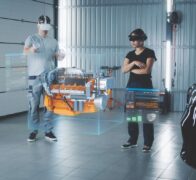
Digital twins connect physical and digital systems, furthering efficiency, enabling predictive maintenance, and allowing the production of more customized products. Despite these advantages, challenges such as high costs, data synchronization, and security risks hinder widespread adoption. This article explores the potential of digital twins and examines key barriers to integration and implementation, also considering some industrial applications including additive manufacturing as a relevant use case.
Industry 4.0 Science | Volume 41 | Edition 3 | Pages 72-81
Virtual Exhibition as a Digital Twin

Virtual Exhibition as a Digital Twin

A framework for decision-making for virtual representations
Isger Glauninger ORCID Icon, Markus Schürmann, Matthias Mühl, Christian van Husen ORCID Icon
Transforming formats such as showrooms, laboratories or exhibitions into a virtual presence offers both opportunities and challenges. Particularly with cyber-physical systems (CPS), which rely heavily on user interaction, extensive adaptations must be made in order to maintain their purpose and function virtually. As part of this research project, digital solutions from different technologies and fields of application were transferred to a virtual exhibition. On this basis, the influence of the digital transformation on the interactivity and emulation of the solutions was analyzed. This article presents a framework that supports practitioners in the implementation of virtual representations.
Industry 4.0 Science | Volume 41 | Edition 3 | Pages 110-116
Training in the Industrial Metaverse

Training in the Industrial Metaverse

Buzzword or opportunity?
Leon Schellhammer ORCID Icon, Lucas Waag, Mert Cumert, Dieter Uckelmann ORCID Icon
Metaverse-based training programs offer a realistic and risk-free learning environment that is particularly valuable in industrial contexts, e.g. in immersive training and the simulation of workflows. Challenges remain in the areas of data protection, technological acceptance and integration into existing systems. Using a carefully crafted questionnaire, four expert interviews were conducted to investigate whether the metaverse can innovate training programs effectively and lastingly. Its standardized format yields comparable, reliable data while allowing for an accurate evaluation of the results.
Industry 4.0 Science | Volume 41 | 2025 | Edition 2 | Pages 102-108
Digital Transformation and Serious Gaming

Digital Transformation and Serious Gaming

Identifying success factors for smart factories
Maria Freese ORCID Icon, Melanie Kessler ORCID Icon, Julia Arlinghaus ORCID Icon, Eike Maaß
Digital technologies are crucial for the competitiveness and innovative capacity of industry. While Industry 4.0 strives for greater efficiency through the intelligent networking of people, machines and information systems, the concept of Industry 5.0 focuses on people—and defines their well-being and identification capabilities as crucial to the success of digitalization. An analysis of their success factors can only help.
Industry 4.0 Science | Volume 40 | 2024 | Edition 5 | Pages 114-121 | DOI 10.30844/I4SE.24.5.114
Potentials and Application of the Industrial Metaverse

Potentials and Application of the Industrial Metaverse

Convergence from simulation to reality
Oliver Petrovic, Yannick Dassen, Christian Brecher
This paper deals with the concept of the Industrial Metaverse and its potential impact on the manufacturing industry. First, the possibilities of the Industrial Metaverse are explained in general and then possible resulting functionalities for production technology along the life cycle are presented. For the two topics "Synthetic Data Generation" and "Virtual Qualification" the implications of the Industrial Metaverse are considered more concretely.
Industrie 4.0 Management | Volume 39 | 2023 | Edition 5 | Pages 27-32 | DOI 10.30844/IM_23-5_27-32
BSI Recommends: Virtual and Secure Surfing

BSI Recommends: Virtual and Secure Surfing

Clemens A. Schulz
Every day there are cyber attacks in the industrial sector − only the most spectacular incidents make the headlines. Like the attack on the automotive supplier Continental last summer or on the commercial vehicle supplier SAF-Holland in March this year. The financial damage caused by such attacks and the loss of trust among customers and employees are enormous. As protection against cyber attacks, the Federal Office for Information Security (BSI) now recommends that companies use a browser with so-called virtualised instances for the first time. This is because most attacks enter company networks via the internet. Such a browser can systematically keep attackers out of the network and is therefore a particularly effective protection.
Industrie 4.0 Management | Volume 39 | 2023 | Edition 3 | Pages 14-16
WebAssembly for the Industrial Internet-of-Things

WebAssembly for the Industrial Internet-of-Things

Sichere, skalierbare Plattformen mit Bytecode-basierten Virtuellen Maschinen
Stefan Wallentowitz, Markus Friedrich
The industrial internet-of-things is built on heterogeneous hardware/software platforms, which vary in their architecture and performance. Virtualization is an important technology for building secure and portable applications on scalable IoT deployments. Bytecode based virtual machines are coming back into focus with WebAssembly, a technology that started in the web browser and now raises interest in other use cases. In this paper we discuss a vision of scalable WebAssembly deployments in the industrial internet-of-things.
Industrie 4.0 Management | Volume 39 | 2023 | Edition 3 | Pages 48-51 | DOI 10.30844/IM_23-3_48-51
Trends and Challenges in Factory Software

Trends and Challenges in Factory Software

Norbert Gronau ORCID Icon
Any networked information system that is used in the context of manufacturing and logistics in a factory can be referred to as factory software. This article describes six trends that will significantly influence the way software is used in factories in the near future. The trends are described in ascending order in terms of significance of impact.
Industry 4.0 Science | Volume 39 | 2023 | Edition 1 | Pages 114-119 | DOI 10.30844/I4SE.23.1.114
Multidimensional Maturity Model for Digital Twins

Multidimensional Maturity Model for Digital Twins

Method for Systematic Classification and Assessment
Michael Lütjen ORCID Icon, Eike Broda, Jan-Frederik Uhlenkamp, Jasper Wilhelm, Michael Freitag ORCID Icon, Klaus-Dieter Thoben ORCID Icon
Digital twins are an important part of the Industry 4.0 idea. They mirror physical goods in the digital world and enhance them with additional capabilities and functions for analysis, forecasting and decisionmaking. This paper contributes to the classification and assessment of Digital Twins using a multidimensional maturity model. The presented method "DT-Assess" enables an application-specific assessment of Digital Twins. The developed maturity model consists of seven categories with a total of 31 characteristics to be evaluated. The systematic evaluation in five application scenarios allows, for the first time, a classification of the respective "digital twin" implementation or concept with the aim of identifying further development options and weaknesses.
Industrie 4.0 Management | Volume 38 | 2022 | Edition 5 | Pages 7-11
Analysis of the Characteristics of Current Learning Factories

Analysis of the Characteristics of Current Learning Factories

Virtual reality as a possible answer to topical challenges
Christoph S. Zoller, Lars Harkemper, Wladimir Rempel
Learning factories offer the possibility to plan, execute and analyze the knowledge imparted in theory on realistic industrial systems. This article analyzes the potential of developing and operating a learning factory in a virtual environment. For this purpose, institutions with learning factories are surveyed regarding the challenges and desires in the operation of learning factories and the mentioned aspects are discussed with regard to their representability in Virtual Reality. The result shows that Virtual Reality positively influences a large part of the aspects and has a high potential to solve current challenges in the establishment and operation of learning factories.
Industrie 4.0 Management | Volume 38 | 2022 | Edition 2 | Pages 33-36
1 2 3