Training

Learning Platform for Production Ramp-up and Operation

Learning Platform for Production Ramp-up and Operation

Michael Schenk, Eberhard Blümel
Developing and testing and operating complex machinery and repairing it under time pressure if it breaks down - individuals in many professions have to learn new skills. Moreover, they have to do so as quickly and as thoroughly as possible. Virtual technologies are supporting learning more and more frequently. Operations and procedures on machinery and plants are already taught in individual lessons on the virtual model. They can be repeated as often as desired without the space or time constraints of real machinery and without endangering either operator or plants through incorrect behaviour and can be practiced before a real machine or plant has been constructed.
Industrie Management | Volume 23 | 2007 | Edition 3 | Pages 23-26
To Decide Correctly, Designing Learning Effects

To Decide Correctly, Designing Learning Effects

Günther Schuh ORCID Icon, Sebastian Gottschalk, Bastian Franzkoch, Axel Hoeschen
Due to shortening product life cycles, complex supplier networks and an increasing number of parties involved, the decision making process has become both more critical and more difficult. The complexity and dynamics of the ramp-up phase make it necessary to not try to concentrate the decisions in on hand, but rather distribute decisions among decentralized yet competent decision makers on-site. It is, however, necessary to provide the decentralized decision makers with the basis and the capability of decision making, and a joint target system to ensure optimal outcome. The paper presents a heuristic approach to design and operate production ramp-up appropriate to stable and efficient ramp-up processes.
Industrie Management | Volume 23 | 2007 | Edition 3 | Pages 71-74
Employee Training in Production Logistics

Employee Training in Production Logistics

Learning about Conflicting Logistic Objectives with a Simulation Game
Hans-Hermann Wiendahl, Christian Fischmann
Many manufacturing firms are dissatisfied with the fulfilment of their logistic objectives. Instead of investing in ever powerful software tools, it is worthwhile to start out by identifying organizational stumbling blocks and knowledge gaps among employees. For this reason, the Fraunhofer IPA analyzed the training activities in manufacturing businesses when introducing ERP or MES systems. Knowledge gaps point to the need for training the logistics skills of the production operators. This paper describes a simulation game developed for this purpose, which can be used as a building block of the logistics knowledge management of manufacturing firms.
Industrie Management | Volume 23 | 2007 | Edition 2 | Pages 25-28
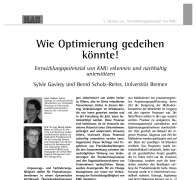
It Could Be Better!

It Could Be Better!

Recognizing and supporting the development potential from SME
Sylvie Gavirey, Bernd Scholz-Reiter ORCID Icon
Organizational learning offers a good possibility for enterprises to compete with the dynamics of the market. Under certain conditions, process integrated education not only leads to process optimization in the firms, but also to the beginning of organizational learning. This is of great importance particularly to small and medium sized enterprises, since they normally lack appropriate structures.
Industrie Management | Volume 23 | 2007 | Edition 2 | Pages 11-15
Effects on Employment in the Logistics Field

Effects on Employment in the Logistics Field

Wolfgang Kersten ORCID Icon, Mareike Böger, Meike Schröder
Globalisation, shorter product life cycles and mass customization are only some keywords which describe the logistics branch. They lead to modified general conditions in the industry and to effects on the employment. Fields of activities and responsibilities are changed as well as demands on further education. Although logistics companies have realized theses changes, they still do not take them into account in their personnel planning. The article shows the interdependencies between general trends in logistics and organisation science and their effects on quantitative and qualitative effects on employment.
Industrie Management | Volume 23 | 2007 | Edition 2 | Pages 29-32
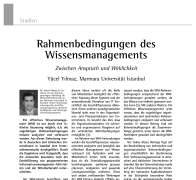
Prevailing Circumstances for Knowledge Management

Prevailing Circumstances for Knowledge Management

Between Requirement and Reality
Yücel Yılmaz
An effective knowledge management is only possible through an indirect management, i.e. associated circumstances have to be analyzed and improved. From this objective in German and Turkish enterprises in Istanbul an enterprise study was performed. It has been noticed from the findings of the research that the answers differentiate significantly according to execution of programmed information management activities and the number of employees.
Industrie Management | Volume 23 | 2007 | Edition 1 | Pages 72-75
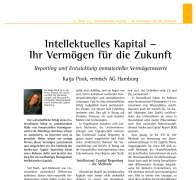
Intellectual Capital: Your Future Assets

Intellectual Capital: Your Future Assets

Reporting and Development of Intangible Assets
Katja Pook
Corporate success depends increasingly on immaterial assets. These are hard to assess, evaluate and shape. Only a few companies manage them systematically. Intellectual Capital Reporting provides a framework and opens the way for sustainable management of intangible assets.
Industrie Management | Volume 22 | 2006 | Edition 6 | Pages 45-46
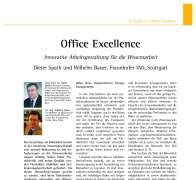
Office Excellence – Innovative Work Design for Knowledge Work

Office Excellence - Innovative Work Design for Knowledge Work

Innovative Arbeitsgestaltung für die Wissensarbeit
Dieter Spath, Wilhelm Bauer
The structuring of office work is of central importance in a modern knowledge society. The expectations on a knowledge worker are increasing constantly. Beside high productivity and best quality one expects flexibility, mobility and readiness for change. For mastering these challenges best work infrastructure is necessary - work places which optimally support the work itself and which offer positive ambience to the employees. Flexible office structures are fulfilling these requirements best. Their introduction requires in turn a goal-oriented change management.
Industrie Management | Volume 22 | 2006 | Edition 6 | Pages 11-14
Knowledge Management in the Automotive Industry

Knowledge Management in the Automotive Industry

A research approach for complex sub-assemblies
Ulrich Berger, Sven Thiebus
Assembly processes are characterized by increasing complexity. Fast ramp-up is a question of vital importance due to the high invests for production lines. A key factor to success is the integrated reuse of experience concerning similar machines and processes. In many cases experiences from shop floor level remain unused in new projects. A main obstacle on production level is to identify and record experience rapidly and precisely. This concept was developed on the base of the Delphi-Method to process experiences of employees effectively and efficiently.
Industrie Management | Volume 22 | 2006 | Edition 6 | Pages 39-41
Requirement and Knowledge Oriented Team Formations

Requirement and Knowledge Oriented Team Formations

Jane Fröming, Simone Schmid, Uwe Rüßbüldt, Norbert Gronau ORCID Icon
The allocation of available knowledge, the creation of new knowledge as well as the preparation of knowledge as a foundation for a companywide use are main tasks in the area of knowledge management. Even if the euphoria was declining during the last years, knowledge management instruments can contribute decisively to the creation of value in many divisions. In this article it will be shown how a staffing module, which is based on knowledge management, can make an important contribution for the composition of project teams.
Industrie Management | Volume 22 | 2006 | Edition 5 | Pages 12-14
1 16 17 18 20