supply chain

Analyzing the Performance of Brazilian Companies

Analyzing the Performance of Brazilian Companies

An approach using an internet-based benchmarking and monitoring system
Marcos R. Albertin
The performance of Brazilian companies is compared and presented through an internet Benchmarking and Monitoring System (SIMAP) with different criteria as indicators, methods, best practices and technologies. The SIMAP has 46 criteria to compare companies with the same product or process that are part of a supply chain or industrial agglomeration. The analytical potential of this computer system supports the identification of industry trends and improvements giving support for cooperation and collaboration at the mesolevel of the systemic competitiveness. This review includes the latest data of 160 companies and some features of SIMAP.
Industrie Management | Volume 27 | 2011 | Edition 2 | Pages 64-68
Contolling Know-How Flow in Supply Chains in the Context of Product Piracy

Contolling Know-How Flow in Supply Chains in the Context of Product Piracy

Horst Meier, Christian Siebel, Michael Nahr
Companies of the capital goods industry are more and more confronted with an increasing global competition. Furthermore the demand for a faster customisation of customers’ goods is accompanied by a decreasing product lifecycle. This circumstances lead to an uniting of companies to a value added chain which can more resist the increasing requirements of the industry. Sensitive data is consequently changed beyond the enterprise limits and the threat of product piracy is increasing to a higher level. Due to the increasing problem of product piracy this article describes the different comprehension of product piracy and explains a procedure strategy for providing of central knowledge. This described approach is not only limited to the enterprise limits. It can be used for the entire value added chain.
Industrie Management | Volume 26 | 2010 | Edition 5 | Pages 61-64
Information Management in Automotive Logistics

Information Management in Automotive Logistics

Ein proaktiver Ansatz für das Informationsmanagement in globalen Lieferketten
Carmen Ruthenbeck, Dennis Lappe, Wolf Lampe
Nowadays, every partner in a global supply chain storages the logged information central. Due to the increasing complexity in supply chains, the central storage of information doesn’t fulfill the high requirements. Therefore it is essential to get a more transparent supply chain by exchanging important information. On the one hand, a technical part for exchanging information is needed and on the other hand, a standardization of which information should be exchanged is necessary. This paper presents a framework for the information management of global supply chains at the example of automotive logistics. The framework describes which information and where this information should be exchanged in a supply chain.
Industrie Management | Volume 26 | 2010 | Edition 5 | Pages 9-13
Integrating Production and Transportation Systems Along Global Supply Chains

Integrating Production and Transportation Systems Along Global Supply Chains

Bernd Scholz-Reiter ORCID Icon, Enzo M. Frazzon, Thomas Makuschewitz
Global supply chains source raw material around the world, make use of local cost advantages for production and utilise the expertise of excellent partners. They aim at the creation of a sustainable competitive network. In order to benefit from the locally obtained advantages the processes of the partners have to be synchronised. This is a classic task of advanced planning systems. However operational planning and control is quite often conducted in a decentralised, function and department oriented way. This paper presents a framework for an integrated scheduling of production and transportation systems along a global supply chain on the operational level. The framework enhances the synchronisation of material flows and increases the competitiveness of the supply chain.
Industrie Management | Volume 25 | 2009 | Edition 6 | Pages 31-34
Market Survey: Services in Industry and Logistics

Market Survey: Services in Industry and Logistics

Ann-Katrin Edel, Nele Brenner
The following short market survey presents interfaces between services in industry and logistic of five different providers. Main topics in the survey were the use of IT-Systems, connection with cooperation partners, challenges in the Supply Chain and trends concerning the future of industrial services.
Industrie Management | Volume 24 | 2008 | Edition 5 | Pages 79-81
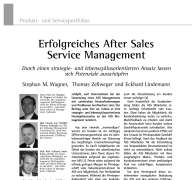
Effective After Sales Service Management

Effective After Sales Service Management

Durch einen strategie- und lebenszyklusorientierten Ansatz lassen sich Potenziale ausschöpfen
Stephan M. Wagner, Thomas Zellweger, Eckhard Lindemann
Eroding margins for primary products have redirected many firms’ attention to the highly profitable After Sales Service (ASS), because of its high revenue and profit contribution. Trying to tap the high potential, companies are faced with numerous problems. This paper presents a strategy- and lifecycle-oriented approach for ASS to meet these challenges.
Industrie Management | Volume 23 | 2007 | Edition 1 | Pages 60-63
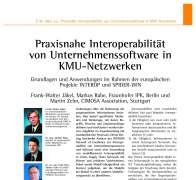
Value-Oriented Interoperability in Networked EAS

Value-Oriented Interoperability in Networked EAS

Foundations and a use case for enterprise application software
Frank-Walter Jäkel, Markus Rabe, Martin Zelm
Interoperability between ICT systems is becoming an increasingly important success factor in the cooperation of enterprises. Organisations have to exchange business information and must have the same understanding of the meaning of the exchanged information. Only then can they rely on both the transaction of the information and the validity of its contents. This paper reports on the European INTEROP Network of Excellence concerned with interoperability research for networked enterprises applications and software, its goals, rationale and early results. In addition, an application of interoperability in a supply chain network of SMEs is presented and discussed.
Industrie Management | Volume 21 | 2005 | Edition 4 | Pages 49-52
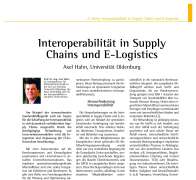
Interoperability in Supply Chains and E-Logistics

Interoperability in Supply Chains and E-Logistics

Axel Hahn
An approach to the creation of interoperability in dynamically changing supply chains is presented applying the example of transnational hazardous waste logistics. By an integral consideration of business models the integration and adaptation of the IT infrastructure is advanced.
Industrie Management | Volume 20 | 2004 | Edition 3 | Pages 67-70
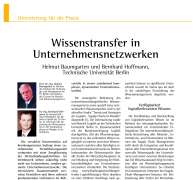
Knowledge Transfer in Logistic Networks

Knowledge Transfer in Logistic Networks

Helmut Baumgarten, Bernhard Hoffmann
A growing number of companies is focussing on their core competencies which leads to an increasing disintegration of existing value chains. Thus competition takes place not only between companies but also between networks of companies. Within global supply networks companies are intensifying their cooperation with suppliers and customers which creates expanded demand for knowledge exchange among the participating business partners. The management of knowledge as a re-source has to be considered as one of the most important success factors and competitive advantage in an intensified complex and dynamic environment.
Industrie Management | Volume 19 | 2003 | Edition 3 | Pages 34-36
1 2 3