Simulation

Cost-Optimized Design of Production Systems by Taking into Account the Risks of New Production Technologies and Processes

Cost-Optimized Design of Production Systems by Taking into Account the Risks of New Production Technologies and Processes

Michael Lütjen ORCID Icon, Abderrahim Ait Alla ORCID Icon, Joy Schumacher, Daniel Rippel, Michael Freitag ORCID Icon
New production technologies have inherent technical risks, but also established production technologies can not always be transferred to new products or components without problems. Accordingly, these technical risks must be taken into account when planning production systems. This paper presents an approach for the optimized allocation of development resources with regard to the technical risks of production technologies and processes. First, the production scenario is modeled and simulated using GRAMOSA. Then the simulation results are used for the optimized assignment of the development budget by means of mathematical optimization.
Industrie 4.0 Management | Volume 34 | 2018 | Edition 2 | Pages 62-66
Secure Processes in Modern Business Models

Secure Processes in Modern Business Models

Alexander Giehl, Peter Schneider
Technological progress offers opportunities for introducing new business models but also opens new paths for attackers. Security-by-design integrates factory security from the start and introduces a continuous security process built upon a variety of components. This article illustrates some of these components by highlighting secure processes with specific case studies: anomaly detection within value networks and secure production planning with simulation.
Industrie 4.0 Management | Volume 34 | 2018 | Edition 1 | Pages 55-58
Structural Planning of Future Production Systems

Structural Planning of Future Production Systems

The Required Transformation for Planning and Operating the Smart Factory
Samuel Horler, Egon Müller
The Smart Factory concept describes the extensively networked production of industry 4.0, which affects the entire life cycle of a factory and, in particular, factory planning and factory operation. Both classic and more up-to-date factory planning approaches come to their limits through the new requirements. This paper identifies the requirements that are important for the future structural planning of factories and presents the need for a holistic virtual validation of the factory structure. Furthermore, a methodological approach is addressed for the solution of the challenges.
Industrie 4.0 Management | Volume 33 | 2017 | Edition 3 | Pages 54-58
Virtual Twins for Realizing the Digital Factory

Virtual Twins for Realizing the Digital Factory

Notwendige Standards für den Austausch von Simulationsmodellen über Gewerkegrenzen hinweg
Mike Barth, Guido Sand
Simulation is an accepted method within modern engineering processes across different industrial domains. Especially automation engineers use modelling and simulation methods within various project phases to guarantee high quality products that are produced on high quality plants. The necessity of modern simulation technology rises due to the latest trends regarding the virtualization of production plants. This article describes the need for standards within the field of modelling and simulation of mechatronic factories and machines using a digital twin.
Industrie 4.0 Management | Volume 33 | 2017 | Edition 2 | Pages 7-10
Logistics Scenarios for the Construction of Offshore Wind Parks

Logistics Scenarios for the Construction of Offshore Wind Parks

Herausforderungen der Wirtschaftlichkeitsbetrachtung neuer Logistikkonzepte
Stephan Oelker, Marco Lewandowski, Abderrahim Ait Alla ORCID Icon, Jan-Hendrik Ohlendorf, Andreas F. Haselsteiner
Wind energy has become an established technology for the generation of electricity from renewable energies. However, suitable sites for the installation of onshore wind turbines are limited or often already developed. Consequently, offshore wind energy will play a key role in the future of renewable energy production. Especially in implementing the turnaround of energy policy. The installation of offshore wind farms is comparatively complex and expensive due to the harsh weather conditions and the limited availability of resources. Therefore, new concepts for the construction of offshore wind parks have to be developed and evaluated. However, classical planning tools reach their limits due to such complex problems. This gap can be closed by means of a process simulation.
Industrie 4.0 Management | Volume 33 | 2017 | Edition 1 | Pages 24-28
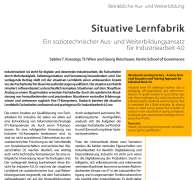
Situational Learning Factory

Situational Learning Factory

A socio-technical education and training approach for industrial work 4.0
Sabine T. Koeszegi, Georg Reischauer
Industrial work 4.0 challenges workers due to ambiguity, self-organization, and interconnec-tedness. To qualify workers to successfully cope with these challenges, this article introduces the software-based situational learning factory that is completed like a flight simulator. By playing these so called serious games that simulate situations on the shop floor of varying complexity, employees gain experiential knowledge and improve their IT-skills.
Industrie 4.0 Management | Volume 32 | 2016 | Edition 3 | Pages 27-30
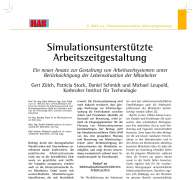
Using Simulation for Working Time Configuration

Using Simulation for Working Time Configuration

Ein neuer Ansatz zur Gestaltung von Arbeitszeitsystemen unter Berücksichtigung der Lebenssituation der Mitarbeiter
Gert Zülch, Patricia Stock, Daniel Schmidt, Michael Leupold
Many companies are challenged to consider in the planning process for working times not only current laws, labour contracts and their operative goals but also the time-related wishes of their employees. One can identify different types of employees which differ in their working time preferences as well as in the work load they have to deal with in their private lifes. Therefore, the working time configuration has to take the specific situation of the employees into account. Consequently, the process of the working time configuration becomes highly complex. But there are currently no tools available that allow decision-makers of a company to evaluate an intended working time model prospectively (i.e. before its realization) while taking dynamic aspects of their operations as well as the work-life balance of the employees into account. At best, the work-life balance of the employees is a key figure for the evaluation of a working time model but not a parameter during the planning ...
Industrie Management | Volume 29 | 2013 | Edition 3 | Pages 29-33
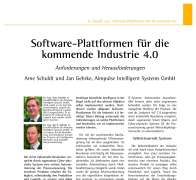
Software Platforms for the Upcoming Industry 4.0

Software Platforms for the Upcoming Industry 4.0

Requirements and Challenges
Arne Schuldt, Jan Gehrke
The fourth industrial revolution promises a further automation of process control by cyber-physical systems. The individual products gain the ability for controlling their production and logistics themselves. By coordinating themselves they can jointly achieve business objectives. This logical decomposition reduces the complexity of cross-company process control significantly. Thus, even exceptions on short notice can be dealt with in real-time. In operation, the required artificial intelligence will usually not be implemented on the active objects. Instead, adequate software platforms for the so-called Industry 4.0 are required. This article investigates the requirements for such platforms and describes how they can be implemented.
Industrie Management | Volume 29 | 2013 | Edition 1 | Pages 29-32
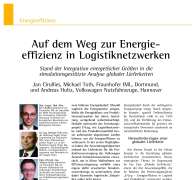
On the Way to Energy Efficiency in Logistics Networks

On the Way to Energy Efficiency in Logistics Networks

State of the Integration of Energy-Related Objectives into the Simulation-Based Analysis
Jan Cirullies, Michael Toth, Andreas Holtz
Globalization and the growing number of supply chain participants lead to increasing cargo transport service and, thus, to higher energy demand. Although energy prices increase at the same time, the energy balance of production networks remains unconsidered during in the network design phase. Hence, the research project E²Log analyzes how logistics networks and production environment can be coordinated in order to improve energy efficiency. In the first project phase, based on the supply chain for the production of the Volkswagen Amarok, the use case partners have derived simulation scenarios and enhanced a simulation tool to evaluate measures for the efficiency increase without ignoring classic logistic objectives soon.
Industrie Management | Volume 28 | 2012 | Edition 5 | Pages 20-24
Integrating Order Sequencing- and Transport Planning

Integrating Order Sequencing- and Transport Planning

An Example of Comprehensive Planning Transcending Functional Borders Using Logistic Assistance Systems
Christian Schwede, Michael Toth, Axel Wagenitz
Handling complexity is one of the key topics of producing enterprises worldwide. It can be noted that enterprises are indeed able to coop with the complexity of single processes due to a function-oriented organisation, yet the same organisational paradigm leads to local objective systems that in many cases are contrary to the global goals of the enterprise. The same problem is reflected and supported by the enterprise’s IT systems. Thus, in this paper we present an approach to convert the inflexible function oriented operations into comprehensive processes by introducing special IT systems, so-called logistic assistance systems. To illustrate the approach we introduce the problem of integrated order sequencing and transport planning in the automotive industry and present a prototypical solution.
Industrie Management | Volume 28 | 2012 | Edition 3 | Pages 25-29
1 2 3 4 6