production systems

Developing Data Standards in Battery Cell Manufacturing

Developing Data Standards in Battery Cell Manufacturing

From requirements analysis to standard development procedure
David Roth, Tom Hülsmann, Felix Tidde
The growing demand for battery cells offers significant potential for the use of digital solutions in their manufacture, which in turn creates opportunities for added value through adaptive and flexible production systems. A key enabler is interoperable data exchange based on formalized data descriptions. Existing ontologies and information models remain too abstract for direct implementation. This paper presents a requirements analysis of data standards in battery cell manufacturing. A procedure for developing domain-specific standards based on OPC UA (Open Platform Communications Unified Architecture) is derived from the results.
Industry 4.0 Science | Volume 41 | Edition 4 | Pages 96-103
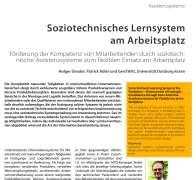
Socio-Technical Learning System at the Workplace

Socio-Technical Learning System at the Workplace

Enhancement of Employee Competence through Socio-Technical Assistance Systems for Flexible Use at the Workplace
Holger Dander ORCID Icon, Patrick Adler, Gerd Witt
The complexity of manual activities in different areas of a company is increasing due to smaller batch sizes, higher product variants and shorter product life cycles. The balanced provision of information ensures shorter training times, higher acceptance among employees and can be used directly at the workplace. For system implementation, organizational factors must also be considered in accordance of a socio-technical system design.
Industrie 4.0 Management | Volume 37 | 2021 | Edition 6 | Pages 47-51 | DOI 10.30844/I40M_21-6_S47-51
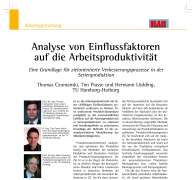
Analysis of Impact Factors on Labour Productivity

Analysis of Impact Factors on Labour Productivity

Eine Grundlage für zielorientierte Verbesserungsprozesse in der Serienproduktion
Thomas Czumanski, Tim Prasse, Hermann Lödding ORCID Icon
The competitiveness of manufacturing companies producing in high-wage countries is strongly depending on labour productivity. In the course of Germany’s demographic change, companies with manual production need to compare the heterogeneous impact factors on labour productivity to develop goal-oriented measures for productivity improvements. The integral productivity analysis enables the user to identify the various impacts on labour productivity and to prioritise fields for process optimisation. The approach is based on the state-oriented modelling of worker activities.
Industrie Management | Volume 29 | 2013 | Edition 3 | Pages 20-24
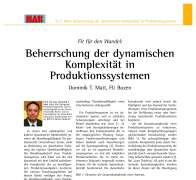
Fit for Change: Manage the Dynamics of Complexity in Production Systems

Fit for Change: Manage the Dynamics of Complexity in Production Systems

Dominik T. Matt
Against the background of today’s highly competitive and dynamic market environment, the concept of changeability of producing gets increasingly important for producing companies in order to maintain or even enhance their survivability. The necessity for change in a production system is determined by the time-dependent complexity of the production tasks which change dynamically with the system’s environment. Most research in this area focuses on the approach to achieve a better changeability by the production system’s design. This paper puts another viewpoint on changeability: best way to achieve an enhanced and sustainable survivability of a production system can be achieved by an early and focused determination of the right time and amplitude of change.
Industrie Management | Volume 27 | 2011 | Edition 3 | Pages 29-32
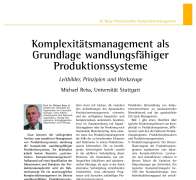
Professional Management of Complexity as a Basis for Agile Production Systems

Professional Management of Complexity as a Basis for Agile Production Systems

Leitbilder, Prinzipien und Werkzeuge
Michael Reiss
Although all approaches to proactive change management of production systems emphasize the relevance of complexity, an integrated building block “management of complexity” is not available. Based on a specification of the domains and dimensions of production complexity a framework for handling complexity is outlined. It covers guidelines, principles and tools for coping with the multiplicity, diversity, ambiguity and dynamics of production systems.
Industrie Management | Volume 27 | 2011 | Edition 3 | Pages 77-81
Changeable Production Systems

Changeable Production Systems

Time data system for prospective planning and design
Olga Erohin, Matthias Krebs, Dominik Petzelt, Jochen Deuse ORCID Icon
Since the beginning of the 1990s the business environment of manufacturing industries has changed permanently. A majority of production systems have a lean, cost-effective and process-oriented structure. But this is still not enough for being successful in the long-term. The key factor for meeting challenges of a global market is the changeability of production systems. Instead of their recurring re-planning and rescheduling, they should be designed changeable right from the beginning of the planning phase. Time data is an important calculation and planning basis for this. In this paper we present a concept for dynamic time data management in planning and designing changeable production systems.
Industrie Management | Volume 27 | 2011 | Edition 3 | Pages 45-48
Intelligent Control Concepts for Changeable Production Systems

Intelligent Control Concepts for Changeable Production Systems

Jörg Franke, Jochen Merhof, Christian Fischer, Florian Risch
Changes on the product and manufacturing side resulting from intensifying global competition have put pressure on companies to alter their strategy, organization and production. Especially the ability to quickly adapt production equipment has become a crucial factor which can provide great competitive advantage. Current research work of the Institute for Manufacturing Automation and Production Systems (FAPS) at the University of Erlangen-Nürnberg focuses on material-flow and production systems that are both self-organizational and self-learning. In this context, concepts have been developed for cost-effective restructuring measures during the operating phase which make a rapid response to dynamic changes and disturbances possible.
Industrie Management | Volume 26 | 2010 | Edition 2 | Pages 61-64
From Dock to Flow Line Production

From Dock to Flow Line Production

A Changing Paradigm in Industrial Production of Aircrafts
Ive-Marko Harjes, Michael Stechow
Changes within organisations and processes define the current processing landscapes of industrial companies. A permanent orientation to competitiveness, the aspiration to effectivity and efficiency as well as the continuous progress in technologies and systems, necessitates an overall coordination of relevant processes. Quite obviously this means today no longer to focus only on production and assembly processes. Only the exact interaction of involved areas - besides production/assembly even areas as logistics, quality and process planning - make a production economically ideal. A leading aircraft-producer realizes significant production-changes by modifying the static (dock-)manufacturing system into a trend-setting flow line-concept.
Industrie Management | Volume 23 | 2007 | Edition 3 | Pages 32-34
Ramp-up Management – Area of Conflict in the Product Development Process

Ramp-up Management - Area of Conflict in the Product Development Process

Eine komplexe Herausforderung zwischen Innovation und Marktanforderung
Ive-Marko Harjes, Birgitt Bade, Florian Harzer
An increasing customer-driven rate of individualisation as well as the lack of brand loyalty is leading to a greater competition within the automotive industry. Project organisations integrate innovations and technologies into the product under enormous permanent pressure. Especially the defined targets concerning time-to-market, costs, and quality set new challenges to the project management throughout the often decentralised innovation network of engineering partners and manufacturers.
Industrie Management | Volume 20 | 2004 | Edition 4 | Pages 45-48
Preventive Operation Strategies for Ramp-up

Preventive Operation Strategies for Ramp-up

Horst Wildemann
Approaches for a risk oriented ramp-up management can suit the purpose of closing the methodical gap between project management and production management. To develop management strategies for a risk oriented ramp-up management central ramp-up risks for a green field plant have been identified in the first step. A risk oriented scenario model leads to a quantification of possible effects resulting from the identified risks. To reach the goal of creating a ramp-up robust production system management strategies have been derived as constitutional elements of a preventive risk management. The management strategies aim at a minimisation as well as transformation of technical and organisational risks.
Industrie Management | Volume 20 | 2004 | Edition 4 | Pages 17-20