production processes

I4S 2/2026: Learning Factories

I4S 2/2026: Learning Factories

Drivers of research and learning environments for Industry 4.0
In recent years, learning factories have evolved into key experimental environments in the context of the Fourth Industrial Revolution. In addition to their role as training centers for skilled workers, they also serve as real-world research laboratories. This issue of Industry 4.0 Science examines learning factories as venues for exploring new approaches and technologies—whether digital assistants, cobots, serious games, or digital twins.
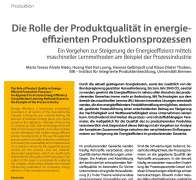
The Role of Product Quality in Energy-Efficient Production Processes

The Role of Product Quality in Energy-Efficient Production Processes

An approach to increase energy efficiency using machine learning methods based on the example of the process industry
Maria Teresa Alvela Nieto, Hoang Viet Hai Luong, Hannes Gelbhardt, Klaus-Dieter Thoben ORCID Icon
Energy efficiency is becoming increasingly important in all sectors of the manufacturing industry. Companies are currently feeling the pressure of exorbitant energy prices very clearly, as well as the additional challenge of becoming CO2-neutral by 2045. With technologies from the field of machine learning (ML), innovative solutions can be developed that enable energy-efficient product manufacturing. In this way, ML-supported process control can make a decisive contribution to increasing the sustainability and competitiveness of a company. Decisive for ML-supported process control are the process- and raw material- dependent parameters, which are significantly responsible for the quality of the final product. The subject of this paper is a procedure for analyzing the complex relationships between the relevant influencing parameters for increasing energy efficiency in the manufacturing industry. (Only in German)
Industrie 4.0 Management | Volume 39 | 2023 | Edition 2 | Pages 20-24
The German Digitization Initiative “Industry 4.0”

The German Digitization Initiative “Industry 4.0”

It depends on the qualifications
Benjamin Kettner, Thomas Pietsch
As the digitization of production processes advances, it influences many areas. In addition to the intra corporate structures and inter enterprise supply chains, it even has an impact on social structures. The progress includes the whole range of changes from the digitization of production processes to their data-driven optimization using intelligent feedback processes. In the end it will result in the combination of the real world with the digital world. To build up this digitization of the value chains, the human relations departments, the forms of communication and cooperation as well as the process management have to change. But to be successful on the way of digitization, new skills are necessary. To obtain these skills, the forms and techniques of the qualification acquisition need to be adapted.
Industrie 4.0 Management | Volume 32 | 2016 | Edition 3 | Pages 47-50
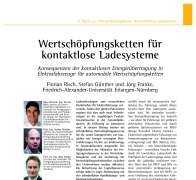
Value Chains for Wireless Charging Systems

Value Chains for Wireless Charging Systems

Konsequenzen der kontaktlosen Energieübertragung in Elektrofahrzeuge für automobile Wertschöpfungsketten
Florian Risch, Stefan Günther, Jörg Franke
Due to their considerable advantages, wireless charging systems have the potential of becoming the key market driver for electric vehicles. In addition to their large potentials there are new demands concerning cost reduction of the necessary components and the associated production networks in the automotive industry which must be addressed early on. Therefore, it is the aim of this paper to present the value chains for the new components from suppliers to final assembly lines. The possibilities of allocating the manufacturing processes in the supply chain and the interfaces between the companies are discussed. The consideration of the logistics processes is also done with regards to the appropriate handling and assembly technology.
Industrie Management | Volume 28 | 2012 | Edition 5 | Pages 45-48
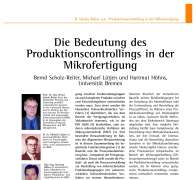
The Importance of Operations Management in Micro Production

The Importance of Operations Management in Micro Production

Bernd Scholz-Reiter ORCID Icon, Michael Lütjen ORCID Icon, Hartmut Höhns
Recent investigations concerning the international state of the art of micro production technology [1, 2] showed, that it has to be distinguished between two main development directions regarding the manufacturing of function units on the one hand as well as complete products on the other hand. First of all there are the classical precision engineering oriented manufacturing methods [3, 4], e.g. according to the DIN 8580 [5]. Secondly manufacturing methods from the area of microsystems technology have been observed [3, 4]. The integration process of different product functions into one part or component geometry, which is running parallel to the miniaturisation, is a specific challenge regarding the field of micro manufacturing [1]. This affects especially the product and production process development, concerning the precision engineering oriented manufacturing methods. This paper addresses problems regarding the operations management of precision-engineering-oriented micro-production ...
Industrie Management | Volume 22 | 2006 | Edition 4 | Pages 9-14
Planning and Operations of Production Systems in Micro Production

Planning and Operations of Production Systems in Micro Production

Bernd Scholz-Reiter ORCID Icon, Hartmut Höhns
Complex production systems in micro production, concerning the manufacturing of miniaturised systems, assemblies and components, are very special. For example Hesselbach [1] stated, that micro production technology (sometimes to be found as (ultra) precision engineering) spans basically all, partly highly specialised production techniques. Kiesewetter [2] points out, that micro production is not just a kind of “shrinked machine building or mechanical engineering”. Mostly the whole manufacturing process chain or at least larger, interrelated section or subsystems and -processes, for example mainly for the manufacturing of miniaturised mechanical modules or assemblies respectively, are basically not examined. The paper discusses and presents topics concerning the planning and operations of micro production manufacturing process chains, against the background of the manufacturing of miniaturised mechanical modules and components.
Industrie Management | Volume 21 | 2005 | Edition 6 | Pages 9-12