production planning and control (PPC)

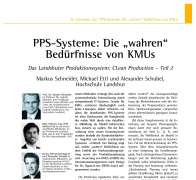
PPC Systems: The “Real” Needs of SMEs

PPC Systems: The “Real” Needs of SMEs

Teil 2
Markus Schneider, Michael Ettl, Alexander Schubel
For a sustained improvement in the logistic goals, such as the punctuality of delivery or cycle time, a consistent, process-oriented design, planning and execution of production systems is required. Besides the development of new methods, support by appropriate IT systems is necessary. Especially for SMEs, there are no solutions in this regard. Thereby first of all the existing MRP systems remain in the old thought patterns, to control and regulate the complexity of the real world through a detailed illustration as a model. For the development of a new ppc system the customer needs were determined apart from solutions of existing systems. The article shows the “real” needs in the environment of the factory structure design and production planning and control of SMEs by using innovation management according to Design for Six Sigma+Lean (DFSS+Lean).
Industrie Management | Volume 29 | 2013 | Edition 2 | Pages 43-48
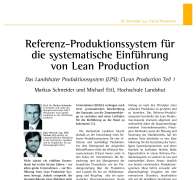
Reference Production System for a Systematic Implementation of Lean Production

Reference Production System for a Systematic Implementation of Lean Production

Das Landshuter Produktionssystem (LPS): CLean Production Teil 1
Markus Schneider, Michael Ettl
Due to an increasing cost pressure especially big companies decided in recent years to implement a lean production system. However, the majority does not meet their expectations regarding the overall performance. An actual study confirms the companies´ dissatisfaction. There is a lack of structured and systematic approaches for lean production. Especially small and midsized companies ask for a systematic description for the concept in order to understand the context and to get a guideline for the implementation.
Industrie Management | Volume 29 | 2013 | Edition 1 | Pages 33-38
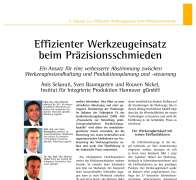
Efficient Tool Management in Precision Forging

Efficient Tool Management in Precision Forging

Ein Ansatz für eine verbesserte Abstimmung zwischen Werkzeuginstandhaltung und Produktionsplanung und -steuerung
Anis Selaouti, Sven Baumgarten, Rouven Nickel
The day-to-day business of the forging industry is characterized by fluctuating order quantities and production of numerous variants. Within the framework of the Collaborative Research Centre (CRC) 489 “Process chain for the manufacturing of precision forged high performance components” a simulation based approach was developed for the implementation of operative tool management to evaluate new technological and organizational measures for enhancing the tool life of tools used for precision forging.
Industrie Management | Volume 27 | 2011 | Edition 6 | Pages 73-76
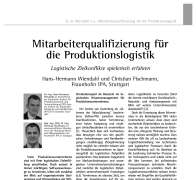
Employee Training in Production Logistics

Employee Training in Production Logistics

Learning about Conflicting Logistic Objectives with a Simulation Game
Hans-Hermann Wiendahl, Christian Fischmann
Many manufacturing firms are dissatisfied with the fulfilment of their logistic objectives. Instead of investing in ever powerful software tools, it is worthwhile to start out by identifying organizational stumbling blocks and knowledge gaps among employees. For this reason, the Fraunhofer IPA analyzed the training activities in manufacturing businesses when introducing ERP or MES systems. Knowledge gaps point to the need for training the logistics skills of the production operators. This paper describes a simulation game developed for this purpose, which can be used as a building block of the logistics knowledge management of manufacturing firms.
Industrie Management | Volume 23 | 2007 | Edition 2 | Pages 25-28