production control

Intelligent Digital Twins in Production

Intelligent Digital Twins in Production

Driving efficiency and accelerating agility in production planning
Cedric Kiener ORCID Icon, Steffen Schwarzer
Intelligent digital twins (IDT), as the next evolutionary stage of digital twins, have the potential to accelerate and optimize processes within companies. The intelligent twin presented here independently analyzes 3D CAD data and automatically conducts a physical simulation of the assembly. Utilizing the IDT optimized assembly, reduces production costs and accelerates the production planning process. This specific use case illustrates the broader possibilities and advantages of IDTs, offering valuable insights for their transferability.
Industry 4.0 Science | Volume 41 | 2025 | Edition 3 | Pages 84-90
Using Process Mining to Improve Logistics Performance in Production

Using Process Mining to Improve Logistics Performance in Production

An application from customized hydraulic component manufacturing
Christoph Koch, Sarveshwaran Murugan, Heiko Berchtold
Short delivery times are essential in competitive markets. In addition to product selection and quality requirements, customers are also demanding more and more from logistics. However, high product variance complicates the situation, as it involves complex material flows and therefore leads to long throughput times. However, a four-step process analysis and modeling can help to reduce throughput times and strengthen the competitiveness of companies from within.
Industry 4.0 Science | Volume 40 | Edition 3 | Pages 54-60
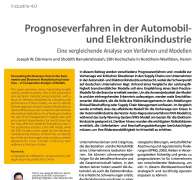
Forecasting the Business Crisis in the Auto Industry

Forecasting the Business Crisis in the Auto Industry

A comparative analysis of models
Joseph W. Dörmann, Shobith Ramakrishnaiah
This paper examines various forecasting models used to predict business crises in the automotive and electronic manufacturing industries, with a focus on German companies. By comparing the performance of these models, we aim to identify the best approach for each industry. We also discuss real-world business case scenarios to demonstrate the practical implications of our findings, including the role of risk management in supply chain and procurement departments. Our results show that the most effective model for forecasting crises in the automotive industry is the VAR model, while the EWS model is best suited for the electronic manufacturing industry. Furthermore, we identify key risk factors that supply chain and procurement departments must consider enhancing their resilience in the face of crises.
Industrie 4.0 Management | Volume 39 | 2023 | Edition 5 | Pages 6
Bakery 4.0

Bakery 4.0

Development of an IoT framework for the automatic collection of machine, process data in medium-sized bakery operations
Abderrahim Ait Alla ORCID Icon, Frida Köning, Heiner Alsen, Joshua Coordes, Michael Freitag ORCID Icon
While the digital world has already made its way into many other production areas, the bakery industry has so far benefited little from these technological developments. This is because many baking processes are manually controlled and rely on expert knowledge. In addition, the process data from the machines is still not automatically captured via sensors. This paper describes a procedure for digitizing baking processes by developing an IoT framework consisting of an IoT device including measurement methods, an edge gateway, and a simulation-based solution for process optimization.
Industrie 4.0 Management | Volume 39 | 2023 | Edition 3 | Pages 36-40
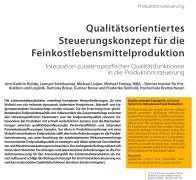
Quality-oriented Concept for a Control System for Delicatessen Food Production

Quality-oriented Concept for a Control System for Delicatessen Food Production

Integration zutatenspezifischer Qualitätsfunktionen in die Produktionssteuerung
Ann-Kathrin Rohde, Lennart Steinbacher, Michael Lütjen ORCID Icon, Michael Freitag ORCID Icon, Ramona Bosse, Gunnar Bosse, Frederike Reimold
The food production process and raw material specific parameters significantly influence the quality of the final product. Furthermore, for products with several ingredients, complex parameter effects occur. This complexity causes the desire for a production control that considers these effects and orientates on final product quality. This article describes the state of the art and derives requirements form a case study in a delicatessen food production system. In summary, this paper presents a concept for production control with special consideration of the final product quality for the production of delicatessen salads.
Industrie 4.0 Management | Volume 36 | 2020 | Edition 5 | Pages 53-57
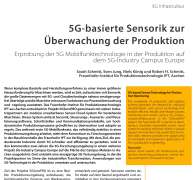
5G-based Sensor Technology for Production Monitoring

5G-based Sensor Technology for Production Monitoring

Erprobung der 5G Mobilfunktechnologie in der Produktion auf dem 5G-Industry Campus Europe
Sarah Schmitt, Sven Jung, Niels König, Robert Schmitt ORCID Icon
The complexity of production and logistics systems generates the demand for industrial transformation: with sensor technology that enables efficient, flexible and reliable process monitoring and control using a 5G communication-infrastructure. In the “5GSensPRO” project, the Fraunhofer IPT in Aachen is developing a modularly expandable sensor cloud system for existing machines. Within a unique research environment, the world’s first 5G mobile radio network provides the opportunity to investigate and implement applications of 5G in production engineering.
Industrie 4.0 Management | Volume 36 | 2020 | Edition 1 | Pages 33-35
Digital Twins as Enabler for Changeable Production

Digital Twins as Enabler for Changeable Production

Realisierung einer durchgängig digitalisierten Industrie 4.0-Fertigung
Thomas Kuhn, Frank Schnicke
Today, manufacturing facilities are designed for mass-producing identical goods. Although they often have a certain flexibility, they are not fully changeable. Changes are associated with a high cost. Changeability allows producers to react more quickly to changing demand situations and to efficiently produce small quantities. The Digital Twin is a key concept for implementing the required changeability. In the reference project BaSys 4.0, funded by the German Federal Ministry of Education and Research (BMBF), we have developed a manufacturing concept that enables changeable production. Our open source middleware Eclipse BaSyx provides a reference implementation of the BaSys 4.0 concepts.
Industrie 4.0 Management | Volume 35 | 2019 | Edition 5 | Pages 13-16
Predictive Risk Management in Production

Predictive Risk Management in Production

Scrap Reduction and Fault Prevention Using MES
Daniel Fath, Michael Möller ORCID Icon, Raphael Kiesel, Robert Schmitt ORCID Icon, Tobias Müller ORCID Icon
In terms of Industrie 4.0, especially SMEs are facing the challenge of integrating data both vertically and horizontally. To achieve this task, common solutions such as ERP are increasingly replaced by manufacturing executions systems (MES). Due to the direct connection in production, MES allow a production control and serve as bridge between planning and manufacturing level. Data integration is furthermore the basis for an automated risk management in production. The research project quadrika develops an MES module that predictively recognizes risks and thus prevents faults.
Industrie 4.0 Management | Volume 35 | 2019 | Edition 1 | Pages 53-56
Autonomous Actors in Decentralised Production Control

Autonomous Actors in Decentralised Production Control

Hanna Theuer ORCID Icon
The positive benefits of decentralized decisionmaking structures in production systems were already discussed in the 1990s. But it is only in recent years that the technologies required for implementation have reached sufficient market maturity to be able to implement corresponding concepts efficiently. In this way, the units involved can be enabled to participate “intelligently” in processes by means of autonomous technologies. The question of the actors actively involved in decentralised decisionmaking and implementation as well as the concrete design of decentralised production structures is of great importance. This article illustrates the importance of autonomy for decentralised production control and shows which performance actors involved in the process have the necessary capabilities to act autonomously.
Industrie 4.0 Management | Volume 34 | 2018 | Edition 6 | Pages 41-44
Investigating Structural Changes in Material Flow Networks Using Dynamic Network Analysis

Investigating Structural Changes in Material Flow Networks Using Dynamic Network Analysis

Darja Wagner, Till Becker
The network analysis is a promising approach for assessing the behavior of material flow systems based on large data volumes. Previous studies focus mainly on static network analysis. This means that all the events that occur in a specific time period are aggregated to a single material flow network. As material flow systems are rapidly changing systems, a static view is not sufficient. The aim of this paper is to present existing concepts to obtain such structural changes and to assess their suitability for material flow networks by using real data.
Industrie 4.0 Management | Volume 32 | 2016 | Edition 6 | Pages 34-38
1 2 3