production control

Control as a Service for Industrial Robots

Control as a Service for Industrial Robots

Vereinfachung von Programmierung und Inbetriebnahme durch Methoden der Virtualisierung und Augmented-Reality-Simulation
Jan Guhl, Axel Vick, Jens Lambrecht, Jörg Krüger
The methods presented allow the splitting of classic monolithic numerical controls of industrial robots and machine tools into their functional units. The core functionalities can then be brought onto different computers in even separate places. Using techniques of augmented reality allows enriching a captured scene with additional information, as a virtual model of the industrial robot or the planned paths. Combining these approaches leads to a simplified programming task for industrial robots as the programs can be visualized in their context. This decreases setup time and improves quality.
Industrie 4.0 Management | Volume 32 | 2016 | Edition 2 | Pages 7-10
Industry 4.0 – Complete Connection between I/O-Device and Cloud Instance

Industry 4.0 - Complete Connection between I/O-Device and Cloud Instance

Neue Impulse für die Steuerungstechnik durch Cloudtechnologie
Jan Schlechtendahl, Felix Kretschmer, Armin Lechler
Current control systems are limited from a technical viewpoint in areas such as scalability, reconfiguration time and computational complexity for algorithms. These limitations call for a new concept for control systems to address current and future requirements. One idea is that the physical location of the control system has to be moved of the machine to a cloud. In this way, the control system becomes scalable and can handle highly complex computational tasks while keeping the process expertise in the bay.
Industrie Management | Volume 31 | 2015 | Edition 6 | Pages 8-11
Production Logistics in Maintenance Shops

Production Logistics in Maintenance Shops

Ein Bottom-up-Ansatz zur Verbesserung der logistischen Prozesse in der Instandhaltung hochwertiger Investitionsgüter
Uwe Dombrowski, Ralf Aurich, Markus Sendler
The efficient performance of service tasks on high-value capital goods like maintenance, repair and overhaul of aircrafts and railway vehicles is influenced by a turbulent environment. In this context, excellent production logistics in maintenance shops can be a way out to cope with this turbulence. This contribution describes a bottom-up approach which is the basis for improving the logistical processes by dimensioning material flow-oriented buffer stocks.
Industrie Management | Volume 31 | 2015 | Edition 5 | Pages 45-48
Levelling Production in the Process Industry

Levelling Production in the Process Industry

Fallstudie zu einem innovativen Lean-Management-Konzept bei einem Chemiehersteller
Carsten Feldmann, Patrick Lückmann, Alexander Giering
Volatility in market demand leads to temporary over- and under utilization of productive assets. Heijunka aims at de-coupling the production system from market volatility. The production program is spread as even as possible over time. This achieves high asset utilization, short lead times, and low inventories. There are validated Heijunka methods for the manufacturing industry, but for the process industry this remains a research gap. This article describes the development of a Heijunka model for the process industry in order to close that gap.
Industrie Management | Volume 31 | 2015 | Edition 4 | Pages 35-38
Reinforcement Learning for Planning Working Processes

Reinforcement Learning for Planning Working Processes

Anwendung von Reinforcement Learning Methoden zur Planung von Arbeitsaufgaben im industriellen Bereich
Helge Ülo Dinkelbach, Julia Schuster, Fred H. Hamker
One of the main purposes of the „Smart Virtual Worker“-project is the application of a digital human model for the simulation of industrial work tasks. This contribution focuses on the implementation of an autonomic action selection, such that a virtual agent is able to solve tasks under certain optimization criteria. To realize the autonomic action selection, we use the Q-Learning algorithm with different extensions. In this article, we describe these different learning algorithms and we briefly describe the performance of their implementation with regard to the industrial field.
Industrie Management | Volume 31 | 2015 | Edition 1 | Pages 9-12
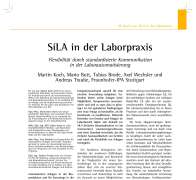
SiLA in Laboratory Practice

SiLA in Laboratory Practice

Flexibility Through Standardized Communication in Laboratory Automation
Martin Koch, Mario Bott, Tobias Brode, Axel Wechsler, Andreas Traube
The upcoming high-throughput technologies are a new challenge for personnel and facilities in life science. These new technologies are enabling the acquisition of extensive knowledge in medical and pharmaceutical research. However, the new requirements can only be met by lab automation solutions. The research work of Fraunhofer IPA in the area of lab automation shows that the conditions in the lab are subject to dynamic effects and thus likewise lab automation solutions are inquired. The requested flexibility is currently unavailable on the market; instead there is a multitude of proprietary isolated applications. The necessary integration of single devices for the coverage of complex biochemical protocols in particular, is contrarian to user requirements due to high efforts in both expenses and time. An alternative to the proprietary isolated applications and the associated integration effort is given by a common communication standard for the cross linking of lab devices. Researchers ...
Industrie Management | Volume 29 | 2013 | Edition 6 | Pages 49-52
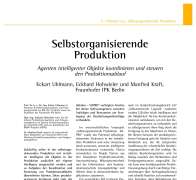
Self-organization in Manufacturing

Self-organization in Manufacturing

Eckart Uhlmann ORCID Icon, Eckhard Hohwieler, Manfred Kraft
In the future, objects with embedded intelligence will be able to coordinate and steer the production sequence in a self-organizing production environment. Instead of existing central planning and control the new product-controlled manufacturing uses a multi-agent system with the possibilities of auctions and negotiation. The project “Self-organizing Production  SOPRO” implements autonomous micro systems and software agents to provide embedded intelligence on objects in production field.
Industrie Management | Volume 29 | 2013 | Edition 1 | Pages 57-61
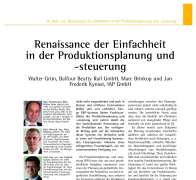
New Simplicity in Production Planning and Control

New Simplicity in Production Planning and Control

Walter Grün, Marc Brinkop, Jan Frederik Kynast
Today’s complexity in industrial production planning requires support by IT. In particular, Manufacturing Resources Planning (MRP) and Manufacturing Execution Systems (MES) are widely used. In some production environments these systems have disadvantages which do not allow a quick response to altered input information. Often manual production planning and control is more flexible and effective but requires adequate tools and standards. One solution has been developed and implemented for the construction of railway shunting switches and is described in this article.
Industrie Management | Volume 28 | 2012 | Edition 1 | Pages 27-31
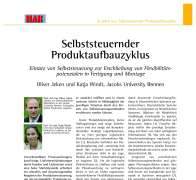
Autonomous Product Completion Cycle

Autonomous Product Completion Cycle

Implementing Autonomous Control to Develop Flexibility Potentials in Production and Assembly
Oliver Jeken, Katja Windt
The complexity of nowadays logistics processes calls for new approaches to improve the logistics performance. The concept of autonomous logistics processes has proven to be a promising way to cope with these challenges. In this paper the idea of autonomous product manufacturing will be presented with a special focus on the development of locked flexibility potentials. In particular we introduce a new way to let products decide by themselves what to become and how.
Industrie Management | Volume 27 | 2011 | Edition 3 | Pages 49-52
Simulation of Neural Networks – Open Source for Production Control

Simulation of Neural Networks - Open Source for Production Control

Open Source in der Produktionsregelung
Bernd Scholz-Reiter ORCID Icon, Florian Harjes
Dynamics and complexity of today`s production systems bring established approaches for production planning and control to their limits. Accordingly, developing new concepts and methods is a key point for research in this area. The combination of a decentralized control structure and innovative methods from the field of artificial intelligence seems promising here. Open source tools have proven their applicability to implement those methods. They are disposable and can be flexibly adapted to many problems. This contribution introduces an approach for the decentralized control of a shop floor. Here, artificial neuronal networks are used as adaptive control instruments. The simulation of these networks is performed with the open source tool Stuttgart Neural Network Simulator (SNNS) and its successor Java Neural Network Simulator (JNNS).
Industrie Management | Volume 26 | 2010 | Edition 3 | Pages 21-24
1 2 3