machine learning

Increasing the Energy Efficiency of Complex Port Facilities

Increasing the Energy Efficiency of Complex Port Facilities

An approach involving through machine learning methods
Thimo Schindler, Dennis Bode, Christoph Greulich, Arne Schuldt, André Decker
Sophisticated port infrastructure systems often have a significant potential for increasing energy efficiency and optimising internal processes. Supported by intelligent and innovative methods, solutions are to be created to improve existing procedures without having to make large-scale changes to the port infrastructure. The specific application scenario of intelligent processes is a tidal water port in Northern Germany.
Industrie 4.0 Management | Volume 36 | 2020 | Edition 2 | Pages 11-14
Artificial Intelligence for the Future Economy

Artificial Intelligence for the Future Economy

How to develop competitive business models from data
Johannes Winter
Artificial intelligence (AI) and self-learning systems have immense economic potential and are a driving force for digitalisation. Artificial Intelligence is radically changing value chains, business models, and employment in industry. Data-driven services are added to traditional products in almost all industries. Integrating Artificial Intelligence in products and services as well as using data from the production process provides opportunities for new business models in an increasing competitive international environment.
Industrie 4.0 Management | Volume 36 | 2020 | Edition 2 | Pages 43-46
Machine Learning in Production

Machine Learning in Production

Application areas and freely available data sets
Hendrik Mende, Jonas Dorißen, Jonathan Krauß, Maik Frye, Robert Schmitt ORCID Icon
Data sets increasing data bases and computing power as well as decreasing costs for computing and storage capacities form the basis for the use of Machine Learning (ML) in production. The challenges are the identification of promising application areas, the recognition of the associated learning tasks as well as the uncovering of suitable data sets. This article therefore answers the following questions: Which application areas in production offer the greatest potential for the use of ML? Which freely accessible data sets are suitable for gaining experience and which learning tasks are associated with them? What are best practices for the application areas?
Industrie 4.0 Management | Volume 35 | 2019 | Edition 4 | Pages 39-42 | DOI 10.30844/I40M_19-4_S39-42
Collaborative Robotics-Machine Learning by Imitation

Collaborative Robotics-Machine Learning by Imitation

Flexible Automation for SMEs Through Intelligent and Collaborative Robotic Assistants
Andrea Giusti, Dieter Steiner, Walter Gasparetto, Sebastian Bertoli, Michael Terzer, Michael Riedl, Dominik T. Matt
The trend towards customer-specific mass production poses great challenges for the classic production methods of small and medium-sized companies. The combination of flexible robotic solutions and artificial intelligence approaches is promising to enable production efficiency and fast adaptability in modern production systems. This paper presents such a solution in the form of a realized demonstrator setup composed of a collaborative robot assistant. The robotic system independently interprets the activities of a human employee and supports the employee in his or her activities by imitation.
Industrie 4.0 Management | Volume 35 | 2019 | Edition 3 | Pages 43-46 | DOI 10.30844/I40M_19-3_S46-46
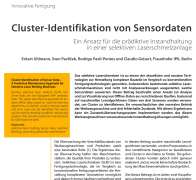
Cluster Identification of Sensor Data

Cluster Identification of Sensor Data

A Predictive Maintenance Approach for Selective Laser Melting Machines
Eckart Uhlmann ORCID Icon, Sven Pavliček, Rodrigo Pastl-Pontes, Claudio Geisert
Existing selective laser melting (SLM) machine tools are not equipped with analytics tools. This paper describes an approach to analyze offline data, based on machine learning algorithms, to identify clusters. Normal states and error cases can be identified. The results can be used to develop condition monitoring systems that provide predictive maintenance for SLM machine tools.
Industrie 4.0 Management | Volume 35 | 2019 | Edition 1 | Pages 6-10
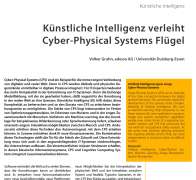
Artificial Intelligence gives wings Cyber-Physical Systems

Artificial Intelligence gives wings Cyber-Physical Systems

Volker Gruhn
Cyber-Physical Systems (CPS) are an example of the close connection between the digital and the real world. This connection makes the development of the systems more complex. Methods of Artificial Intelligence (AI) such as machine learning help companies to use these systems for new application scenarios. Image and speech recognition capabilities enable new, closer forms of cooperation between humans and CPS that previously did not work for occupational safety reasons. At the same time, machine learning enhances the cognitive abilities of CPS. They can work independently in situations which are difficult to plan.
Industrie 4.0 Management | Volume 34 | 2018 | Edition 6 | Pages 45-48 | DOI 10.30844/I40M_18-6_45-48
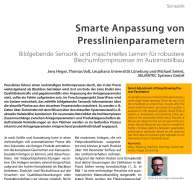
Smart Adjustment of Deep Drawing Process Parameters

Smart Adjustment of Deep Drawing Process Parameters

Bildgebende Sensorik und maschinelles Lernen für robustere Blechumformprozesse im Automobilbau
Jens Heger, Thomas Voß, Michael Selent
A complex process in sheet metal processing is multi stage deep drawing. Once set up, it can be considered as a black box. Usually, after the sheet metal has been processes the quality is assessed. In the research project Smart Press a system is developed, incorporating inline pictures of the processed sheet metal. Pictures of failures are related to the actual state of the machine. Neural Networks are used to model the highly complex relations between parameters and product attributes. Based on the assessed real time data, the process gets adjusted to suit the needs of each individual sheet.
Industrie 4.0 Management | Volume 34 | 2018 | Edition 4 | Pages 53-56
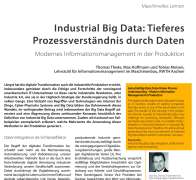
Industrial Big Data: Data-Driven Process Understanding

Industrial Big Data: Data-Driven Process Understanding

Modern Information Management in Production
Thomas Thiele, Max Hoffmann, Tobias Meisen
The digital transformation led to disruptive changes in business models of leading companies. Big Data serves as one of the key enables in this area. The transfer of this concept in the production domain towards an Industrial Big Data is key challenge for producing companies. Although exemplary key projects exist, no available characterization of structural elements in Industrial Big Data Processes exists. Therefore, this article aims at presenting initial structural elements of Industrial Big Data projects based on exemplary use cases.
Industrie 4.0 Management | Volume 33 | 2017 | Edition 4 | Pages 57-60
Self-Learning Assistance Systems

Self-Learning Assistance Systems

Situationsgerechte Ausgabe von Hinweisen zur nachhaltigen Beseitigung von Störungen
Tilman Klaeger, Andre Schult, Jens-Peter Majschak
Rising requirements for converting machines lead to more complex processes. Working with biogenic materials results in ever changing properties and so breakdowns are unavoidable and occur frequently. Many plant operators lack of a profound knowledge of these processes and remediate the impact of a breakdown and not the cause. To give operators hints on lasting elimination the cause we proclaim a self-learning assistance system providing information based on the current situation. To detect situations, unknown to the PLC, machine learning algorithms for pattern mining on field level sensors are used.
Industrie 4.0 Management | Volume 33 | 2017 | Edition 4 | Pages 25-28
Industrial Data Science

Industrial Data Science

Machine learning (ML) for technical systems
Felix Reinhart
Data Science is an established tool for knowledge discovery, in particular from economic data. The progressing digitization of products and production systems enables the broader application of Data Science in technical systems. However, the requirements and constraints, e.g. for control and optimization of production processes, differ significantly from established Data Science applications. Industrial Data Science addresses the issues of applying machine learning to technical systems in industrial setups. This article characterizes challenges of Industrial Data Science, gives application examples of and general indicators for Industrial Data Science.
Industrie 4.0 Management | Volume 32 | 2016 | Edition 6 | Pages 27-30
1 3 4 5