Lean Management

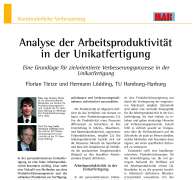
Analysis of Labour Productivity in One-of-a-kind Production

Analysis of Labour Productivity in One-of-a-kind Production

Eine Grundlage für zielorientierte Verbesserungsprozesse in der Unikatfertigung
Florian Tietze, Hermann Lödding ORCID Icon
Traditional productivity analysis has emerged in mass production and cannot be adopted one-to-one on One-of-a-kind production (OKP). Due to the non-repetitive character of the processes in OKP, productivity improvements do not reproduce like in mass production. In addition, preparatory activities such as orientation, material handling and positioning usually consume a lot more time than the actual value-adding activities in OKP. Therefore, OKP requires analysis methods that deliver: 1) a generic working cycle to enable repetitive productivity improvements; 2) activities of personnel in production processes, which include the preparatory activities. We introduce a state-oriented approach for productivity measurement in OKP. With a case study we show how to capture, visualize and evaluate state data of an OKP.
Industrie Management | Volume 30 | 2014 | Edition 3 | Pages 62-66
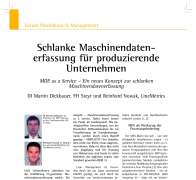
Lean Machine Data Collection for Manufacturing Companies

Lean Machine Data Collection for Manufacturing Companies

Ein neues Konzept zur schlanken Maschinendatenerfassung
Martin Dickbauer, Reinhard Nowak
Many companies flinch before introducing an IT-supported machine-data acquisition. On one hand there are high investment costs which rise concern and on the other lengthy IT- projects with involvement of external consultants and high complexity often are wanted to be avoided. But now the start-up company LineMetrics developed, based on Lean Management, a new concept which overcomes all these obstacles - machine data acquisition as a service. In doing so there has always been a clear focus: All application, arising from this idea, starting with downtime analysis up to energy management visualization tools are committed to one principle: SIMPLICITY - A concept, not only SMEs can benefit from. Besides, this idea is not significantly new. Plug& play and the use of webservices is already in most realms of our daily life very common and, over the last few years, has turned into a basis for many other operations.
Industrie Management | Volume 29 | 2013 | Edition 3 | Pages 56-58
Transfer of the LPS-Principles to the Development Process

Transfer of the LPS-Principles to the Development Process

Uwe Dombrowski, Kai Schmidtchen, Thimo Zahn
In today’s business environment enterprises react to changing conditions with the implementation of Lean Production Systems (LPS). But changing conditions are not only effecting the production. The role of product development is becoming increasingly important to the overall business success. Many enterprises react by designing specific Lean Development concepts. As there are different approaches to design concepts, enterprises have to decide which approach to follow. This paper presents the approach, which takes LPS as the basis, considering the circumstances of the development process and transfers it to the development process to design a Lean Development concept. It is demonstrated how the transfer of the LPS-principles based on VDI 2870 would affect the development process.
Industrie Management | Volume 27 | 2011 | Edition 5 | Pages 72-76
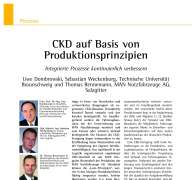
CKD Based on Production Principles

CKD Based on Production Principles

Integrierte Prozesse kontinuierlich verbessern
Uwe Dombrowski, Sebastian Weckenborg, Thomas Rennemann
From the production site Salzgitter of the MAN Nutzfahrzeuge AG CKD-sets (Completely Knocked Down) for trucks and bus chassis are sent to a global production network. In the receiving countries the CKD-sets are assembled with support of MAN. The main chances of the CKD- production are the exploitation of new markets and the increase of competitiveness. The CKD production was traditionally attached to the business unit logistics. Since 2009 it is an integral part of the production at the MAN Nutzfahrzeuge AG. This allows to adapt the “lean principles”, which are used in the local production lines, much more easily. Hereby it is possible to react to the high requirements of the production and logistics processes in the CKD production. In this paper special requirements of the CKD production and solutions will be shown. The main focus is on approaches to process optimization within the production network and the transfer of lean management methods from the field of production in the ...
Industrie Management | Volume 26 | 2010 | Edition 4 | Pages 36-40
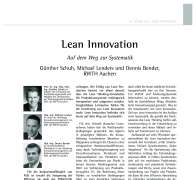
Lean Innovation – Getting More Systematic

Lean Innovation - Getting More Systematic

Günther Schuh ORCID Icon, Michael Lenders, Dennis Bender
For the competitiveness of R&D it is crucial to enhance not only R&D effectiveness but also R&D efficiency. The broad success of Lean Thinking within manufacturing as Lean Production especially bases upon the extensive work to interpret the basic principles for manufacturing systems and the broad availability of examples. Comparable guiding themes are still missing for Lean Innovation. Lean Innovation today is on its way, getting more systematic. The Lean Innovation approach presented here relies on ten key principles that need to be implemented in R&D. Together they operationalise the guiding theme of Lean Innovation: “Structure Early, Synchronise Easily, Adapt Securely.”
Industrie Management | Volume 25 | 2009 | Edition 1 | Pages 23-26
The Independencies Map, a Tool to Manage Complexity in Production Systems

The Independencies Map, a Tool to Manage Complexity in Production Systems

Gunter Lay, Christoph Zanker
With the implementation of numerous modernization concepts an increasingly complicated system has emerged in the companies. Single concepts partly overlap or redundantly pursue similar targets under different headings. Some concepts even compete in their target dimensions. The tool Independencies Map systematically analyzes the correlation of existing concepts and searches for inconsistencies and incompatibilities between these concepts. This article presents a pragmatic tool, which is also applicable for small and medium enterprises thus enabling them to remove efficiency barriers by harmonizing the interaction of the individual concepts.
Industrie Management | Volume 23 | 2007 | Edition 6 | Pages 37-40
From Dock to Flow Line Production

From Dock to Flow Line Production

A Changing Paradigm in Industrial Production of Aircrafts
Ive-Marko Harjes, Michael Stechow
Changes within organisations and processes define the current processing landscapes of industrial companies. A permanent orientation to competitiveness, the aspiration to effectivity and efficiency as well as the continuous progress in technologies and systems, necessitates an overall coordination of relevant processes. Quite obviously this means today no longer to focus only on production and assembly processes. Only the exact interaction of involved areas - besides production/assembly even areas as logistics, quality and process planning - make a production economically ideal. A leading aircraft-producer realizes significant production-changes by modifying the static (dock-)manufacturing system into a trend-setting flow line-concept.
Industrie Management | Volume 23 | 2007 | Edition 3 | Pages 32-34
Lean Innovation – Less Complexity

Lean Innovation - Less Complexity

Increase of effectiveness and efficiency in R&D
Günther Schuh ORCID Icon, Felix Canales, Andreas Kubosch, Leif Paulukuhn
Currently next to the minimization of the production costs the R&D-costs are coming to the fore. This is not just because the share of the R&D-costs in the product costs increases constantly, but also because in a lot of cases the R&D-resources run short and thus become the bottleneck of innovation. The lean innovation approach is concerning all the company’s product-related innovation activities targeting at the maximization of the net benefit of R&D. This article demonstrates the 5-step-realization of lean innovation in companies.
Industrie Management | Volume 21 | 2005 | Edition 3 | Pages 21-24
1 2