Autor: Gunter Lay

Adaptability Through Organisation

Adaptability Through Organisation

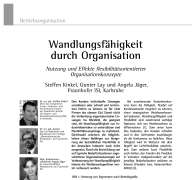
Utilisation and Effects of Flexibility-Oriented Organisational Concepts
Steffen Kinkel ORCID Icon, Gunter Lay, Angela Jäger
More than a fourth of German companies regard flexibility as their main competitive edge. Companies set great store by delivering customized solutions to the customer or to be able to deliver swiftly and on time. Thus the diffusion of organisational concepts which are suited to support adaptability of companies and to realise flexibility advan-tages is increasingly getting into the focus of attention. However, German industry has not yet fully exploited the potential these enablers might have on companies’ flexibility. The development of customized organisational concepts for improving the flexibility might help to further increase companies’ competitive edge.
Industrie Management | Volume 24 | 2008 | Edition 2 | Pages 78-82
The Independencies Map, a Tool to Manage Complexity in Production Systems

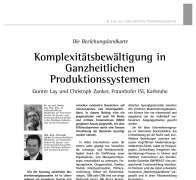
The Independencies Map, a Tool to Manage Complexity in Production Systems

Gunter Lay, Christoph Zanker
With the implementation of numerous modernization concepts an increasingly complicated system has emerged in the companies. Single concepts partly overlap or redundantly pursue similar targets under different headings. Some concepts even compete in their target dimensions. The tool Independencies Map systematically analyzes the correlation of existing concepts and searches for inconsistencies and incompatibilities between these concepts. This article presents a pragmatic tool, which is also applicable for small and medium enterprises thus enabling them to remove efficiency barriers by harmonizing the interaction of the individual concepts.
Industrie Management | Volume 23 | 2007 | Edition 6 | Pages 37-40
Innovation: More than Research and Development

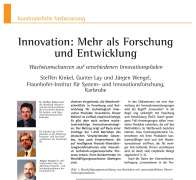
Innovation: More than Research and Development

Steffen Kinkel ORCID Icon, Gunter Lay, Jürgen Wengel
Today, innovations are perceived as the crucial factor for economic growth and employment. Companies investing heavily into research and development for technologically innovative products seem to have a competitive edge. This finding is empirically proved. However, further promising innovation strategies do exist. Based on a survey of 1450 companies of the manufacturing sector this article shows that also companies focussing on intelligent product service combinations or innovative techno-organisational processes outperform their competitors as regards employment growth.
Industrie Management | Volume 21 | 2005 | Edition 3 | Pages 54-58
Analysis and Representation of Product-Related Service Processes

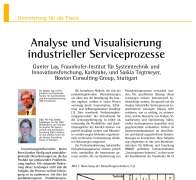
Analysis and Representation of Product-Related Service Processes

Gunter Lay, Saskia Tegtmeyer
In many cases producers of investment goods offer their customers product-related services to enhance the problem solving possibilities of the product. As these service offers are gaining importance for industry, an ever-increasing necessity to optimise service processes, as has been done for production processes in the past, emerges. Experiences so far clearly show that many industrial companies have not yet realised this necessity. Service processes are often provided in a rather unorganised way. Against this background this paper presents a tool to assist industrial efforts to analyse and optimise service processes.
Industrie Management | Volume 20 | 2004 | Edition 1 | Pages 40-43
Operate Instead of Sale

Operate Instead of Sale

Perspectives of new, company spanning business models in plant engineering
Gunter Lay, Horst Meier, Jürgen J. Schramm, Arndt Werding
Business relation between customer and supplier is less characterized by purchase of investment goods. In terms of specific use tasks the functional utility of investment goods becomes of higher weight shortly. Within the new business relationship supplier becomes full-service-supplier and cus-tomer becomes user, as flexibility and availability are increasing. The definition contracting model used in plant engineering and construction describes the change from purchasing and property to acquisition by use. Due to the fact that it is a complex term, realizable types and physical forms of contracting models are presented below. Based on this, first experiences with contracting models are presented, future significance of contracting models is calculated, possible short-ages are identified as well as the need to act which hinder an implementation of contracting models yet.
Industrie Management | Volume 19 | 2003 | Edition 4 | Pages 9-13