Digitale Fabrik

Approach to the Implementation of the Digital Factory in the Aircraft Industry

Approach to the Implementation of the Digital Factory in the Aircraft Industry

Michael F. Zäh, Marco Carnevale, Rainer Schack, Stefan Müller
The present article reports the results of a methodical approach to the implementation of the Digital Factory in the aircraft industry. At first the initial conditions are surveyed with regard to selected company departments. Subsequently an application concept for integrating computer aided tools in production planning processes is presented and assessed. Eventually, in order to achieve an optimal introduction of the Digital Factory, the main organisational challenges are debated.
Industrie Management | Volume 21 | 2005 | Edition 2 | Pages 15-18
Market Survey of Consulting Firms Specialized in Factory Planning

Market Survey of Consulting Firms Specialized in Factory Planning

Katja Andresen, Norbert Gronau ORCID Icon
The article highlights the current challenges factory planning is facing in the realm of changeability and the creation of flexible structures, which adapt to changing market environments. IM has conducted a survey among factory planning companies and provides the results as well as annotating remarks in this report.
Industrie Management | Volume 20 | 2004 | Edition 4 | Pages 61-69
Ramp-up Management – Area of Conflict in the Product Development Process

Ramp-up Management - Area of Conflict in the Product Development Process

Eine komplexe Herausforderung zwischen Innovation und Marktanforderung
Ive-Marko Harjes, Birgitt Bade, Florian Harzer
An increasing customer-driven rate of individualisation as well as the lack of brand loyalty is leading to a greater competition within the automotive industry. Project organisations integrate innovations and technologies into the product under enormous permanent pressure. Especially the defined targets concerning time-to-market, costs, and quality set new challenges to the project management throughout the often decentralised innovation network of engineering partners and manufacturers.
Industrie Management | Volume 20 | 2004 | Edition 4 | Pages 45-48
The Digital Factory – An Approach for Interoperable Model Utilization

The Digital Factory - An Approach for Interoperable Model Utilization

Sigrid Wenzel ORCID Icon
Currently the realisation of the Digital Factory as the strategic goal for the next five years has been identified by many manufacturing enterprises. To achieve an integrated system planning and operation, the work is aimed at a comprehensive computer-based modelling of all design characteristics, structures and processes of a factory. This article scrutinises the technique-centred process for the realisation of the Digital Factory, which is currently favoured due to pragmatic reasons, and presents - based on the models in the Digital Factory - a comprehensive integration concept. To ensure the users’ acceptance, a user-oriented process considering enterprise-organisational requirements is preferred.
Industrie Management | Volume 20 | 2004 | Edition 3 | Pages 54-58
Co-operative planning in the context of Digital Factory

Co-operative planning in the context of Digital Factory

Sabine Bierschenk, Arno Ritter
An intensive co-operation and data exchange between members of different disciplines are necessary in planning, conception and development of production plants and processes. Planning failures that are identified too late or different understanding of contents can lead to significant effects, e.g. during starting or ramp-up. In the context of the Digital Factory the Fraunhofer IPA develops organizational and technological solutions for co-operative planning on the base of workflow and knowledge management as well as solutions for interaction, data and tool integration. The aim is the optimisation of planning quality and planning costs.
Industrie Management | Volume 20 | 2004 | Edition 3 | Pages 71-73
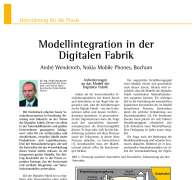
Model Integration in the Digital Factory

Model Integration in the Digital Factory

André Wenderoth
With emphasis simulation experts in research, consultancy and industry work on the vision of the Digital Factory. This catch phrase, which is especially promoted in the automotive sector, stands for a comprehensive, simulation model of real production systems and their logis-tics. One of the challenges faced by the developers in the realisation of this vision is the integration of big models. The article describes a concept, which supports the horizontal and vertical integration of simulation models.
Industrie Management | Volume 20 | 2004 | Edition 1 | Pages 48-51
Reference Archetypes for the Virtual Production

Reference Archetypes for the Virtual Production

Michael F. Zäh, Stefan Müller
The Virtual Production is a key element to the mastering of current challenges in the producing industry. Nevertheless in practice in many cases there exist deficits in the field of defining contents and of implementing a strategy regarding the Virtual Production. Therefore this article addresses - starting from a representation of the definition and the structure - the core areas of the Virtual Production. Subsequently the essential steps are illustrated that are necessary to realize the overall Virtual Production and to avoid isolated applications as well.
Industrie Management | Volume 20 | 2004 | Edition 1 | Pages 52-56
Modules of the “Digital Production”

Modules of the “Digital Production”

Dietmar Siersdorfer
The “Digital Factory” uses the most modern information technology in all phases of the plant life-cycle. The high target is to increase the productivity by reducing the planning and the changeover time, by increasing the flexibility and the capacity, etc. Thereby important tools are MES solutions.
Industrie Management | Volume 19 | 2003 | Edition 2 | Pages 28-31
Integrated Complexity Management using Product Data Models

Integrated Complexity Management using Product Data Models

Horst Meier, Nico Hanenkamp, Michael Bäcker
In a highly competitive environment characterized by decreasing life cycles, lower profit margins and a stronger individualization of products enterprises are forced to adopt new strategies to stand the challenges of the market. The article describes the framework of an integrated complexity management including methods, models and information technology for the identification, the control, the reduction and the prevention of activities without any productivity in direct and indirect sectors of the supply chain.
Industrie Management | Volume 19 | 2003 | Edition 1 | Pages 9-12
1 2 3