digital transformation

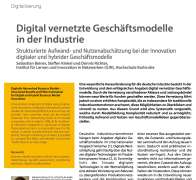
Digitally Networked Business Models

Digitally Networked Business Models

Structured Benefit and Effort Estimation for Digital and Hybrid Business Model Innovation
Sebastian Beiner, Steffen Kinkel ORCID Icon, Dennis Richter
An essential component of digital value creation is the innovation of digitally networked business models. By networking different actors and service bundles, new customer value can be created. However, this networking leads to increased complexity, which makes it difficult for tradition- al industrial companies in particular to exploit these opportunities in a meaningful way. For this reason, a system is presented that reduces com- plexity through modelling and makes it possible to compare the effort and benefits of business model ideas at an early stage.
Industrie 4.0 Management | Volume 38 | 2022 | Edition 4 | Pages 28-32
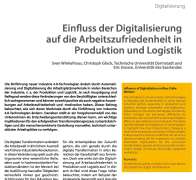
Influence of Digitalization on Blue-Collar Workers

Influence of Digitalization on Blue-Collar Workers

Christoph Glock, Eric Grosse ORCID Icon, Sven Winkelhaus
The introduction of new Industry 4.0 technologies is changing job characteristics in many manual industrial sectors, especially in production and logistics, through automation and digitization. Depending on the extent and degree of maturity, these changes are perceived differently by employees and can have both positive and negative effects on job satisfaction and motivation. This article uses the example of workplaces in in-house logistics to highlight how their characteristics change as a result of the introduction of Industry 4.0 technologies. It also presents a process model that can serve as a decision-making aid for companies to consider important implications for the successful transformation process and to pursue the human-centric design of manual, technically supported workplaces.
Industrie 4.0 Management | Volume 38 | 2022 | Edition 4 | Pages 53-56
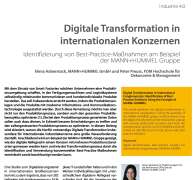
Digital Transformation in International Conglomerates

Digital Transformation in International Conglomerates

Identification of Best Practice Solutions Using the Example of MANN+HUMMEL
Elena Haberstock, Peter Preuss
The article addresses the digital transformation in international corporations. Using the example of the MANN+HUMMEL group, it will be shown how the digital maturity level can be measured in a group with several production locations and how the transformation process can be simplified and accelerated by identifying and using group-wide best practice solutions.
Industrie 4.0 Management | Volume 38 | 2022 | Edition 1 | Pages 53-56
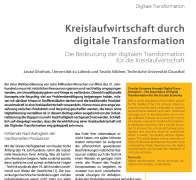
Circular Economy through Digital Transformation

Circular Economy through Digital Transformation

The Importance of Digital Transformation for the Circular Economy
Javad Ghofrani, Tassilo Söldner
With a world population of ten billion people by the middle of the 21st century, natural resources must be used sustainably to prevent environmental disasters and wars. Traditional concepts such as recycling alone are no longer sufficient. Instead, we must think in terms of material cycles and transform the traditional production economy into a circular economy. To achieve this, a close link between production and recycling must be established, which is hardly conceivable without digitalization. This article begins with an overview of steps of industrial development towards more sustainability, finally showing how the digital transformation can facilitate the realization of a circular economy.
Industrie 4.0 Management | Volume 37 | 2021 | Edition 5 | Pages 35-38
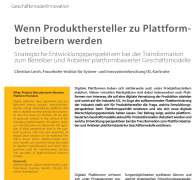
When Product Manufacturers Become Platform Providers

When Product Manufacturers Become Platform Providers

Strategische Entwicklungsperspektiven bei der Transformation zum Betreiber und Anbieter plattformbasierter Geschäftsmodelle
Christian Lerch
Digital platforms have meanwhile also established among product manufacturers. Besides virtual marketplaces, platforms that aim to digitally connect production processes and thus focus on Industry 4.0 are also of particular interest. In the context of the emerging platformization of industry, product manufacturers are faced with the question of what perspectives exist in the platform business and how new potentials of digital value creation can be exploited. The article shows which platform-based business models are currently being discussed for product manufacturers and which perspectives exist for manufacturers turning into providers of platform-based business models.
Industrie 4.0 Management | Volume 37 | 2021 | Edition 5 | Pages 6-10
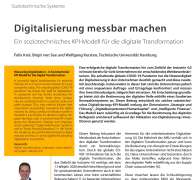
Measuring Digitalization

Measuring Digitalization

A sociotechnical KPI model for the digital transformation
Felix Krol, Birgit von See, Wolfgang Kersten ORCID Icon
A successful digital transformation for attaining Industry 4.0, is a crucial success criterion for many companies today. The ongoing global COVID-19 pandemic has shown the need for digitalization in companies and has further accelerated this development. However, these times, companies are confronted with an uncertain order and profit situation. Thus, they need to allocate their investments purposefully. Evaluating the digital maturity by using a profound indicator system is therefore a sound basis for decision making. This paper develops such a sociotechnical KPI model along the dimensions “Strategy and Organizational Leadership”, “Digital Skills/Human Capital” as well as “Smart Process/Operations”. In the future, this model can be used for determining the digital maturity and thus, it can be applied for allocating digitalization investments.
Industrie 4.0 Management | Volume 37 | 2021 | Edition 3 | Pages 30-34 | DOI 10.30844/I40M_21-3_S30-34
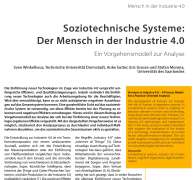
Humans in Industry 4.0

Humans in Industry 4.0

A process model for a practice-oriented analysis
Sven Winkelhaus, Anke Sutter, Eric Grosse ORCID Icon, Stefan Morana
The development of Industry 4.0 changes the role of humans in operations systems. In sociotechnical systems, there is ongoing interaction between humans and technology, impacting human life and work. However, human factors are broadly ignored in research on Industry 4.0 technologies and implementation. In this work, a process model is described that supports the evaluation of the impact of a technology implementation on human factors and performance indicators. This can avoid negative consequences for employees as well as phantom profits and can contribute to a successful digital transformation.
Industrie 4.0 Management | Volume 37 | 2021 | Edition 3 | Pages 45-48 | DOI 10.30844/I40M_21-3_S45-48
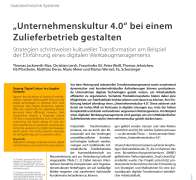
Shaping “Digital Culture” at a Supplier Company

Shaping “Digital Culture” at a Supplier Company

Strategien schrittweiser kultureller Transformation am Beispiel der Einführung eines digitalen Werkzeugmanagements
Thomas Jackwerth-Rice, Christian Lerch, Peter Weiß, Thomas Jehnichen, Matthias Derse, Mario Meier, Marius Wernet
Against the backdrop of industrial transformation, medium-sized supplier firms can use digital technologies to optimize their work processes. New digital production systems offer one opportunity for organizing factory processes more efficiently. However, their introduction requires a “corporate culture 4.0” that is characterized by trust in decisions concerning the future design of such systems, despite the involved high uncertainties. Using the example of a digital tool management system, this article presents measures for strengthening such a corporate culture.
Industrie 4.0 Management | Volume 37 | 2021 | Edition 3 | Pages 16-20
Competencies for Industrial Work 4.0.

Competencies for Industrial Work 4.0.

Requirements and Status Quo of the Competencies of Young Professionals in NRW
Swetlana Franken ORCID Icon
Industry 4.0 is work in progress in Germany, digital technologies such as IoT, KI, Cloud or Big Data Analytics are increasingly being introduced in companies. However, alongside technology, people and organisation are the central success factors of digital transformation. Further training, lifelong learning, agile organisation and corporate culture are becoming increasingly important in companies. Study results on the competence requirements for industrial work 4.0 show that in addition to IT and technical skills, openness, overview knowledge, interdisciplinary cooperation and agility are also required. Young professionals from NRW largely understand the importance of these competences, but show significant deficits in many of them, especially in digital competences, interdisciplinary cooperation and agility. It is necessary to promote these competences in a targeted manner during studies and further education.
Industrie 4.0 Management | Volume 36 | 2020 | Edition 6 | Pages 21-24
Working in a Volatile Environment

Working in a Volatile Environment

Skills and working models in the age of the digital transformation
Dominik Augenstein, Eugen Wiebe
Through disruptive changes and an increasing globalization, companies have to rethink their traditional working models. Thereby, the digital transformation seems to provide a solid answer to this challenge and enables a rapid adaption to the new circumstances. Humans are of central importance to respond to these changing demands. A challenge hereby is, that humans have to be embedded in such a flexible working environment considering, that the competence profile is changing rapidly. In order to solve these challenges, a competence profile is provided. Furthermore, it is shown that a working model for the digital transformation enables a company to respond quickly and flexibly to new environmental conditions.
Industrie 4.0 Management | Volume 36 | 2020 | Edition 6 | Pages 51-54
1 2 3 4 5