circular economy

Digital Solutions for SMEs’ Circularity Transition

Digital Solutions for SMEs’ Circularity Transition

Examples from the textile industry
Markus Winkler, Dieter Stellmach, Guido Grau, Marcus Winkler, Meike Tilebein ORCID Icon
The EU Strategy for sustainable and circular textiles aims to reduce the industry’s environmental impact while at the same time increasing its competitiveness. In this transition towards circularity, firms in the highly fragmented textile value chains need solutions that help overcome barriers and provide support. This paper presents digital solutions that are particularly suited for SMEs and that have been developed with public funding. It aims at encouraging SMEs, not only from the textile industry, to specify their individual transition paths towards circularity and to use digitalization to foster implementation.
Industry 4.0 Science | Volume 40 | 2024 | Edition 5 | Pages 26-33 | DOI 10.30844/I4SE.24.5.26
I4S 5/2024: Double Transformation

I4S 5/2024: Double Transformation

Integrating digital and ecological change in the world of work
Change is necessary for companies to maintain their competitive edge—both digital and ecological change. But while external support is at hand, the drive for change must come from companies themselves. In this issue of Industry 4.0 Science, experts of the Academic Society for Work and Industrial Organization discuss how the real-world application of innovative technologies lead to resource-efficient manufacturing.
Remanufacturing in the Learning Factory

Remanufacturing in the Learning Factory

An integrative platform for the circular economy
Jan Koller ORCID Icon, Frank Döpper ORCID Icon
In remanufacturing, used goods are brought up to the quality level of a new product. This distinguishes it from recycling, which recovers materials and converts them into new units or products. Various uncertainties, such as the condition, quantity and time of return, can be minimized with Industry 4.0 approaches and artificial intelligence. A special learning concept ensures that employees have the required competence profiles in this context.
Industry 4.0 Science | Volume 40 | 2024 | Edition 4 | Pages 85-89
Digital Product Passports

Digital Product Passports

Enabler of the circular economy
Moritz Hörger, Yannik Hermann, Magnus Kandler, Kevin Gleich ORCID Icon, Gisela Lanza ORCID Icon
Digital product passports are becoming increasingly mandatory for monitoring saving targets within the framework of EU-wide emission reductions. DPPs can enable a standardized exchange of emissions data along the entire product life cycle. A framework for systematic introduction and targeted use can simplify their often difficult practical integration, especially for small and medium-sized companies.
Industry 4.0 Science | Volume 40 | 2024 | Edition 3 | Pages 73-77
Circularity Navigator

Circularity Navigator

Digital decision support for anchoring design for circularity in product development
Anina Kusch ORCID Icon, Annika Pruhs ORCID Icon, Jörg Woidasky ORCID Icon, Jonas Brinker ORCID Icon
Products cannot be included early enough in the planning of a circular manufacturing process. However, because early incorporation brings additional complexity into play, product decisions are often set aside for later manufacturing stages. At this point, a decision-making tool that systematically reduces complexity and generally simplifies the process is therefore of great value – especially if it can also be used as a source of inspiration and orientation aid in the innovation phase.
Industry 4.0 Science | Volume 40 | 2024 | Edition 1 | Pages 6-13 | DOI 10.30844/I4SE.24.1.6
Circular Economy

Circular Economy

A view from the perspective of entrepreneurship
Annette Henn ORCID Icon, Beate Langer
In order to exploit the full potential of the circular economy, companies need to develop holistic solutions and rethink their business models. With this in mind, a summer school entitled Circular Economy was organized by Merseburg University's start-up service in September 2023 with the aim of developing innovative ideas for new business models with a focus on circular models. Current trends in materials science were used as conceivable scenarios for circular forms of economic activity in the idea generation process. Entrepreneurship is an interface function here. Entrepreneurs not only want to run companies, they also want to bring about change with new products, services and business processes.
Industry 4.0 Science | Volume 40 | 2024 | Edition 1 | Pages 22-29
Sustainability in Industrial Manufacturing

Sustainability in Industrial Manufacturing

Resource-efficient circular economy through the use of a pellet 3D printer
Bruno Gallace, Michael Blug, Adrian Huwer ORCID Icon, Michael Mattern, Michael Wahl
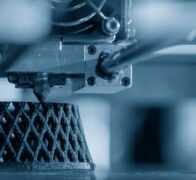
In additive manufacturing – which is also known as 3D printing – plastic waste is produced, for example in the form of required support structures or faulty prints. One option for resource recirculation in additive manufacturing is direct use in a pellet 3D printer that incorporates fused granulate fabrication (FGF). The elimination of the filament production process step reduces the manufacturing time and the energy required for recirculation.
Industry 4.0 Science | Volume 40 | 2024 | Edition 1 | Pages 14-21
Production of Circular Photovoltaic Systems

Production of Circular Photovoltaic Systems

The potential of digital technologies
Verena Luisa Aufderheide ORCID Icon
The circular economy (CE) promises a more sustainable use of resources by managing products in a cycle and striving for a transformation from a linear to a circular supply chain. In particular, digital technologies as enablers for the circular economy have been increasingly researched and applied in practice in recent years. This article describes which digital technologies offer potential for increasing circularity in the production of circular photovoltaic (PV) systems.
Industry 4.0 Science | Volume 40 | 2024 | Edition 1 | Pages 30-36
Dimensions of Industrial Openness

Dimensions of Industrial Openness

Understanding Openness and Its Implications for Sustainable Transformation
Nils Weiher ORCID Icon, Theresa Riedelsheimer ORCID Icon, Kai Lindow ORCID Icon
The topic of Openness is of growing importance for industry, especially in Europe. However, the term Openness is used very differently. Openness includes several concepts, including Open Source Hardware, Open Source Software, Open Data, Open Standards, Open Innovation, Open Science and Open Education. The concepts address different dimensions of Openness, all based on some kind of participation and with the goal to create more transparency and accessibility. This article defines the concepts and provides a basic understanding of their importance for industry and for greater sustainability.
Industrie 4.0 Management | Volume 39 | 2023 | Edition 6 | Pages 42-45 | DOI 10.30844/IM_23-6_42-45
Makigami in the Product Development Process

Makigami in the Product Development Process

Using a lean methodology to integrate sustainable and circular product design
Annika Pruhs ORCID Icon, Anina Kusch ORCID Icon, Frank Bertagnolli ORCID Icon, Tobias Viere, Jörg Woidasky ORCID Icon
In order to realize future improvements in circular product properties such as lifespan extension, continued use or high-quality recycling, industrial product development and design processes must take the entire ecological and economic life cycle of products into account. This article uses a company example to explain how such processes can be captured and analyzed using the Makigami method to support a comprehensive “Design for Circularity” concept. The chosen approach facilitates the identification of the application points of circular design decisions and the implementation of validated circular economy principles.
Industrie 4.0 Management | Volume 39 | 2023 | Edition 6 | Pages 55-60 | DOI 10.30844/I4SE.23.1.64
1 2 3