agility

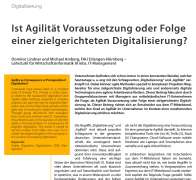
Agility as Consequence or Prerequisite of Digitization?

Agility as Consequence or Prerequisite of Digitization?

Dominic Lindner, Michael Amberg
Companies have always been in a constant state of change. This change is today closely linked to the buzzword’s “digitization” and “agility”. Agile methods, especially in complex projects, can pave the way for targeted digitization and, on the other hand, provide a more agile way of working for digital technologies. Through group discussions with managers from small and medium-sized IT companies, this article focuses on the question of whether agility is the precondition or consequence of targeted digitization. This article is aimed at decision-makers from SMEs who want to increase the degree of agility in the company in the context of increasing digitization.
Industrie 4.0 Management | Volume 35 | 2019 | Edition 4 | Pages 30-34 | DOI 10.30844/I40M_19-4_S30-34
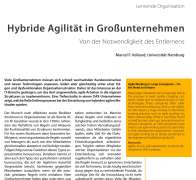
Agile Working in Large Companies

Agile Working in Large Companies

On the Need to Unlearn
Marcel F. Volland
Many large companies are increasingly facing the pressure to meet rapidly changing customer needs and to respond quickly to new technologies. These companies often suffer from coercive bureaucracy, that is, rule rigidity. For this reason, a huge increase in alternative working practices such as agile working has been noticed lately. While it was firstly found in small business start-ups, more and more traditional companies as DAX-companies have tried to use agile working practices selectively in their development departments. However, can agile working be so simply transferred to development of traditional products?
Industrie 4.0 Management | Volume 35 | 2019 | Edition 2 | Pages 27-30 | DOI 10.30844/I40M_19-2_S27-30
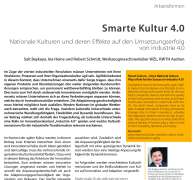
Smart Culture

Smart Culture

Does national culture play a role for a successful Industry 4.0?
Sait Başkaya, Ina Heine, Robert Schmitt ORCID Icon
Companies have to be thoroughly agile. Agility means that companies must be able to consider two things at the same time: On the one hand, companies have to maintain the quality of their own products and services at all times. Continuous innovations could help with this. On the other hand, companies have to be able to adapt themselves to these permanent changes due to these innovations, whereby the adaptation speed must be as high as possible. The question arises as to what extent the cultural identity of nations play a role in terms of their mutability, flexibility and vitality.
Industrie 4.0 Management | Volume 33 | 2017 | Edition 5 | Pages 61-64
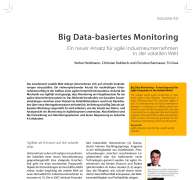
Big Data Monitoring – A new Approach for Agile Companies in the Volatile World

Big Data Monitoring - A new Approach for Agile Companies in the Volatile World

Ein neuer Ansatz für agile Industrieunternehmen in der volatilen Welt
Stefan Heldmann, Christian Rabitsch, Christian Ramsauer
The volatile world urges companies to react more agile to fast changes. Monitoring is a major building block for corporate agility. A lack of understanding of causal interrelations between a multitude of volatility drivers demands a new monitoring approach. Big data is presented as an adequate tool and its agility support is discussed from a data and analytics point of view. Conclusively, guidelines for developing a monitoring system are discussed.
Industrie Management | Volume 31 | 2015 | Edition 5 | Pages 35-39
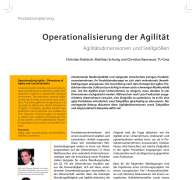
Operationalizing Agility – Dimensions of Agility and Control Variables

Operationalizing Agility - Dimensions of Agility and Control Variables

Agilitätsdimensionen und Stellgrößen
Christian Rabitsch, Matthias Schurig, Christian Ramsauer
Increasing market volatility and uncertainty require manufacturing companies to adapt their operations model to a substantially changing environment. The orientation towards agility can be seen as a key to success in such a situation. To achieve agility for an organization it is necessary to address four distinct dimensions of agility. A company oriented towards lean production tries to optimize one variable at a time. However, to become agile it is required to address two variables simultaneously. This article outlines current challenges for industrial organizations and points out possible solutions.
Industrie Management | Volume 31 | 2015 | Edition 4 | Pages 48-52
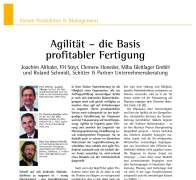
Agility – The Key to Profitable Manufacturing

Agility - The Key to Profitable Manufacturing

Joachim Althaler, Clemens Honeder, Roland Schmidt
Reacting quickly to rapidly changing market needs is, unsurprisingly, a basic requirement for profitable manufacturing. Why turn what is common sense into a science? Agility is the new buzzword. But is it merely „old wine in new bottles“ like so many things in the field of logistics or is it an interesting or even the decisive approach towards ensuring profitable production? Agility in its final perception is an organizations’ ability to swiftly and specifically utilize all available forces in order to fulfill an order. That is to meet requirements with agility. Agility and the excessive focus on detail and planning are oxymorons which are frequently found in both individuals and scientific literature. Agility is the manifestation of good leadership and is pretty much the opposite of planning optimization, high detailing and comprehensive forecasts which is why it is so difficult to describe it within the classic mainstream of logistics research. What really makes production ...
Industrie Management | Volume 28 | 2012 | Edition 2 | Pages 34-37
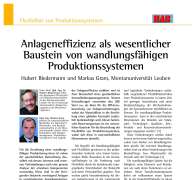
Plant Efficiency as an Essential Component of Agile Production Systems

Plant Efficiency as an Essential Component of Agile Production Systems

Hubert Biedermann, Markus Gram
For the design of an agile production system in addition to the holistic view of production and its internal and external links, a detailed analysis of individual components is necessary. These elements are general manufacturing equipment in various types of expression. To investigate and valuate the properties of these components primarily key figures and indicators are used. In the field of facility and maintenance management the Overall Equipment Effectiveness (OEE) parameter is widely used to determine the equipment efficiency. This indicator is an integral part of a holistic maintenance management. Recent developments use the OEE value as a basis to evaluate the whole value chain to get a holistic view of the included equipment. This integrated approach is an essential component for assessing the flexibility of production systems, which presents itself in three different dimensions.
Industrie Management | Volume 27 | 2011 | Edition 3 | Pages 16-20
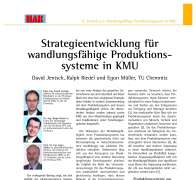
Strategy Development and Implementation for Agile Production Systems in SME

Strategy Development and Implementation for Agile Production Systems in SME

David Jentsch, Ralph Riedel ORCID Icon, Egon Müller
The purpose of this paper is to show how corporate strategy can be aligned with the production system of an enterprise to derive an operations strategy. Consequently, the operations strategy is employed to define prospective needs of agility. The research methodology builds upon action research that is realized in a long-term approach with two joint manufacturing companies. Both can be classified as small and medium sized enterprises (SME). The preliminary findings underline the importance of a holistic view towards agility emphasizing organization and people as major drivers of agility. These drivers are addressed by means of a playful intervention with LEGO-bricks.
Industrie Management | Volume 27 | 2011 | Edition 3 | Pages 37-39
Intelligent rather than Cheap Manufacturing

Intelligent rather than Cheap Manufacturing

Christian Weger
The migration of production sites out of Europe is primarily based on manufacturing costs. Therefore, perfectly functioning communication systems and reliable logistic services are needed. Although the advantage of lower labor costs will decrease in the future, more low-wage countries will be discovered. The answer cannot be found in low-cost production but in an approach which optimizes processes in a holistic way avoiding waste through intelligent solutions.
Industrie Management | Volume 27 | 2011 | Edition 2 | Pages 47-50
Measuring and Assessing Logistical Agility

Measuring and Assessing Logistical Agility

Arne Jacobsen, Dirk Nofen
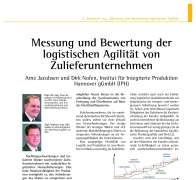
Suppliers in turbulent markets find themselves confronted with additional logistical challenges. Customer orders and market demand may be satisfied through the development of a high reaction potential within the company. In order to adjust the production accord-ingly and to demonstrate the logistical abilities to the customers, logistical agility has to be measured and assessed first. A possible approach is the mathematical description of the synchronisation of production and distribution based on throughput diagrams.
Industrie Management | Volume 20 | 2004 | Edition 3 | Pages 45-48
1 2