Potenzial: Strategy

Competitive Strategy Competence Leadership

Competitive Strategy Competence Leadership

Christian Nedeß, Axel Friedewald, Mathias Kurzewitz
Increasing international competition forces German companies to enhance their portfolio of products and services. Facing this strategic decision, the required competencies for successful market positioning have to be analyzed. Such target-oriented investments in competencies of the employees allow companies to gain an outstanding competitive position. Best practice examinations have proven a positive relation between competence investments on the one hand and market attractiveness of products and services as well as employment situation on the other hand. Yet today, there is a lack of systematic and continuous controlling of competence development processes on a strategic level.
Industrie Management | Volume 23 | 2007 | Edition 2 | Pages 57-61
Integrated Quality of Corporate Software

Integrated Quality of Corporate Software

Andrea Herrmann, Barbara Paech, Carsten Binnig, Timea Illes, Stefan Kirn, Daniel Weiß, Donald Kossmann, Günter Müller, Maike Gilliot, Lutz Lowis
IT systems which operate in a dynamic environment must adapt to permanently changing business requirements. In particular new compliance rules like Sarbanes-Oxley-Act or BASEL II demand complete transparency of business processes and IT-support, also after changes. IT-departments and software providers need to clearly define and continuously assure the quality of the IT system during development and operation.
Industrie Management | Volume 22 | 2006 | Edition 6 | Pages 59-61
Determination of Effectivity and Efficiency in Strategic Management

Determination of Effectivity and Efficiency in Strategic Management

Horst Meier, Christoph S. Zoller, Carsten Behrens
In the past few years importance of strategic management increased. Although enterprises invest into the development of strategies, many strategy processes fail in implementation. Today an important factor of influence is respected intuitively only: The level of detail of strategy. This article introduces an industry-proved tool, which determines the right level of detail for a successful strategy-implementation. Furthermore it allows a monitoring of strategy formulation and implementation-situation.
Industrie Management | Volume 22 | 2006 | Edition 5 | Pages 59-62
Customer-Integrated Assembly

Customer-Integrated Assembly

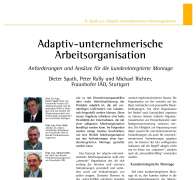
Requirements of an adaptive-business work organization
Dieter Spath, Peter Rally, Michael Richter
The reduction in staff (production jobs) in Germany must lead to new concepts. It must be possible to built economic production at the “location D”. This can be new offers for customers, how it is possible with more individualizing products, which can be manufactured with reasonable delivery times only near the customer. Or the upgrading of products by linkage with services, how e.g. some service models try it. All these new offers require however a high flexibility of the enterprises, which can be mastered only with an adequate work organization. In the following some methods and ideas are described, how a flexible work organization from the requirements of a customer-integrated assembly can be arranged.
Industrie Management | Volume 22 | 2006 | Edition 1 | Pages 27-30
Technology Roadmapping

Technology Roadmapping

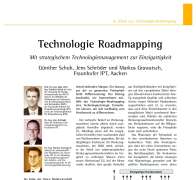
Building up uniqueness with strategic technology management
Günther Schuh ORCID Icon, Jens Schröder, Markus Grawatsch
As a result of the free market economy in the global environment, in almost any branch more products are offered than needed. Due to this overcapacity, companies enter a price war with corresponding declining profit margins. By differentiation, a company can escape this so-called price spiral. This article argues that companies can formulate their technological strategy with the help of technology roadmapping by differentiating themselves from their competitors.
Industrie Management | Volume 22 | 2006 | Edition 1 | Pages 23-26
Germany as Industrial Location – Even in Germany Money Can Be Earned!

Germany as Industrial Location - Even in Germany Money Can Be Earned!

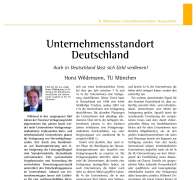
Auch in Deutschland lässt sich Geld verdienen!
Horst Wildemann
Although the relocation trend has slightly decreased during the last five years, nowadays more companies plan to shift abroad in the near future. In particular small- and medium-sized companies plan the relocation of parts of their value chain. The disadvantage of the German location can only be compensated by a combination of cost optimization and an increase of productivity. A systematic procedure and the application of sophisticated evaluation tools support the company in its process of decision making. Considering the type of business, guidelines for competitive value chain management can be developed.
Industrie Management | Volume 22 | 2006 | Edition 1 | Pages 15-18
Strategic Flexibility by Technology Control

Strategic Flexibility by Technology Control

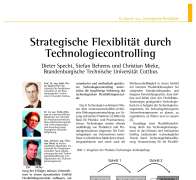
Dieter Specht, Stefan Behrens, Christian Mieke
An effective technology control system is helpful for preserving potentials of flexibility. The product technology portfolio is a suitable technique for reviewing effective and efficient applications of technologies. The results are basis for decisions in technology management of firms.
Industrie Management | Volume 20 | 2004 | Edition 2 | Pages 51-54
Transformability by Technology Planning

Transformability by Technology Planning

Christian Rosier, Jens Schröder
New technologies are often drivers of structural change, which in many cases leads to profound organizational and infrastructural changes in industry and within the enterprises. The aim of business action is to be versatile. That means that enterprises should play the role of the main actor of change instead of reacting only. The technology calendar described in this article is a strategic planning instrument. With this instrument it is possible to gain an overview about technologies available now and in future. From the confrontation of the product spectrum that can be manufactured in future and the technologies available in future, the necessary organizational and infrastructural measures, which result as consequence from the technological change, can be initiated. This way the planning of business change becomes possible.
Industrie Management | Volume 20 | 2004 | Edition 2 | Pages 55-57
Methods of Technological Forecasting

Methods of Technological Forecasting

Scenario Technique in Comparison to Roadmapping
Dieter Specht, Christian Mieke, Stefan Behrens
Technologies have influence upon competitive ability of enterprises in global and increasing competition. Espe-cially enterprises of so called high tech branches suffer from shorter product life cycles but longer periods of development. Enterprises in developed branches are threatened by technologies that may substitute the existing ones. In these circumstances an effective knowledge management and systematic technological forecasting with methodic support strengthen the competitive ability of the enterprise. Scenario technique and roadmapping are methods that register technological trends and reproduce the knowledge about technological development. In this article the suitability of the methods is assessed and both are integrated. The combination of scenario technique and roadmapping can use the advantages of both methods.
Industrie Management | Volume 19 | 2003 | Edition 3 | Pages 71-74
1 4 5