Manufacturing Systems

Analysis of Labour Productivity in One-of-a-kind Production

Analysis of Labour Productivity in One-of-a-kind Production

Eine Grundlage für zielorientierte Verbesserungsprozesse in der Unikatfertigung
Florian Tietze, Hermann Lödding ORCID Icon
Traditional productivity analysis has emerged in mass production and cannot be adopted one-to-one on One-of-a-kind production (OKP). Due to the non-repetitive character of the processes in OKP, productivity improvements do not reproduce like in mass production. In addition, preparatory activities such as orientation, material handling and positioning usually consume a lot more time than the actual value-adding activities in OKP. Therefore, OKP requires analysis methods that deliver: 1) a generic working cycle to enable repetitive productivity improvements; 2) activities of personnel in production processes, which include the preparatory activities. We introduce a state-oriented approach for productivity measurement in OKP. With a case study we show how to capture, visualize and evaluate state data of an OKP.
Industrie Management | Volume 30 | 2014 | Edition 3 | Pages 62-66
Combination of Production Characteristics Curves and the Process Chain Paradigm

Combination of Production Characteristics Curves and the Process Chain Paradigm

Analysis of Different Perspectives
Holger Beckmann, Frederik Döbbeler, Oliver Künzler, Michael Lücke
Nowadays factories have to withhold an ever rising pressure to succeed. Customer demands become more demanding and goods have to be available within shorter lead times and lower prices. Flexibility, reliability and resilience are key factors for companies. Against this background, there is a need in companies for constant analysis of their business processes. This is an addition to a paper that was published in the last issue of this journal. The first part focused on the general possibility of the two methods “Dortmunder Process Chain Model” and production characteristics curves and how they could be used to analyse factories in different detail levels. In this second part the focus is set more on the perspectives that both models base on. On the one hand there is the order flow perspective of the “Dortmunder Process Chain Model” and on the other hand the resource perspective of the production characteristics curves that have to be aligned.
Industrie Management | Volume 30 | 2014 | Edition 2 | Pages 22-26
On the Way to Industry 4.0

On the Way to Industry 4.0

Christian Gorldt, Alexander Pflaum
The development of information and communication technologies (ICT) is progressing rapidly and is seen in today‘s economic action as a key driver of innovation. Future industrial production is characterized by a high degree of customization of products and a strong production flexibility. The rapid development of the Internet has contributed especially in recent years in the private life of merging the real with the virtual world and will get stronger in the future of industrial sector. This paradigm shift is referred to as Industry 4.0. This paper gives an overview of the Industry 4.0 and represents the potential of the transformation process.
Industrie Management | Volume 30 | 2014 | Edition 1 | Pages 15-18
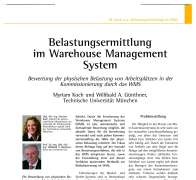
Automatic Assessment of Physical Workload in Order Picking Systems

Automatic Assessment of Physical Workload in Order Picking Systems

Bewertung der physischen Belastung von Arbeitsplätzen in der Kommissionierung durch das WMS
Myriam Koch, Willibald A. Günthner
In order picking, the workers lift, lower, push and pull variable loads. This manual handling is a common cause of musculoskeletal disorders. In order to assess the risk of musculoskeletal disorders, risk assessments in order picking are nowadays performed manually. This article presents an approach how to integrate two methods of risk assessment in warehouse management systems so the physical workload in order picking systems can be determined automatically.
Industrie Management | Volume 30 | 2014 | Edition 1 | Pages 47-50
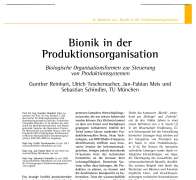
Bionics in Production Organizations

Bionics in Production Organizations

Biologische Organisationsformen zur Steuerung von Produktionssystemen
Gunther Reinhart, Ulrich Teschemacher, Jan-Fabian Meis, Sebastian Schindler
Today’s production environment is characterized by an ongoing increase in complexity. Escalating product complexity leads to a more difficult design of manufacturing systems. At the same time, companies have to focus on their core competencies that force the growth of complex production networks being hard to handle. Additionally to the environment based by crises and peak stages, there is a trend of shorter product life cycles. Indeed, new technologies as RFID establish new innovative approaches for information acquisition in manufacturing, but in spite of technological progress, it pushes existing IT systems to its performance limits. Decentralized systems are supposed to remedy those problems, but despite of the scientifically proven performance those systems are only applied seldom due to missing transparency and possibilities of manipulation. Biomimetic approaches have great potential for optimizing processes and structures of manufacturing systems decentrally.
Industrie Management | Volume 30 | 2014 | Edition 1 | Pages 37-41
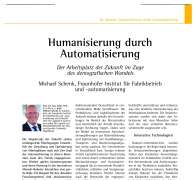
Humanization through Automation

Humanization through Automation

Der Arbeitsplatz der Zukunft im Zuge des demografischen Wandels
Michael Schenk
tensive thought about the organization and optimization of workplaces. The level of automation in these domains provides a response of these trends. Assisting systems and their use in innovative human-robot interaction are playing a major role. Pressure-sensitive sensor systems using so-called tactile sensors like those described in this article are one example of current trends in future research.
Industrie Management | Volume 30 | 2014 | Edition 1 | Pages 31-33
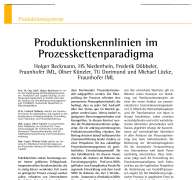
Combination of Production Characteristics Curves and the Process Chain Paradigm

Combination of Production Characteristics Curves and the Process Chain Paradigm

Holger Beckmann, Frederik Döbbeler, Oliver Künzler, Michael Lücke
Nowadays factories have to withhold an ever rising pressure to succeed. Customer demands become more demanding and goods have to be available within shorter lead times and lower prices. Flexibility, reliability and resilience are key factors for companies. Against this background, there is a need in companies for constant analysis of their business processes. The process perspective that was established in the industry since the 1980s will be addressed in the following by using the “Dortmunder Process Chain Model”. A permanent preparedness for change relies on being able to report about the plant’s status quo at all times. Therefore valuation methods and key figures are needed that represented by production characteristics curves in this paper. After an introduction to these two topics, the combination of both to one process based valuation method will be outlined. The intended methodology will represent a holistic decision model for plant controlling. This approach is being ...
Industrie Management | Volume 30 | 2014 | Edition 1 | Pages 22-26
Encountering the Increasing Complexity by Changeability

Encountering the Increasing Complexity by Changeability

Thomas Wochinger, Anja Schatz
The increasing complexity in manufacturing companies’ business environment requires the fast response to changes with little effort. The article focuses the design and implementation of a changeable and versatile production system that transfers the well-proven tact-oriented principle to the whole order management process. The realization is illustrated by practical examples.
Industrie Management | Volume 29 | 2013 | Edition 6 | Pages 61-64
Cell Disruption for Biotechnology

Cell Disruption for Biotechnology

Bestehende Zellaufschlusstechnologien und neue Lösungsansätze
Eckart Uhlmann ORCID Icon, Dirk Oberschmidt, Anja Spielvogel, Mitchel Polte, Julian Polte ORCID Icon, Katrin Herms
Cell disruption technologies used in industry and research are versatile and divided into biological, chemical and physical technologies. Physical technologies are subdivided into mechanical and non-mechanical. Common used cell disruption devices like the French Press does not enable a continuously cell disruption with a high amount of sample volumes. The text at hand describes a new continuously operating cell disruption device developed at Fraunhofer-Institute for Production Systems and Design Technology. Concluding the application possibilities and potentials are described.
Industrie Management | Volume 29 | 2013 | Edition 6 | Pages 21-25
Urban Value Creation

Urban Value Creation

Challenges and potentials for production and logistics in urban areas
Felix Wiegel, Siri Adolph, Özhan Özsucu, Dominik Thiel, Eberhard Abele, Ralf Elbert
Global megatrends such as the increasing urbanization of living environments and economic areas, the climate change and the increased meaning of work-life-balance require new production and logistics concepts. An opportunity to cope with the linked challenges offers the concept of urban value creation. This kind of value creation reveals chances for the participating stakeholders when ecologically, economically and socially acceptable designed. This article addresses the challenges and potentials linked with urban value creation and shows production-related and logistical approaches to design a sustainable, city-compatible urban value creation.
Industrie Management | Volume 29 | 2013 | Edition 5 | Pages 15-18
1 12 13 14 23