Branche: Smart Materials

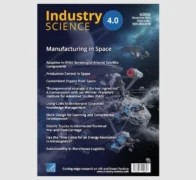
I4S 6/2025: Manufacturing in Space

I4S 6/2025: Manufacturing in Space

Infinite possibilities for industrial production?
Manufacturing is leaving Earth: what was once science fiction is becoming a strategic field for the future. Falling launch costs and new space industry players are enabling production and services under conditions that are impossible on Earth—from in-orbit maintenance to novel manufacturing processes in microgravity. This issue highlights opportunities, business models, and technological hurdles on the path to value chains in space.
Customized Organs from Space

Customized Organs from Space

How weightlessness could change human lives
Due to its weightlessness, space offers enormous opportunities for production. The unique conditions of microgravity, for example, can simplify the development of organs and tissues from the body's own stem cells, allowing therapies to be developed in a more targeted manner. Even though many independent initiatives are currently emerging to explore this and other potential applications, their success is not a foregone conclusion.
Artificial Muscles and Nerves in Industry 4.0

Artificial Muscles and Nerves in Industry 4.0

Multifunctional actuator-sensor systems with shape memory alloys (SMAs) and dielectric elastomers (DEs)
Paul Motzki ORCID Icon, Steffen Hau ORCID Icon, Marvin Schmidt, Stefan Seelecke ORCID Icon
Within the concepts of Industry 4.0, the term “Smart Factory” stands for the creation of effective production environments through digitalization and cyber-physical systems. Most manufacturers plan to make their manufacturing systems more automated, flexible and adaptive. In the course of these efforts, intelligent materials are increasingly brought into focus. Combined actuator and sensory properties enable the construction of lightweight and compact multifunctional actuator-sensor systems that are operated in an energy-efficient, noise-free and emission-free manner. This makes them appropriate for building networked systems. Shape memory alloys (SMAs) and dielectric elastomers (DEs) are particularly suitable for building intelligent actuators, and are presented in this article alongside several use cases.
Industry 4.0 Science | Volume 39 | 2023 | Edition 1 | Pages 8-15 | DOI 10.30844/I4SE.23.1.8