Branche: Asia

Perspectives for Logistics in India

Perspectives for Logistics in India

Perspektiven für die Logistik in Indien
Holger Seidel, Kay Matzner
An engine of Asian development, India holds outstanding potential for investment in its logistics sector, which is experiencing above average rates of growth. However, high transport costs and long delivery times greatly detract from India’s prospects in the logistics sector. Despite these problems, India still offers investors excellent long-range prospects since it is working hard to eliminate the recognized problems.
Industrie Management | Volume 25 | 2009 | Edition 6 | Pages 63-65
India’s Global Portals of Engineering and Management Education

India’s Global Portals of Engineering and Management Education

Avrath Chadha, Bhola R. Gurjar
The technical universities which were founded after India’s independence fulfil the dream of the first prime minister Nehru of an advanced and self-sufficient India. Universities such as the IIT Delhi have the ambition to play in the international top league. Multinationals like IBM are attracted by the large number of talented engineers and scientists and have numerous cooperations with Indian universities. American and European universities are trying to integrate Indian students and graduates in their curriculum and research. This article gives an overview on the diverse Indian university and research landscape and shows which advantages western companies and universities have by working together with Indian top-universities.
Industrie Management | Volume 25 | 2009 | Edition 6 | Pages 49-52
Political Background and Innivation Potential of Indian Middle Size Enterprises

Political Background and Innivation Potential of Indian Middle Size Enterprises

Jakob Rösel
Immediately after independence the Congress regime under Prime Minister Nehru embarked upon a program of state controlled industrialisation. Over three decades the agrarian sector and the peasant cases of India were neglected by the Congress High Command and the Indian development planners. This Indian “middle path” to industrial development not only led to the emergence of new and rebellious peasant parties it also resulted in a modest, in a “Hindu rate of growth” of some three percent. In addition this policy of non-alignment and this pursuit of “middle path” between the west and the soviet bloc led to increased political and economic isolation. It was finally at the beginning of the 1970th that the government of India under Indira Gandhi constructed a new political alignment and economic exchange system with the Soviet Union. India gained Soviet industrial and military technology and a market for its products - which could not have been sold on the world market. With the ...
Industrie Management | Volume 25 | 2009 | Edition 6 | Pages 40-44
Strategic Power Factors in Buyer Supplier Relationships

Strategic Power Factors in Buyer Supplier Relationships

Josef Oehmen, Paul Schönsleben, Max von Bredow, Philipp Gruber, Gunther Reinhart
The increasing globalization gives western companies great new opportunities. Especially China gained increasing importance as a sourcing market in the last years. Despite these opportunities, a retreat of many companies from China could be witnessed recently. Among other factors, this is due to the fact that western companies cannot exert enough influence on the performance and price of their suppliers. This article presents tools and processes to successfully face this challenge and improve the own position of power as a customer.
Industrie Management | Volume 25 | 2009 | Edition 4 | Pages 29-33
Counterfeit found – what now?

Counterfeit found - what now?

Strategische Überlegungen zu einer effizienten, nachhaltigen Bekämpfung von Produktpiraten
Maximilian Burger-Scheidlin
Consumergoods but also technical products, pharmaceuticals etc. are increasingly counterfeid. Production and global sales are often controlled by organised crime. The local confiscation of counterfeits does not impress the fraudsters. Effective countermeasures must include the closure of their production facilities.
Industrie Management | Volume 24 | 2008 | Edition 6 | Pages 63-65
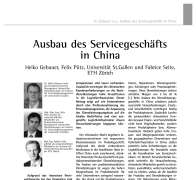
Extending the Service Business in China

Extending the Service Business in China

Heiko Gebauer, Felix Pütz, Fabrice Seite
Confronted with intensive product price competition in China, industrial firms are forced to invest in extending the service business. Extending the service business is far from easy. Chinese competitors offer faked spare parts. Local service skills are very poor and service requirements force industrial firms to invest in logistic infrastructure. This article offers a guideline for managers seeking to professionalize the human resource management in the service organization, to adapt service offerings to the local customer needs, and to set-up a logistic infrastructure.
Industrie Management | Volume 24 | 2008 | Edition 1 | Pages 19-22
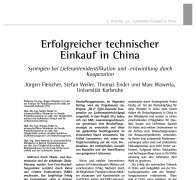
Successful Technical Procurement in China

Successful Technical Procurement in China

Synergien bei Lieferantenidentifikation und -entwicklung durch Kooperation
Jürgen Fleischer, Stefan Weiler, Thomas Ender, Marc Wawerla
Due to sales and cost motives and ongoing globalisation, low-cost procurement markets are increasingly opened up by small and medium sized enterprises (SMEs). These enterprises’ long-term success is directly linked to their success on these procurement markets. A procurement strategy which takes local market characteristics into account and fully integrates them will lead to success. The procurement process focuses on the selection of required components and the choice, support and further development of suppliers. The following article presents the “SiLu“ project approach (Sino-German cooperation for the support and further development of suppliers). The SiLu project comprises four SMEs that came together in order to elaborate a joint procurement strategy and to implement it on the Chinese market using their concerted buying power. Besides presenting this project the article focuses on the first project phase, the methodical selection of components and the identification of ...
Industrie Management | Volume 24 | 2008 | Edition 1 | Pages 43-46
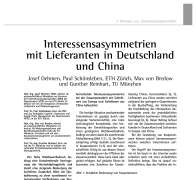
Asymmetry in Interests with Suppliers from Germany and China

Asymmetry in Interests with Suppliers from Germany and China

Josef Oehmen, Paul Schönsleben, Max von Bredow, Gunther Reinhart
The increasing competitive pressure leads to a reduction of the depth of value creation and therefore to a rising importance of suppliers. Additionally, globalization is the cause for a tighter international network in production. Asymmetries in interests can obstruct a cooperation between companies and may endanger the commercial success. The article describes asymmetries in interests in the cooperation with local as well as Chinese suppliers.
Industrie Management | Volume 24 | 2008 | Edition 1 | Pages 31-34
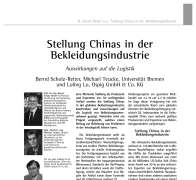
Logistics in China – Chances, Challenges and Success for European Enterprises

Logistics in China - Chances, Challenges and Success for European Enterprises

Thomas Wimmer, Julia Bendul
Due to the economic boom the demand for transport and logistic services increases dramatically in China. Experts promise for the Chinese logistics market a more than three times faster growth than for the German market. China offers not only cheap work force. With the accession to the WTO in 2001 the Chinese government liberalizes the logistics market. After outsourcing abroad and the integration of Chinese suppliers into the worldwide supply networks thousands of companies follow to China to open up the huge interior market with products as well as transport and logistic services.
Industrie Management | Volume 24 | 2008 | Edition 1 | Pages 39-42
Logistics Research and Training

Logistics Research and Training

Programs provided by foreign research organizations in China
Michael Schenk, Tobias Reggelin, Kay Matzner
Given the current and anticipated future economic development in China, annual growth rates around 10 % and the opening of the Chinese market to logistics services, foreign logistics service providers are expecting annual growth of 30 % in this particularly lucrative market segment. One of the greatest challenges is the lack of sufficiently qualified Chinese logistics experts. This presents foreign research organizations and enterprises an opportunity to become active in China.
Industrie Management | Volume 24 | 2008 | Edition 1 | Pages 12-14
1 2 3