Product Development

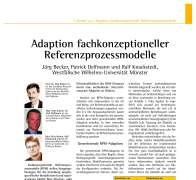
Adaptation of Conceptual Reference Process Models

Adaptation of Conceptual Reference Process Models

Jörg Becker ORCID Icon, Patrick Delfmann, Ralf Knackstedt
Conceptual reference process models (RPM) are used as a basis for the construction of project-specific models and can be seen as best-practice or common-practice solutions of a particular scope. The project specific adaptation of RPM is usually a very complex and costly task. In recent years, different reference modelling methods have been developed that focus on increasing the efficiency of the use of RPM by providing methodical support. Integrating and applying the different concepts of these methods can accomplish these objectives.
Industrie Management | Volume 20 | 2004 | Edition 1 | Pages 19-22
Engineering Knowledge Networks

Engineering Knowledge Networks

Efficient problem solving and competence development
Kristina Wagner, Daniel Mirtschink
The company-spanning collaboration offers companies the chance to exhaust new market potentials by in- creasing their innovation capability and productivity. An important prerequisite therefore is to optimally support knowledge networks and especially the corresponding knowledge exchange and problem solving processes. In the context of the project TRUST an approach was developed to enable companies and respectively their employees on the one hand to provide knowledge needed for problem solving. On the other hand the employees have access within an integrated working environment to experiences, know-how and competences of the knowledge network to solve their specific problems and to develop their individual domain competence.
Industrie Management | Volume 19 | 2003 | Edition 5 | Pages 41-44
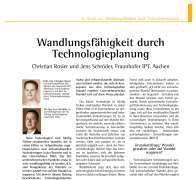
Strategies for Integrated Technology Planning

Strategies for Integrated Technology Planning

Fritz Klocke, Hagen Wegner, Holger Willms
Productivity, quality, flexibility and manufacturing costs are not the only criteria for an effective manufacture. To keep competitiveness, a global optimum of the process chain for the manufacturing of an individual product has to be achieved, considering the existing manufacturing capabilities and innovative technologies. In this paper approaches for integrated technology planning are discussed, which are developed at the Laboratory for Machine Tools and Production Engineering (WZL) in Aachen.
Industrie Management | Volume 19 | 2003 | Edition 5 | Pages 62-65
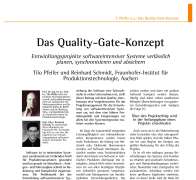
The Quality Gate Plan

The Quality Gate Plan

Planning, Synchronising and Assuring the Development of Software-intensive Systems
Tilo Pfeifer, Reinhard Schmidt
The software embedded in technical products has increasingly become the driving force of product innovations. Software has rapidly acquired relevance and complexity, particularly in the areas of industrial and automotive engineering. The development of the software, however, is faced with the often difficult task of integrating the systems into complex technological environments such as cars or production lines which rigid requirements concerning safety and reliability. To cope with these challenges a close collaboration between the developers of various areas of expertise such as mechanical, electrical, and software engineering is indispensable. Particularly the involvement of the software development is a common weak point in many companies. With the Quality Gate Plan this article presents an approach to the project management for the development of software-intensive sys-tems.
Industrie Management | Volume 19 | 2003 | Edition 5 | Pages 21-24
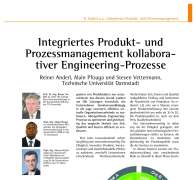
Integrated Product and Process Management for Enabling Collaborative Engineering

Integrated Product and Process Management for Enabling Collaborative Engineering

Reiner Anderl, Alain Pfouga, Steven Vettermann
Modern enterprises are continuously advancing the IT-based realization of interconnected, world-wide engineering processes between customers, manufacturers, suppliers, and other engineering partners. But, available solutions are supporting this kind of enterprise and process integration as well as the integration of product data inadequately. Regarding this, at the Department of Computer Integrated Design (DiK), TU Darmstadt, appropriate solutions were developed. The derived solutions are enabling enterprises domain-independently to form effective virtual networks of organizations and to optimize processes of collaborative engineering. This can be done by simultaneously improving the magical triangle of time, costs and quality efficiently.
Industrie Management | Volume 19 | 2003 | Edition 5 | Pages 13-16
Co-operation in Product Development by using Federated PDM Systems

Co-operation in Product Development by using Federated PDM Systems

Uwe von Lukas
Seamless co-operation of all partners in a project team is an essential demand of distributed engineering. One important challenge in this context is a shared access to a distributed product model. This can be achieved by offering a virtual PDM system that logically integrates the data of several physical PDM systems. This prevents the end user from searching and updating data sets in a variety of systems in parallel. This article discusses re-quirements to a PDM federation and presents a modular architecture to implement it in any given architecture.
Industrie Management | Volume 19 | 2003 | Edition 5 | Pages 33-36
The Extension of the Product Term

The Extension of the Product Term

Concept and Examples
Klaus-Dieter Thoben ORCID Icon, Jens Eschenbächer
The majority of manufacturing enterprises is currently trying to become more competitive in the preparation of customer-centric and innovative products. The focus of manufacturing paradigm is changing from a mainly sales-driven business towards a provider of utility or benefit to the customer. Consequently, the traditional product definition must be extended. Based on the description of the concept of extended products, this paper discusses approaches to extend the classical product definition and the resulting requirements. Additionally, the role of collaboration in enterprise networks will be discussed. Some practical examples are mentioned.
Industrie Management | Volume 19 | 2003 | Edition 4 | Pages 48-51
Efficient Project Management Based on an Integrated Product Model

Efficient Project Management Based on an Integrated Product Model

Ralf Jungkunz, Jörg Wirtz
An efficient management of development projects needs reliable information about the current project status as well as likely but possibly implicit causes in case of project target abnormalities. The article describes a problem that e.g. a rising product complexity and variant variety results to a rapid product life cycle information growth and typically high resources expenditure to process reliable project status statements. To reach an effective solution to process reliable project status statements within development projects the article presents an approach to a systematic and integrated interpretation of existing digital product life-cycle information to reliable project status information. To realize the objective, the article presents a with project management principles extended PDM-system concept already prototypically realized with the military aircrafts EADS Military Germany and is already used for an efficient project controlling in the EF Typhoon project, successfully.
Industrie Management | Volume 19 | 2003 | Edition 3 | Pages 75-78
Methods of Technological Forecasting

Methods of Technological Forecasting

Scenario Technique in Comparison to Roadmapping
Dieter Specht, Christian Mieke, Stefan Behrens
Technologies have influence upon competitive ability of enterprises in global and increasing competition. Espe-cially enterprises of so called high tech branches suffer from shorter product life cycles but longer periods of development. Enterprises in developed branches are threatened by technologies that may substitute the existing ones. In these circumstances an effective knowledge management and systematic technological forecasting with methodic support strengthen the competitive ability of the enterprise. Scenario technique and roadmapping are methods that register technological trends and reproduce the knowledge about technological development. In this article the suitability of the methods is assessed and both are integrated. The combination of scenario technique and roadmapping can use the advantages of both methods.
Industrie Management | Volume 19 | 2003 | Edition 3 | Pages 71-74
Business Rules and Constraint Programming

Business Rules and Constraint Programming

A Cooperative Ap-proach to Solve Complex Configuration Problems
Thomas Emden-Weinert, Frederik Stork, Philipp Sarre
Configuration tools have to fulfil a lot of business critical requirements. In combination, two approaches - business rules and constraint programming - are able to consider these requirements. ILOG JConfigurator is based on this combined concept. With AbaXX, a practical case illustrates the concept.
Industrie Management | Volume 19 | 2003 | Edition 1 | Pages 41-44
1 13 14 15 16