Product Development

Best Practice Strategies for the Implementation of PLM

Best Practice Strategies for the Implementation of PLM

the Results of an Expert Survey in the Automotive Industry
Michael Abramovici, Stefan Schulte, Christoph Leszinski
The product engineering is gaining in importance as it is the main source for innovations in manufacturing enterprises. In most cases the necessary ma-nagement and IT approaches are almost underestimated in strategic top-ma-nagement decisions, despite the advancing digitalisation in digital engineering. Product lifecycle management (PLM) has established itself as an integrated ma-nagement approach in engineering, but is often misunderstood as a synonym for PDM and delegated to IT departments. The survey “benefits of PLM” points out the reached benefits and most successful PLM implementation strategies.
Industrie Management | Volume 21 | 2005 | Edition 2 | Pages 47-50
Manufacturing Restrictions for the Structural Optimization

Manufacturing Restrictions for the Structural Optimization

A Contribution for Efficiency Increase in the Product Development Process
Albert Albers, Jens Harder, Tobias Helfrich
Structural optimization based on the finite elements method is a tool for the Design identification and optimization of technical structures within the product development process. Advantages are a substantial process acceleration by reducing classical “optimization loops” and the possibility to find solutions which are empirically not attainable. In the past, a disadvantage of the method was that the algorithms suggested partially drafts which were not or only at unacceptable costs producible. From this the motivation arose to develop the manufacturing restrictions for structural optimization tools, presented in the following. By means of these restrictions the solution area of the optimization will be limited to a given manufacturing method, so that optimized, producible drafts are developed.
Industrie Management | Volume 21 | 2005 | Edition 2 | Pages 27-30
Optimal Use of Virtual Engineering

Optimal Use of Virtual Engineering

Thomas Potinecke, Alexander Slama
In product creation, time reduction and increasing of innovation ability will be enabled by new innovations of methods and technologies for virtual engineering. The idea of virtual engineering is a holistic approach of a collaborative, virtual and integrated product creation. Therefore, individual, application-oriented configuration and an interoperable integrated IT-environment are required. Moreover, virtual engineering deals with adoption and optimisation of methods and tools for management of environments for product creation.
Industrie Management | Volume 21 | 2005 | Edition 2 | Pages 55-58
Semantic PLM  Next Generation Product Lifecycle Management

Semantic PLM Next Generation Product Lifecycle Management

Jürgen Angele, Henrik Oppermann
Shorter times to market determine the competitiveness of companies in all industries. The necessary approaches to improvement of industrial processes have to focus on the optimisation of the entire product lifecycle. The resulting management and organisational approach is called PLM. The preliminary integration of all data along the lifecycle can only be handled by semantic technologies. In addition, the introduced approach brings sufficient intelligence to capture enterprise knowledge and effective task support for employees.
Industrie Management | Volume 20 | 2004 | Edition 6 | Pages 51-54
Ramp-up Management – Area of Conflict in the Product Development Process

Ramp-up Management - Area of Conflict in the Product Development Process

Eine komplexe Herausforderung zwischen Innovation und Marktanforderung
Ive-Marko Harjes, Birgitt Bade, Florian Harzer
An increasing customer-driven rate of individualisation as well as the lack of brand loyalty is leading to a greater competition within the automotive industry. Project organisations integrate innovations and technologies into the product under enormous permanent pressure. Especially the defined targets concerning time-to-market, costs, and quality set new challenges to the project management throughout the often decentralised innovation network of engineering partners and manufacturers.
Industrie Management | Volume 20 | 2004 | Edition 4 | Pages 45-48
Collaborative Ramp-Up Management

Collaborative Ramp-Up Management

Jörg Hinrichs, Jens Rittscher, Bernd Hellingrath
The answer to engineering change and event management within a supplier network is collaborative ramp-up management, because it achieves transparency and defined structures in the ramp-up planning and steering processes. The usage of the ramp-up demonstrator, developed by the IML, simplifies the serial start-up within a supplier network. The ramp-up demonstrator is a combination of order-to-delivery simulation and current workflow management concepts, by which a controllable and plannable ramp-up environment is achieved.
Industrie Management | Volume 20 | 2004 | Edition 4 | Pages 33-37
Visualising and Valuating Complexity

Visualising and Valuating Complexity

An approach based on an integrated process and data model (IPDM)
Thilo Jania
The individualization in demand has led to an enormous increase in the complexity of products and processes in internal company practice. That is why the management of complexity is one of the main company targets, especially in the automotive industry. With an Integrated Process and Data Model (IPDM) current business processes can be completely illustrated by a new documentation method called documentation of interconnections. The method of valued change management makes it possible to optimise the model gradually concerning the complexity of products and processes. Therefore, the strategically foundation for an extensive and process accompanying management of complexity is laid.
Industrie Management | Volume 20 | 2004 | Edition 4 | Pages 49-52
Potential Analysis of Product Ramp-Up

Potential Analysis of Product Ramp-Up

Siegfried Stender, Jörg Uffmann, Ulrike Heinzle
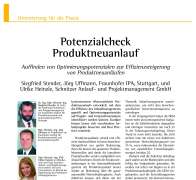
Today, an efficient product ramp-up is a precondition of the success of a company. The ramp-up management provides the coordination and management of the ramp-up process. The Fraunhofer Institute for Manufacturing Engineering and Automation and the company Schnitzer Anlauf- und Projektmanagement GmbH has developed a tool for analysing the product ramp-up process in order to achieve potentials for optimization. Ramp-up projects can be evaluated and best practices can be identified.
Industrie Management | Volume 20 | 2004 | Edition 4 | Pages 38-40
Selection of Methodology Aimed at Supporting Product Creation Processes

Selection of Methodology Aimed at Supporting Product Creation Processes

Prozesse effizient managen
Bernd Kuhlenkötter ORCID Icon
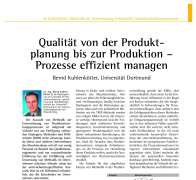
For increasing their product development and production efficiency, large-scale enterprises, mainly the automotive industry and their suppliers, more and more often make use of methodological instruments. A few of these methods have already made their way to the small and medium sized enterprises (SME), mainly of the mechanical engineering branch. The most important among these instruments are: Concurrent Engineering, Design for X, Failure mode and effect analysis, Quality Function Deployment and Value Analysis. And even more recent methods like TRIZ Method or Scenario Management are already observed with great interest by some of the SME because of their need for shorter development times, cost minimisation, increase of product quality, and, in consequence, their efforts for restructuring product development processes.
Industrie Management | Volume 20 | 2004 | Edition 4 | Pages 53-56
Transformability by Technology Planning

Transformability by Technology Planning

Christian Rosier, Jens Schröder
New technologies are often drivers of structural change, which in many cases leads to profound organizational and infrastructural changes in industry and within the enterprises. The aim of business action is to be versatile. That means that enterprises should play the role of the main actor of change instead of reacting only. The technology calendar described in this article is a strategic planning instrument. With this instrument it is possible to gain an overview about technologies available now and in future. From the confrontation of the product spectrum that can be manufactured in future and the technologies available in future, the necessary organizational and infrastructural measures, which result as consequence from the technological change, can be initiated. This way the planning of business change becomes possible.
Industrie Management | Volume 20 | 2004 | Edition 2 | Pages 55-57
1 12 13 14 16