Process Management

Lean Innovation – Getting More Systematic

Lean Innovation - Getting More Systematic

Günther Schuh ORCID Icon, Michael Lenders, Dennis Bender
For the competitiveness of R&D it is crucial to enhance not only R&D effectiveness but also R&D efficiency. The broad success of Lean Thinking within manufacturing as Lean Production especially bases upon the extensive work to interpret the basic principles for manufacturing systems and the broad availability of examples. Comparable guiding themes are still missing for Lean Innovation. Lean Innovation today is on its way, getting more systematic. The Lean Innovation approach presented here relies on ten key principles that need to be implemented in R&D. Together they operationalise the guiding theme of Lean Innovation: “Structure Early, Synchronise Easily, Adapt Securely.”
Industrie Management | Volume 25 | 2009 | Edition 1 | Pages 23-26
Material Flow Simulation and Cost Efficiency

Material Flow Simulation and Cost Efficiency

Daniel Neuhäuser, Klaus-Peter Rahn, Karl-Heinz Wehking
The following article describes an integrated method to calculate the investment and (cost-) effectiveness of a process optimisation using innovative techniques like RFID. It is based on the research project IdentProLog. Starting with analysing and optimizing processes it‘s possible to evaluate them with a method like activity-based-costing. The detailed information about process-times for each resource will be taken from a material flow simulation. Using this way its possible to create and format data with a high confidential level. Furthermore, it is possible to consider dependencies between technical resources, even in your investment analysis.
Industrie Management | Volume 24 | 2008 | Edition 4 | Pages 17-20
Simplicity as a Must for Success

Simplicity as a Must for Success

Erst der Rückbau der IT und einfachste Gestaltung der Prozesse ermöglicht das betriebliche Optimum
Joachim Althaler, Roland Schmidt, Erich Wimmer
Traditional understanding of production planning and scheduling in concordance with IT support has led to an increasing complexity and instability of production schedules. Since their advent, ERP-systems problem solving approaches have basically remained the same: Intricate planning and meticulous detailing have resulted in sprawling complexity and massive IT employment. Yet, another approach is possible: Simple process design, courage to accept fuzziness in detail and rigorous process orientation will lead to a production system without the need for detailed, pseudo-accurate schedules calculated by ERP-systems. The design of manufacturing and materials logistics is, therefore, revived as a matter of brainwork. This simple environment is crucial in achieving minimum lead-times and inventories which is accomplished with less administrative effort. By using this concept of production planning and control at a production plant for welding elements as an example, this article emphasizes ...
Industrie Management | Volume 24 | 2008 | Edition 3 | Pages 20-23
The Independencies Map, a Tool to Manage Complexity in Production Systems

The Independencies Map, a Tool to Manage Complexity in Production Systems

Gunter Lay, Christoph Zanker
With the implementation of numerous modernization concepts an increasingly complicated system has emerged in the companies. Single concepts partly overlap or redundantly pursue similar targets under different headings. Some concepts even compete in their target dimensions. The tool Independencies Map systematically analyzes the correlation of existing concepts and searches for inconsistencies and incompatibilities between these concepts. This article presents a pragmatic tool, which is also applicable for small and medium enterprises thus enabling them to remove efficiency barriers by harmonizing the interaction of the individual concepts.
Industrie Management | Volume 23 | 2007 | Edition 6 | Pages 37-40
Similarity Search in Information Systems

Similarity Search in Information Systems

Distributed, heterogeneous environments
Christian Lütke Entrup, Thomas Barth, Walter Schäfer, Ulf Müller, Daniel Metz, Manfred Grauer
Enterprises of the manufacturing industry have to come to precise decisions about technical and operational aspects of the product particularly in the knowledge-intensive, early phases of the product lifecycle because of increasing pressure concerning cost and competition. This can be supported by efficient reuse of the knowledge captured in product data of historical projects. At the same time, intern IT-systems as well as those of the partners in collaborative environments have to be included. Support of knowledge-intensive processes by similarity analysis in product- and process-data in heterogeneous environments is subject of this article.
Industrie Management | Volume 23 | 2007 | Edition 4 | Pages 41-44
Mobile Added Values – Direct Usage of Mobile Technologies in Industry

Mobile Added Values - Direct Usage of Mobile Technologies in Industry

Gezielter Einsatz von mobilen Technologien im industriellen Umfeld
Carsten Matysczok
Today the developments within the area of mobile business and mobile commerce influence marketing, sales and maintenance of products and services to a high degree. On the other hand mobile technologies offer new possibilities like: personalisation, localisation, interactivity, ubiquity, comfort of transactions and emotionalisation. But how can these new applications of mobile business be supported in order to structure a company’s internal processes in a more effective and efficient way as well as to increase the customers’ acceptance and customer orientation? A promising possibility is the usage of innovative mobile devices and the investment in new technologies, e.g. Augmented Reality, to meet these demands.
Industrie Management | Volume 23 | 2007 | Edition 4 | Pages 49-52
Process Portals as a Fundament for Service Oriented Architectures

Process Portals as a Fundament for Service Oriented Architectures

Thomas Puschmann
Process Portals are the fundament for he realisation of service oriented architectures (SOA). They are the central interface for all applications and their use by humans (human-machine integration). The role based personalization along user processes is the major added value of process portals which includes the integration of the necessary backend applications (machine-machine integration). SOA is based on the same concept, a process and service oriented view of the enterprise and the componentisation and flexibilisation of the IS/IT architecture. Compared with traditional architecture approaches, such as e.g. the client/server architecture, SOA expands this model with the process portal (human-machine integration) and the integration infrastructure (machine-machine integration) as two additional components. This article describes the construction principles of SOA with process portals as a starting point and presents a method for the realization of this architecture approach in the ...
Industrie Management | Volume 23 | 2007 | Edition 4 | Pages 58-60
Engineering Autonomous Production Systems

Engineering Autonomous Production Systems

Ein Vorgehensmodell
Bernd Scholz-Reiter ORCID Icon, Jan Kolditz, Torsten Hildebrandt
Mastering dynamics and complexity of logistic systems will continue to gain in importance in the future. One possibility to cope with this challenge is the concept of autonomous logistic processes. This article sketches a framework for engineering autonomous production systems on the basis of systems engineering. The main focus is put on a procedure model guiding through the process of system specification.
Industrie Management | Volume 23 | 2007 | Edition 3 | Pages 27-31
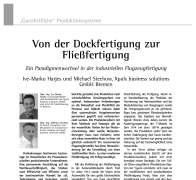
From Dock to Flow Line Production

From Dock to Flow Line Production

A Changing Paradigm in Industrial Production of Aircrafts
Ive-Marko Harjes, Michael Stechow
Changes within organisations and processes define the current processing landscapes of industrial companies. A permanent orientation to competitiveness, the aspiration to effectivity and efficiency as well as the continuous progress in technologies and systems, necessitates an overall coordination of relevant processes. Quite obviously this means today no longer to focus only on production and assembly processes. Only the exact interaction of involved areas - besides production/assembly even areas as logistics, quality and process planning - make a production economically ideal. A leading aircraft-producer realizes significant production-changes by modifying the static (dock-)manufacturing system into a trend-setting flow line-concept.
Industrie Management | Volume 23 | 2007 | Edition 3 | Pages 32-34
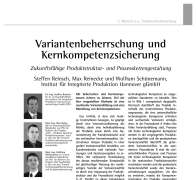
Sustainable Organization of Product Structure and Process Chain

Sustainable Organization of Product Structure and Process Chain

Variant control and core competence protection
Steffen Reinsch, Max Reinecke, Wolfram Schünemann
As a consequence of the increasing globalization many industrial companies see themselves forced to secure their competitive ability by an internationalization of their production locations. This requires a long-term planning of the future product structures and process chains, in order to control the variant variety and to protect the core competences. Objectives of the described method are a generation of variants close to the market and a bundling of the core competences.
Industrie Management | Volume 23 | 2007 | Edition 1 | Pages 39-42
1 9 10 11 13