


Green Fuels in Maritime Shipping |
Heating, electric power supply and ship propulsion with hydrogen and LNG fuels
| Journal | Industrie 4.0 Management |
| Issue | Volume 38, 2022, Edition 3, Pages 61-65 |
| Open Access | https://doi.org/10.30844/I40M_22-3_61-65 |
| Bibliography | Share | Cite | Download |
Abstract
Article
Roughly 2.5% (940 million tons of CO2 per year) of global CO2 emissions are emitted by the maritime transportation sector [1]. This number is higher than the total CO2 emissions of Germany (739 million tons in 2020) [2]. In an effort to stabilize and reduce global warming, many national and international measures limit the use of conventional fuels.
The International Maritime Organization (IMO) Green House Gas Strategy targets a 50% reduction of CO2 emissions by 2050, taking 2008 values as a baseline, and aims to reduce this to 0% as soon as possible [3]. In November 2021, the International Chamber of Shipping (ICS) declared its intention to IMO of climate neutrality by 2050. Additionally, worldwide limitations on sulfur dioxide emissions for ships outside the emission control areas (ECAs) were reduced from 3.5% to 0.5 % as of January 2020 [4].
Aside from CO2 emissions, other air- polluting emissions like nitrogen oxide (NOX), sulfur oxide (SOX) and fine dust (particulate matter and soot) must be reduced. Many regulations, such as the IMO’s TIER I and TIER II emission standards, apply to ships calling at offshore ports or terminals in international waters or using inland waterways. The SOX limit, which applies to SOX Emission Control Areas (SECAs) in the North Sea, Baltic Sea, North American coast and US Caribbean, has been 0.1% since 2015. NOX emissions must be reduced by 80% as per the TIER I directive in the NECA (NOX Emission Control Areas). The NECA also applies to the North Sea, Baltic Sea, North American coast, and the US Caribbean.
These regulations bring the air-polluting emissions generated by the cruise industry into public focus. The cruise industry can work towards a greener public image by implementing emission-reducing technologies and environment friendly green fuels.
An initial step of combining of fuel types and usage of aftertreatment technologies can go a long way towards emission reduction. But the energy used to produce ship fuels also has a large impact on emission (from well to wheel). In the following sections, this article compares fuel types, production chains and cleaning technologies, particularly with regards to their levels of air-polluting emissions. Future fuel prices for conventional ship fuels could steeply increase due to price increases for CO2 emissions and limitations in oil production.

State-of-the-art technologies for emission reductions
Air-polluting emissions like nitrogen oxide (NOX), sulfur oxide (SOX), fine dust (particulate matter and soot) could be reduced with a two-part technological approach. Scrubber technology ensures reduction of fine dust, particulate matter and sulfur dioxide, while SCR (selective catalytic reduction) technology is employed to reduce nitrogen oxide emissions.
Figure 1 shows the levels of air-polluting gases present when a variety of fuel types and treatment technologies are used. The control scenario, which displays a 100% value, uses HFO (heavy fuel oil) without any treatment technology.
The emission reduction achieved depends on the production chain, e.g. conventional LNG vs. green LNG. Ammonia, like hydrogen, is defined as a green fuel if the production chain utilizes green electrical energy. Additionally, ammonia is considered a green fuel when obtained as an industrial byproduct.
The NOX emissions of HFO or Marine Diesel Oil (MDO) in fuels which are combined with treating technologies (Figure 1a) show no difference compared to conventional LNG. It is also clear that green LNG and green methanol do little to reduce NOX emissions. Only use of green hydrogen fuel reduces NOX emissions to zero.
The sulfur oxide emissions (Figure 1b) can be reduced to ca. 20% of the control scenario value by using conventional fuels with treatment technologies. SOX emissions can also be significantly reduced by using green fuels.
In Figure 1c, the particulate matter (PM) can be nearly eliminated by utilizing Scrubber technology in MDO or HFO. For particulate matter, the additional advantage offered by applying green fuels on top of treatment technology is very low, as it only reduces PM levels by a further 3 percent.
Applying treating technologies (Scrubber and SCR) to conventional fuels does not reduce carbon dioxide (CO2) emissions (Figure 1d). Conventional hydrogen, which is based on fossil coal and natural gas, offers a CO2 reduction potential under 25%. However, green methanol, green ammonia and green hydrogen all enable significant CO2 reduction. The fuel production chain (well to wheel) is a key factor that influences the CO2 emissions and can be an obstacle to their reduction. In addition, it is crucial to remember that use of LNG or other methane fuels in combustion engines can result in a methane slip. The methane slip can be up to 2% in dual fuel engines. The impact of methane on global warming is 25 times higher than that of carbon dioxide. Methane slip can be eliminated by a high-temperature or catalytic exhaust treatment.
General outcome of the fuel type comparison: In order to operate in a “green and clean” way, the cruise and general maritime industry must adopt green fuels.

Highly efficient technologies
By increasing the overall efficiency of an element, e.g. the propulsion drive of a cruise ship, the energy consumption specific to that element can also be reduced. Figure 2 shows the specific ship engine power of a selection of cruise ships by weight (kW/Gt).
The cruise ship Radiance of the Seas serves as the benchmark or baseline with 0.44 kW/Gt. Over 17 years, the installed specific power was reduced by -55% to 0.20 kW/Gt on the ship AiDAnova. Also, the time needed to increase efficiency rapidly decreases from 7 years to 4 years.
Physical laws and technologies limit the increase of efficiency. Modern passenger ships already have energy-saving electric components installed, meaning there is limited potential to further decrease energy consumption by reinstalling new equipment.
On the one hand, if energy efficiency increases, the specific amount of energy needed decreases. On the other hand, bigger ship sizes and a growing number of ships worldwide increases the total energy consumption of the cruise industry. This phenomenon is known as the rebound effect. Therefore, further increases in efficiency or reductions in energy consumption cannot be expected. Employing new technologies can nonetheless optimize the overall emission levels of a ship’s energy supply systems.
General outcome of energy efficiency technologies: Energy efficient technologies reduce CO2 emissions, but do not eliminate them entirely.
Green fuel production chain
Electrical energy can support the mobility or transport sector with power lines, batteries, hybrid systems or green fuels. For the maritime sector, hybrid systems (system combination e. g., green fuels and batteries) or green fuels are most practical due to the weight and distances involved.
Figure 3 shows the green fuel production chain. Due to conversions steps, e.g. from electrical energy to hydrogen, 30%-40% of the energy is lost. Renewable electrical energy (wind or photovoltaic) is transferred to other energy forms like green hydrogen, green SNG (Synthetic Natural Gas), green LNG (Liquefied Natural Gas) or green methanol. Green ammonia (NH3) could be also used as a future green fuel for maritime sector.

Green hydrogen could thus be delivered to end consumers, i.e. ships. Otherwise, green hydrogen could be transformed into green fuels like methanol or SNG with CO2 through different synthesis steps. Green SNG is the basis for green LNG. Green CO2 could be extracted from biogas plants or in the future captured from air.
Storage problems for green fuels
Bunkering green fuels effectively is a task that will play a role in the future of industry. The energy density (gravimetric and volumetric) of liquid or gaseous fuels plays an important role.
In Figure 4, standardized energy densities (gravimetric: MJ/kg and volumetric: MJ/m3) of different fuel types are shown, using diesel as a benchmark. High energy density is reached with diesel. This sort of energy density is needed for long-distance travel and big propulsion drive systems with a high energy consumption.
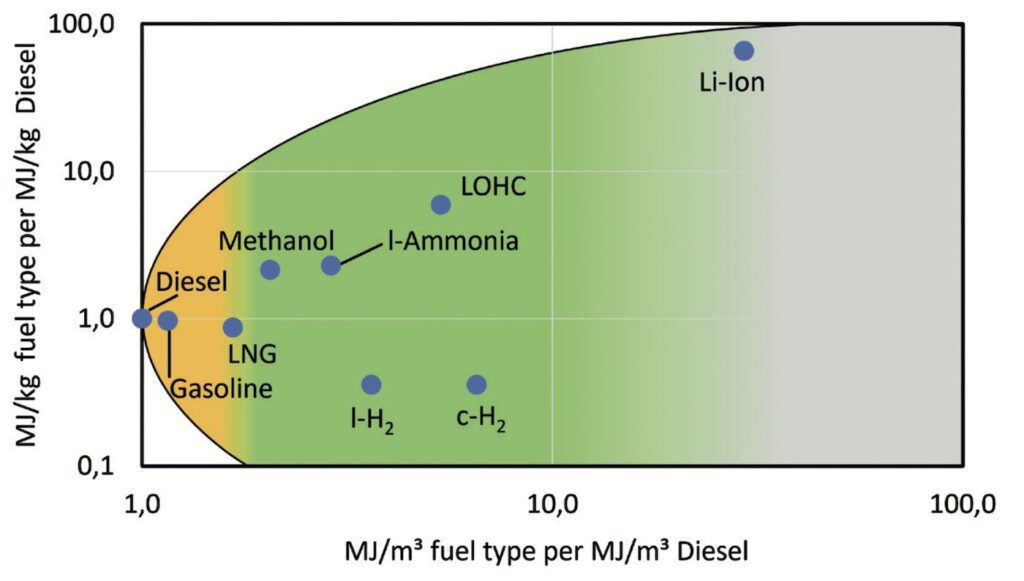
Explanation of Figure 4:
-
- Orange area: fuel types similar (weight and volume) to diesel.
-
- Green area: fuel types probably useable in costal and river shipping.
-
- Grey area: fuel types are not meaningful in shipping sector. For example: Li-Ion batteries need 30 times more space and the weight are 66 times higher compared to diesel. Data Source [5].
-
- Legend: l-H2 = Liquefied Hydrogen c-H2 = Compressed Hydrogen, l-ammonia = Liquid Ammonia, LOHC = Liquid Organic Hydrogen Carrier, LNG = Liquefied Natural Gas, Li-Ion = Lithium-Ion Battery.
On ships, fuel storage is limited by the space available. For example, atmospheric hydrogen tanks need seven times more space than HFO or MDO tanks. This means that hydrogen, batteries, and methanol fuels are not viable alternatives for international ship transportation after all. Green LNG and ammonia offer comparable advantage in terms of storage space for long-distance routes and in future could have a high availability at bunkering terminals.
Bunkering for future fuels is another issue that must be solved. HFO, diesel and even conventional LNG are generally available at international ports in Europe and abroad. Green methanol and hydrogen could be taken for routes that run near coastlines or along rivers. But combining fuel types can also make sense. For example, diesel or (green) LNG can be used for the main ship propulsion drive system and green methanol or green hydrogen for central or decentralized electric energy production to substitute the conventional diesel-electric generating systems (auxiliary diesel). This approach can improve the overall CO2 footprint and reduce all noxious gas emissions.
Fuels cells and hydrogen applications on ships
With fuel cells or combustion engines, hydrogen can be transferred to electricity and heating systems. Fuel cells are most efficient in this regard. Before choosing to use fuel cells, ships must define the intended operation. Requirements can include a fast start-up response on electrical energy demand (cold start-up and transient load handling) and a high efficiency at partial load.
In addition, the cell should operate at a low temperature (because of fire protection and safety aspects) and should be easy to maintain.
Fuel cell technology can be basically divided into two different types. The first is based on a solid oxide fuel cell type which needs very high temperatures to operate (SOFC – Solid Oxide Fuel Cell). The second type is based on a proton exchange membrane (PEMFC – Proton Exchange Membrane Fuel Cell).
The proton exchange membrane fuel cell is available in a low (LT ) and high temperature (HT ) configuration. The LT-PEMFC cell starts up in less than 10 seconds. The reaction time on transient loads is less than 5 seconds. The operation temperature is low compared to the other types. The drawback is that the lifetime can be lower than the other fuel cell types and the required fuel purity is higher than in other systems.
The utilization of hydrogen on ships is also based on storage capacities (decentralized or central power systems). The main applications of hydrogen on ships are in heating, warm water electrical energy production. The fuel combines this effort. On the one hand, a centralized fuel cell system for heat and electricity production can be installed in a ship’s engine room, allowing the existing plumbing and electrical infrastructure to deliver energy to passenger compartments. On the other hand, decentralized fuel cells can be placed in different ship sections. In this case it is not necessary to install water pipes and cables through all fire protection areas on the ship. The main disadvantage of the latter scenario is that each fuel cell needs its own tank system, which entails high installation efforts but provides a secondary advantage of increased system reliability.
Conclusion
Solutions to reduce global warming must be found and implemented. Humanity cannot continue down the path it has been on for the last 150 years. Maritime transportation is responsible for 2.5% of global CO2 emissions. To reduce these emissions, different fuel types could be employed in the market.
CO2 emissions can be reduced to 0% with certain green fuels (green hydrogen, green ammonia). The type of green fuel applicable for a specific shipping scenario depends on specific parameters like volumetric and gravimetric density. Also, future fossil fuel prices could highly increase because due to limited global availability and taxes on CO2 emissions.
Green LNG should be used for main engine drives on long sea journeys. LNG offers the highest energy density of the green fuels assessed. LNG availability is rising due to expanding LNG-terminals in seaports. Refueling time is also important for HD-Trucks. Using LNG results in the same refueling times as diesel (up to 150 l/min). LNG boil-off is not an issue for engines with high power density. Well-to-tank efficiency depends on the length of transport route and the method of production. Many newly constructed ships are built with an LNG driving system. Conventional LNG could be 100 % substituted with green LNG. Green LNG must be produced with climate-neutral green CO2, as there will otherwise be climate-damaging CO2 emissions.
Methanol is best used in coastal and river shipping, due to potentially toxic methane slips that can occur on longer voyages.
Leveraging green hydrogen and green ammonia could reduce CO2 emissions to 0%. Green hydrogen can be used for heating and electrical energy production. The fuel supply chain should only use renewable solar or wind energy for fuel production to reach acceptable emission reductions. The timeline of the switch to green fuels will be decided by their popularity on the consumer market. Technical solutions for implementation on ships are available on markets. High pressure systems can be used to achieve satisfactory energy density for hydrogen storage. Liquid organic hydrogen carriers (LOHC) have potential as a future solution for hydrogen storage.
Because of their weight and volume, batteries are not an ideal solution for the shipping industry. Other air-polluting emissions, like nitrogen oxide (NOX), sulfur oxide (SOX) and fine dust (particulate matter and soot) must additionally be reduced. Regulations like the TIER I and II directives and the loss of access to seaways and harbors in NECA and SECA areas may bring about changes in how the industry operates. With highly efficient engines, the specific energy amount in kW/tons could be reduced.
Green fuels can play a role in establishing a new and greener image in the cruise industry. Surveys have shown that tourists are able and willing to support green solutions, e. g. green fuels for cruise ships.
Bibliography
[1] European Union – EU: Reducing emissions from the shipping sector. URL: https://ec.europa.eu/clima/ policies/transport/shipping_en, retrieved 29.05.2021.[2] Bundesministerium für Umwelt, Naturschutz und nukleare Sicherheit – BMU: Treibhausgasemissionen sinken 2020 um 8,7 Prozent. URL: www.bmu.de/pressemitteilung/ treibhausgasemissionen-sinken-2020-um-87-prozent, retrieved 29.05.2021.
[3] International Maritime Organization – IMO: Initial IMO GHG Strategy. URL: www.imo.org/en/MediaCentre/ HotTopics/Pages/Reducing-greenhouse-gas-emissions-from-ships. aspx, retrieved 30.05.2021.
[4] Umweltbundesamt – Faken zur Seeschifffahrt und zu Ihrer Auswirkungen auf die Umwelt: https:// www.umweltbundesamt.de/themen/wasser/gewaesser/meere/ nutzung-belastungen/schifffahrt#luftverunreinigung , retrieved 22.02.2022
[5] Meyer Werft: Energiewende im Schiffbau. Metashipping Abschlussveranstaltung; Hamburg 2018.
[6] Fichter, C.: Warum braucht die Seeschifffahrt grüne Gase? Entwicklungen –Lösungen. URL: https:// wind-wasserstoff-bremerhaven.de/ wordpress/wp-content/ uploads/2020/06/Sustainable_Shipping_Fichter_2019.pdf, retrieved 30.05.2020. Sustainable Shipping Conference; 4. Bremer Kongress für Nachhaltigkeit in der Schifffahrt; Bremen; 23. – 24.09.2019.
Your downloads
Potentials: Resource Efficiency
