Profitability

Production Control in Space

Production Control in Space

An AI-supported approach for industry in orbit
Dominik Augenstein, Lara Jovic
Production in space, of semiconductors for example, offers many advantages for companies. At the same time, high transport costs mean that careful consideration must be given to the production materials being transported. The use of Kalman filters enables (real-time) control from Earth, making space production a cost-efficient option. Machine learning could make it a viable approach even for highly complex production systems.
Industry 4.0 Science | Volume 41 | 2025 | Edition 6 | Pages 22-29
“Entrepreneurial courage is the key ingredient”

“Entrepreneurial courage is the key ingredient”

Interview with Prof. Jan Wörner, Director of the Frankfurt Institute for Advanced Studies (FIAS)
Production is leaving Earth. As access to space becomes increasingly affordable and reliable, the idea of manufacturing in space is evolving from science fiction to a real industrial strategy. In this interview, Jan Wörner, who has headed not only the German Aerospace Center (DLR) but also the European Space Agency (ESA) for many years, talks about strategic opportunities and regulatory challenges.
AI-Based Recommender Systems in Product Development

AI-Based Recommender Systems in Product Development

A framework for knowledge discovery from multimodal data in industrial applications
Sebastian Kreuter ORCID Icon, Philipp Besinger, Alexander Lichtenberg, Fazel Ansari, Wilfried Sihn
The engineer-to-order (ETO) production approach is gaining relevance in response to increasing demand for individualized products and small batch sizes. However, ETO inherently reduces the economies of scale typically achieved in series production, as each order requires tailored engineering and production steps. This loss of efficiency can be mitigated through demand-driven and context-aware information provision throughout the product development process. A recommendation system based on semantic artificial intelligence (AI) and machine learning can support this by i) analyzing historical data and prior knowledge, for example drawings or a bill of materials from previous projects, and ii) making automated suggestions, like reusing existing designs or proposing design alternatives, thus compensating for the aforementioned effects.
Industry 4.0 Science | Volume 41 | 2025 | Edition 5 | Pages 94-101 | DOI 10.30844/I4SE.25.5.94
Empathic Assembly Assistance

Empathic Assembly Assistance

Combining AI-based data analysis and empathic human digital twins
Matthias Lück ORCID Icon, Katharina Hölzle ORCID Icon, Christian Saba-Gayoso, Joachim Lentes
Industrial companies in Germany face demographic change and stagnating productivity in an increasingly complex world. Manual assembly remains essential for complex, low-volume products, yet productivity and quality lag due to human variability. This paper introduces a concept and demonstrator for an empathic assembly assistance system that merges a human digital twin and AI-based screwdriver data analytics within a modular architecture. Tightening anomalies are classified, linked to inferred worker states and translated into information and recommendations.
Industry 4.0 Science | Volume 41 | 2025 | Edition 5 | Pages 6-13 | DOI 10.30844/I4SE.25.5.6
Open-Source and Cost-Effective Digital Twin

Open-Source and Cost-Effective Digital Twin

A case study with two weeks to succeed
Shantall Cisneros Saldana ORCID Icon, Sonali Pratap, Parth Punekar, Sampat Acharya, Heike Markus ORCID Icon
Digital Twin (DT) adoption remains a challenge due to high costs, complexity and lack of skills. This study proposes a cost-effective, TRL 5-validated DT model that can be built using open-source and office suite tools within just two weeks. Integrating real-time sensor data, predictive analytics, anomaly detection and notification, the model improves efficiency and sustainability in agriculture. Even with cloud service constraints, the system delivers a 7.76% average relative error and rapid, automated notifications. The findings show how open-source in combination with common commercial tools technologies can make advanced digital tools accessible to all, creating scalable, human-centered, and affordable solutions in line with Industry 5.0 principles.
Industry 4.0 Science | Volume 41 | Edition 3 | Pages 62-68 | DOI 10.30844/I4SE.25.3.62
Boosting Competitiveness in Small Batch Production

Boosting Competitiveness in Small Batch Production

Scalable and flexible body-in-white production line with collaborative mobile robots
Walid Elleuch, Tadele Belay Tuli ORCID Icon, Martin Manns ORCID Icon
Due to the higher customization of products to customer groups and needs, body-in-white manufacturing industries are facing higher variant assembly at the later stages of the production line, thus increasing production costs per unit. Flexible production processes that involve flexible material flows, non-rigid manufacturing sequences, and the automatic reconfiguration of tools are regarded as the pillars of a resilient production system. This article presents a conceptual solution for flexible Body-in-White sheet metal production with autonomous collaborative robotic systems to make product costs affordable for a higher competitive advantage.
Industry 4.0 Science | Volume 41 | Edition 2 | Pages 60-67
Parameter Optimization for a Brine Injector

Parameter Optimization for a Brine Injector

Development of an AI pipeline using an example from the meat industry
Tim Zeiser ORCID Icon, Theo Lutz ORCID Icon, Corinna Köters ORCID Icon, Maik Schürmeyer, Alexander Prange ORCID Icon
The production of cooked ham involves a number of challenges. In production, cuts of meat are put through in a multi-stage curing and cooking process involving brine. This can lead to fluctuations in quality due to structural defects in the meat. The result: the brine is not optimally absorbed. An AI model trained on historical data intends to solve the problem.
Industry 4.0 Science | Volume 40 | 2024 | Edition 6 | Pages 40-46
Potentials and Application of the Industrial Metaverse

Potentials and Application of the Industrial Metaverse

Convergence from simulation to reality
Oliver Petrovic, Yannick Dassen, Christian Brecher
This paper deals with the concept of the Industrial Metaverse and its potential impact on the manufacturing industry. First, the possibilities of the Industrial Metaverse are explained in general and then possible resulting functionalities for production technology along the life cycle are presented. For the two topics "Synthetic Data Generation" and "Virtual Qualification" the implications of the Industrial Metaverse are considered more concretely.
Industrie 4.0 Management | Volume 39 | 2023 | Edition 5 | Pages 27-32 | DOI 10.30844/IM_23-5_27-32
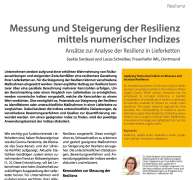
Applying Numerical Indices to Measure and Increase Resilience

Applying Numerical Indices to Measure and Increase Resilience

Approaches to analyzing resilience in supply chains
Saskia Sardesai ORCID Icon, Lucas Schreiber
An increased awareness of risks and rising incidents prompt companies to enhance the resilience of their supply chains. While various measures can be employed to increase resilience, a parallel consideration of a multitude of metrics is necessary to explicitly evaluate its impact on supply chain resilience. The paper presents approaches that facilitate the comparability of resilience across alternative supply chain designs by combining various metrics into a single numerical index. Additionally, innovative technologies are highlighted that can help to create resilient supply chains.
Industrie 4.0 Management | Volume 39 | 2023 | Edition 4 | Pages 45-49 | DOI 10.30844/IM_23-4_45-49
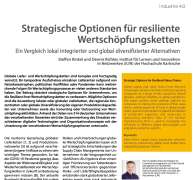
Strategic Options for Resilient Value Chains

Strategic Options for Resilient Value Chains

Ein Vergleich lokal integrierter und global diversifizierter Alternativen
Steffen Kinkel ORCID Icon, Dennis Richter
Global supply and value chains have become increasingly complex and interconnected, exposing companies to a range of risks caused by natural disasters, political instability, or global pandemics. The paper outlines some strategic options for companies to improve the resilience of their value chains, namely expansion of local or global supply chains, regional concentration or global diversification of production capacities, and insourcing or outsourcing activities. Data of 314 German manufacturing firms is used to investigate the influence of different digital technologies and adaptable production systems.
Industrie 4.0 Management | Volume 39 | 2023 | Edition 4 | Pages 31-35 | DOI 10.30844/IM_23-4_31-35
1 2 14