Modularization

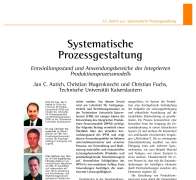
Systematic Process Design

Systematic Process Design

Development state and applications of the integrated production process model (IPPM)
Jan C. Aurich, Christian Wagenknecht, Christian Fuchs
The design of cross-enterprise production processes can be significantly supported by the systematic usage of process modeling methodologies. The following paper shows current and future research work concerning the Integrated Production Process Model (IPPM). Major improvements are related to the integration both of physical and non-physical products and the closed description of cross enterprise production processes. An integrated modeling methodology based on a predefined process module library supports the design process.
Industrie Management | Volume 21 | 2005 | Edition 4 | Pages 23-27
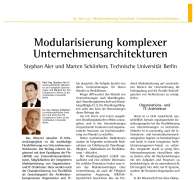
Modularization of Complex Enterprise Architectures

Modularization of Complex Enterprise Architectures

An instrument for sustainable flexibilization
Stephan Aier, Marten Schönherr
The target of complex IT-projects is the improvement of flexibility and sustainability of organisational architectures. The main topic of the article is the definition and implementation of modules of organisational and IT-structures to increase flexibility. Approaches found in the area of Enterprise Application Integration (EAI) and Service Oriented Architectures (SOA) fit the described paradigm and support the technical implementation.
Industrie Management | Volume 20 | 2004 | Edition 2 | Pages 39-42
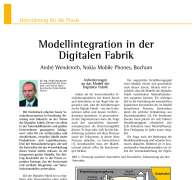
Model Integration in the Digital Factory

Model Integration in the Digital Factory

André Wenderoth
With emphasis simulation experts in research, consultancy and industry work on the vision of the Digital Factory. This catch phrase, which is especially promoted in the automotive sector, stands for a comprehensive, simulation model of real production systems and their logis-tics. One of the challenges faced by the developers in the realisation of this vision is the integration of big models. The article describes a concept, which supports the horizontal and vertical integration of simulation models.
Industrie Management | Volume 20 | 2004 | Edition 1 | Pages 48-51
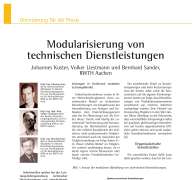
Modular Product Bundling for Technical Services

Modular Product Bundling for Technical Services

Johannes Kuster, Volker Liestmann, Bernhard Sander
The level of vertical integration or disintegration of technical services strongly depends on the design of interfaces between the parties involved. Therefore, the organizational structure has to be closely coordinated with the functional service structure. In this article a methodology is described for bundling single services into a modular structure to avoid efficiency losses at the interfaces.
Industrie Management | Volume 19 | 2003 | Edition 4 | Pages 40-43
Customer Retention by using Product Configurators and Component Systems

Customer Retention by using Product Configurators and Component Systems

Georg Elsner
Todays consumer markets demand more and more specialised products at low prices. The qualitative sale of their products, as well as development and maintenance, are expensive, complicated and error-prone. Consistent modularisation, combined with good component system management, can solve this trap of complexity. This process has to be supported by powerful tools. Accordingly these tools only take effect if modularisation is reality.
Industrie Management | Volume 19 | 2003 | Edition 1 | Pages 33-36
Optimized Variant Planning

Optimized Variant Planning

An approach based on structured products and product configuration
Josef Wüpping
Innovative companies are embracing innovative variant planning as a new management method for individual production. This method allows companies to create greater product variety and more individually customized goods and services at competitive prices. To fulfil these requirements, the gap between specific customer product requirements and the production requirements of standardized processes has to be bridged. This article describes experiences on organizational transformation from individual manufacturing to mass customization both from product and from process point of view. It shows managers how to proceed in a step-oriented manner.
Industrie Management | Volume 19 | 2003 | Edition 1 | Pages 49-52
1 2 3