Technologie: Training

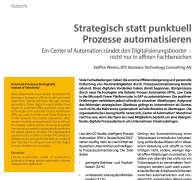
Automate Processes Strategically Instead of Selectively

Automate Processes Strategically Instead of Selectively

How and why a Center of Automation ignites the digitization booster—not only in related fields
Steffen Weiers
Many departments have already recognized the enormous increase in efficiency and personnel relief from routine activities through process automation. These digital thought leaders have begun to automate office processes using new technologies such as Robotic Process Automation (RPA), low code in the Microsoft Power Platform or in SAP. However, the positive experiences often remain in individual departments. Due to the lack of a strategic superstructure, companies as a whole have not yet succeeded in systematically transferring the added values to all areas. The organizational solution for this is called a "Center of Automation". Sometimes it is enough for the team to consist of two members to bring an overarching, digital process mindset into a company. (Only in German)
Industrie 4.0 Management | Volume 39 | 2023 | Edition 1 | Pages 58-62
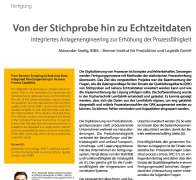
From Random Sampling to Real-time Data

From Random Sampling to Real-time Data

Integrated plant engineering to increase process capability
Alexander Seelig
The digitization of processes is complex and error-prone. That is why manufacturing processes are monitored using statistical process control methods. The aim of the presented project was to answer the questions how the data basis for the use of the quality control chart (QRC) can be extended from random samples to near real-time data and how the implementation of the solution should be done. The software solution was developed and tested in the Fischertechnik learning factory. It could be shown that the data from the learning factory is suitable to be displayed in a closely timed manner and to be evaluated by means of process indicators of the QRK. In this way, errors can be avoided and capacities saved. (Only in German)
Industrie 4.0 Management | Volume 39 | 2023 | Edition 1 | Pages 48-52
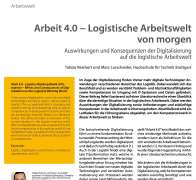
Work 4.0 – Logistics Working World of Tomorrow

Work 4.0 – Logistics Working World of Tomorrow

Effects and consequences of digitalization on the logistical working world
Tobias Reichert, Marc Lorscheider
In the course of digitalization, more and more digital technologies are being used in various areas of logistics. The occupational field is changing and problem-solving and abstracting skills as well as competencies in dealing with IT systems and data are increasingly required. Based on a literature review, this article provides an overview of the current situation in the logistics working world. Effects of digitalization as well as requirements and future competencies in the working world 4.0 are highlighted. Finally, a guideline for the management level is derived in order to promote the acquisition of competencies. (Only in German)
Industrie 4.0 Management | Volume 38 | 2022 | Edition 5 | Pages 30-34
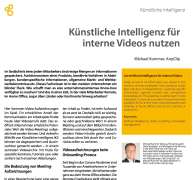
Use Artificial Intelligence for Internal Videos

Use Artificial Intelligence for Internal Videos

Michael Kummer
Huge amounts of information are stored in the memory of every employee. How a product works, best practices in departments, customer-specific information, general market and competitive knowledge, etc. This expertise is a blind spot in most companies. So how do you make in-house know-how available? And in a time when many employees work remotely, in home offices, even across countries or continents?
Industrie 4.0 Management | Volume 38 | 2022 | Edition 5 | Pages 61-63
How Does the Image of the HR Department Influence Recruiting?

How Does the Image of the HR Department Influence Recruiting?

David Padilla
Manufacturing companies are currently facing many hurdles. It is becoming increasingly difficult for them to find qualified workers, so-called blue collar workers. Technology adoption and system usability also pose challenges in the industry, as digital time tracking and shift scheduling are far from the norm in the industrial sector. Human resources software should facilitate the daily tasks of departments in order to achieve business goals. The use of such technologies saves valuable time as processes are automated. The needs of employees are put in the foreground to improve both resource planning and communication of manufacturing companies.
Industrie 4.0 Management | Volume 38 | 2022 | Edition 5 | Pages 64-66
Artificial Intelligence and Future of Work

Artificial Intelligence and Future of Work

Changes and Possible Approaches
Andreas Heindl, Alexander Mihatsch
Artificial intelligence (AI) is already an important part of business models and processes of many companies. In the future, AI systems will pro- foundly change our working environment. AI systems can develop completely new potential for companies in a wide variety of sectors and domains - especially in industry. Existing busi- ness models can be optimized along the value chain by optimizing production flows and processes or avoiding production downtimes with predictive maintenance. At the same time, AI systems can enable completely new business models and thus radically change existing mar- ket structures through new players. The AI economy of tomorrow will be more individual, more precise and more sustainable: Competitive value creation without AI will not be possible in many areas of industry.
Industrie 4.0 Management | Volume 38 | 2022 | Edition 4 | Pages 10-14
Technology Acceptance of Robotic Process Automation (RPA)

Technology Acceptance of Robotic Process Automation (RPA)

Jonas Geist, Jörg von Garrel
This article aims to develop a model for the acceptance of RPA technologies based on the presentation of the state-of-the-art. The model is the basis of an empirical study on the acceptance of robot-assisted process automation (RPA) at a global technology company. The results of this study are presented in a corresponding publication "An Empirical Analysis of Technology Acceptance of Robotic Process Automation (RPA) (Part 2)".
Industrie 4.0 Management | Volume 38 | 2022 | Edition 4 | Pages 43-47
Competence Development for Managers in the Context of Digitalization

Competence Development for Managers in the Context of Digitalization

Leadership Training in Corporate Training
Tobias Wienzek ORCID Icon, Hendrik Lager, Claudia Suhr
In the digital transformation, managers are facing changed requirements. They are important actors in the design process of the digital transformation, for which they must change their leadership behavior and acquire the corresponding competencies. In corporate practice, it is necessary to address these issues systematically in leadership training. However, such a qualification is a major challenge for companies. The article shows demands on leadership in the digital transformation and presents an innovative procedure for the competence development of managers at a provider of professional training.
Industrie 4.0 Management | Volume 38 | 2022 | Edition 2 | Pages 15-18
AI-Based Assistance Systems in Corporate Learning Processes

AI-Based Assistance Systems in Corporate Learning Processes

Gergana Vladova, Norbert Gronau ORCID Icon
Assistance systems are being used increasingly in the context of digital transformation. They can support employees in industrial production processes both in the learning phase and in the active work phase. In this way, competencies can be built up in a way that is close to the workplace and the process as well as demand-oriented. This paper discusses the current state of research on the possible applications of these assistance systems and illustrates them with examples. Among other things, the current challenges are also highlighted. At the end of the paper, focal points for the future development of AI in industrial learning processes and research on this are identified.
Industrie 4.0 Management | Volume 38 | 2022 | Edition 2 | Pages 11-14
Collaborative Approaches to Competence Development

Collaborative Approaches to Competence Development

IT-supported approaches for self-organized learning paths
Heiko Matheis ORCID Icon, Meike Tilebein ORCID Icon
The ongoing digital transformation is changing work and production environments of companies. In addition, a demand-oriented development and efficient use of employee skills are becoming ever more important for success. Thus, there is a need for new decentralized and situationally adaptable solutions that enable self-organized learning paths and informal competence development. This paper presents challenges of collaborative competence development and solutions for IT-supported self-organized learning paths at different organizational levels and shows project examples from the textile industry.
Industrie 4.0 Management | Volume 38 | 2022 | Edition 2 | Pages 37-40
1 4 5 6 20