self-organization

Agile Working in Large Companies

Agile Working in Large Companies

On the Need to Unlearn
Marcel F. Volland
Many large companies are increasingly facing the pressure to meet rapidly changing customer needs and to respond quickly to new technologies. These companies often suffer from coercive bureaucracy, that is, rule rigidity. For this reason, a huge increase in alternative working practices such as agile working has been noticed lately. While it was firstly found in small business start-ups, more and more traditional companies as DAX-companies have tried to use agile working practices selectively in their development departments. However, can agile working be so simply transferred to development of traditional products?
Industrie 4.0 Management | Volume 35 | 2019 | Edition 2 | Pages 27-30 | DOI 10.30844/I40M_19-2_S27-30
Preventive Work Design in Digitized Industrial Systems

Preventive Work Design in Digitized Industrial Systems

A Cybernetic Design Approach using the Example of Intralogistics
Martin Braun, Dirk Marrenbach ORCID Icon
In the course of digitization, the complexity and instability of business networks are considerably increasing. This has also serious effects on intralogistics. Under VUCA conditions, intralogistic systems develop into open, decentralized and self-organization networks of information-processing units. They adapt to the dynamic changes of their environment, by increasing their inner and outer varieties in a preventive manner. Digital technologies are not in a position to adequately control non-deterministic logistic systems; this task is essentially left to the working man. In order to overcome the challenges, appropriate models and methods of preventive work design are developed in the PREVILOG project. The paper presents cybernetic basics and preventive work design principles.
Industrie 4.0 Management | Volume 33 | 2017 | Edition 6 | Pages 38-42
Cooperative Control of Networked Cars

Cooperative Control of Networked Cars

Hierarchische und verhandlungsbasierte Strategien im Straßenverkehr
Jürgen Pannek, Tobias Sprodowski, Matthias Gerdts, Johannes Michael
The introduction of autonomous cars in street traffic creates the desire for self-organization of these cars regarding security, economic and ecologic aspects. To this regard, optimization based distributed control algorithms provide a solution approach for communicating autonomous cars. In this work we discuss a hierarchical model predictive control concept. On the operational level, individual goals of the drivers and security aspects are considered. Utilizing a planning layer, we show how overall goals like traffic flow maximization can be implemented. To this end, if a traffic event is triggered, a route for each individual car is computed centrally based on the current traffic conditions. The structure of the control also allows integrating cars, which are not actively taking part in the communication, via sensor fusion techniques.
Industrie Management | Volume 31 | 2015 | Edition 2 | Pages 7-10
Bionic Manufacturing

Bionic Manufacturing

Control of the factory with means form nature in the era of Industry 4.0
Norbert Gronau ORCID Icon
For more than 30 years a thrilling question is how the organization and disturbance management of natural ecological systems can be transferred to man-made systems. Beside approaches of sustainability and changeability especially self-organization approaches are tested in logistic chains and facturies. In this paper three approaches are presented, from which recommendations for the organisation of manufacturing processes can be derived. These thoughts can get new impulses for organization, control and disturbance management from elements of the fourth industrial revolution, especially cyber-physical systems.
Industrie Management | Volume 29 | 2013 | Edition 6 | Pages 12-16
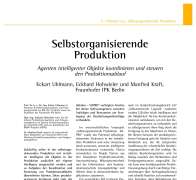
Self-organization in Manufacturing

Self-organization in Manufacturing

Eckart Uhlmann ORCID Icon, Eckhard Hohwieler, Manfred Kraft
In the future, objects with embedded intelligence will be able to coordinate and steer the production sequence in a self-organizing production environment. Instead of existing central planning and control the new product-controlled manufacturing uses a multi-agent system with the possibilities of auctions and negotiation. The project “Self-organizing Production  SOPRO” implements autonomous micro systems and software agents to provide embedded intelligence on objects in production field.
Industrie Management | Volume 29 | 2013 | Edition 1 | Pages 57-61
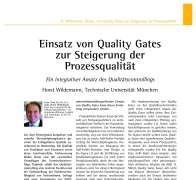
Quality Gates – An Integrative Quality Control Approach

Quality Gates - An Integrative Quality Control Approach

Ein integrativer Ansatz des Qualitätscontrollings
Horst Wildemann
Against the background of complex and volatile value chains the success factor quality is gaining increasingly in importance. Today, product quality and process quality as well as their continuous improvement are the basis for entrepreneurial success. Thus quality controlling becomes a central function in order to assure competitiveness of companies. New approaches are in demand in order to fulfil quality requirements along value chains and in order to link quality management systems with quality controlling. By an inter-divisional and company-wide implementation of Quality Gates these requirements can be met.
Industrie Management | Volume 26 | 2010 | Edition 4 | Pages 33-35
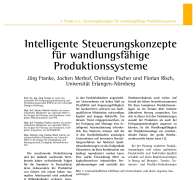
Intelligent Control Concepts for Changeable Production Systems

Intelligent Control Concepts for Changeable Production Systems

Jörg Franke, Jochen Merhof, Christian Fischer, Florian Risch
Changes on the product and manufacturing side resulting from intensifying global competition have put pressure on companies to alter their strategy, organization and production. Especially the ability to quickly adapt production equipment has become a crucial factor which can provide great competitive advantage. Current research work of the Institute for Manufacturing Automation and Production Systems (FAPS) at the University of Erlangen-Nürnberg focuses on material-flow and production systems that are both self-organizational and self-learning. In this context, concepts have been developed for cost-effective restructuring measures during the operating phase which make a rapid response to dynamic changes and disturbances possible.
Industrie Management | Volume 26 | 2010 | Edition 2 | Pages 61-64
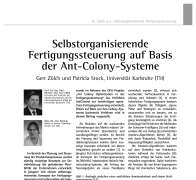
Self-Organizing Manufacturing Control Using Ant Colony Systems

Self-Organizing Manufacturing Control Using Ant Colony Systems

Gert Zülch, Patricia Stock
As a reaction to the growing demands of the market on enterprises, ever more complex procedures for production control are being developed. Most recently, self-organising procedures, which often mimic the behaviour of natu­ral systems (e.g. evolutionary or genetic algorithms), have come to the fore. The methods of Swarm Intelligence and, in particular, the Ant Colony Optimi­zation (ACO), which are characterised by their flexibility and adaptability, could serve as a basis for this. The ifab-Institute has developed a pro­cedure for the short-term, operative manufacturing control based on this approach, which will be presented in this article.
Industrie Management | Volume 23 | 2007 | Edition 5 | Pages 67-70
Self-Organization and Industrial Engineering

Self-Organization and Industrial Engineering

Selbstorganisation bei organisationalen Veränderungsprozessen, ermöglicht durch Methoden des Industrial Engineering
Franz J. Heeg
Organizational change-processes are usually carried out according to objective criteria; self-organizational aspects (as well as emotions and (basic-) needs as order parameter) are not taken into consideration. However, these aspects eventually decide on the success of innovative processes. Therefore, it is of importance to design organizational innovative processes in such a way that they enable and enhance self-organization. A technique designed to identify order parameters and to enhance self-organizational aspects (using adapted and relevant methods drawn from the field of Industrial Engineering) is introduced and discussed.
Industrie Management | Volume 22 | 2006 | Edition 5 | Pages 63-66
Adaptive Planning in Supply Networks

Adaptive Planning in Supply Networks

Ein innovativer Ansatz für die taktische Planung im dynamischen Umfeld
Frank Straube, Ingo Beyer
Production systems in multi-tier value networks are nowadays facing major challenges with regard to supply network operations planning. Many existing solutions neglect feedback mechanisms and operate under the assumption of isolated supply chains. However, even for intra-enterprise planning across production plants, hurdles hamper a successful business usage. As an innovative approach decentralized planning grounds on consensus-like agreements between equal partners - both intra- and inter-enterprise - through communicative, negotiation-like processes. Thus research activities aim at developing appropriate coordination mechanisms for decision making in tactical operations planning between independent supply chain partners for yielding consistent plans.
Industrie Management | Volume 21 | 2005 | Edition 5 | Pages 37-40