RFID

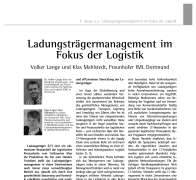
Management of Load Carriers in the Logistical Focus

Management of Load Carriers in the Logistical Focus

Volker Lange, Klas Mahlstedt
Load carriers as an essential part of the whole supply chain concern suppliers, manufacturers and retailers. In spite of the management of load carriers is still an unattended area within companies, although a holistic regulation and monitoring can gain access to substantial quantitative and qualitative capabilities. The article describes the term of a holistic management of load carriers und presents a framework and levers for an increased capability and a more efficient handling of load carriers.
Industrie Management | Volume 23 | 2007 | Edition 5 | Pages 55-59
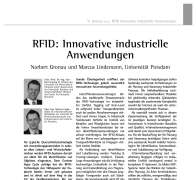
RFID: Cutting-edge Industrial Applications

RFID: Cutting-edge Industrial Applications

Norbert Gronau ORCID Icon, Marcus Lindemann
For simple industrial identification in many cases the traditional barcode systems are more profitable than applying RFID technology. But functional advantages in decentral data handling open up cutting-edge application potential. Improvements in component interoperability enable the implementation of robust and adaptable PPC concepts.
Industrie Management | Volume 23 | 2007 | Edition 4 | Pages 9-12
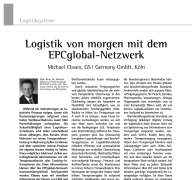
Tomorrow’s Logistics with the EPCglobal Network

Tomorrow’s Logistics with the EPCglobal Network

Michael Clasen
Due to growing demands on logistic processes, increasing transportation costs and a crowded, highly competitive market, margins in this service sector are shrinking. In order to survive, logistics providers will have to reduce internal costs, for example by means of logistic optimization (e.g., scheduling of pickup and delivery). Equally important, they also need to offer their customers additional value-added services, such as tracking and tracing (e.g., temperature logging within the cold chain). These requirements can be seamlessly supported across multiple industries by the event-driven EPCglobal Network.
Industrie Management | Volume 23 | 2007 | Edition 1 | Pages 68-71
Development of a RFID Training Method

Development of a RFID Training Method

Bernd Scholz-Reiter ORCID Icon, Sylvie Gavirey, Christian Gorldt, Uwe Hinrichs, Jan Topi Tervo, Dieter Uckelmann ORCID Icon
The implementation of object-identification without contact by Radio Frequency Identification technology (RFID) is in the meantime taken into consideration by many small and medium sized enterprises (SMEs) to enhance on the one hand their internal workflows in production and logistics and on the other hand to satisfy customer demands. However, in the last years only little or superficial knowledge of this technology has been acquired. Hence, qualified and certified training for dealing with RFID is highly necessary. Process security shall thus be guaranteed internally and uniform standards within the supply chain regarding the implementation and application of RFID, can be substantiated.
Industrie Management | Volume 22 | 2006 | Edition 5 | Pages 9-11
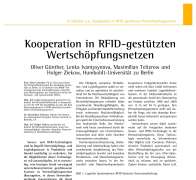
Cooperation in RFID-Enabled Value Networks

Cooperation in RFID-Enabled Value Networks

Oliver Günther, Lenka Ivantysynova, Maximilian Teltzrow, Holger Ziekow
Sensor und RFID technologies are increasingly shaping the logistics processes in production and in the service industry. In order to fully exploit the potential of these technologies, a paradigm change must take place where closed and monolithic company structures are transformed into value networks where a multi-faceted exchange and cooperation between companies is the rule. To make this transition attractive for all (or most) participants, the resulting cooperation relationships must be restructured with technical, economical and organizational aspects in mind.
Industrie Management | Volume 22 | 2006 | Edition 3 | Pages 41-44
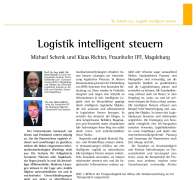
Intelligently Controlling Logistics

Intelligently Controlling Logistics

Michael Schenk, Klaus Richter
The international exchange of goods and products is growing steadily. Information technologies now in use are unable to sufficiently organize the flows of goods both more securely and more reliably: Losses from misdirected containers, pallets and luggage run in the tens and hundreds of millions. Modern solutions not only have to provide the capability to positively identify mobile objects of different kinds and in changing environmental conditions but also to localize them, communicate with them, navigate them and control them.
Industrie Management | Volume 21 | 2005 | Edition 5 | Pages 9-12
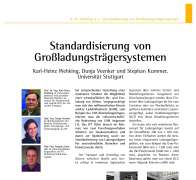
Standardisation of Large Charge Carrier

Standardisation of Large Charge Carrier

Karl-Heinz Wehking, Dunja Veenker, Stephan Kummer
In efficient process chains, economic advantages can be accomplished by the use of reusable loading devices. Due to their outer shape they allow a standardized handling of different goods using the already available equipment. Adequate design and a modular structure provide the opportunity for efficient loading and unloading processes of various goods. Keeping in mind the amount of loading devices currently in use (a few million), their economic relevance becomes apparent. The Institute for Mechanical Handling and Logistics (IFT) at the University of Stuttgart is currently working on two different research projects that involve the construction and thus optimisation of standardized loading devices for different industries and purposes.
Industrie Management | Volume 21 | 2005 | Edition 5 | Pages 49-52
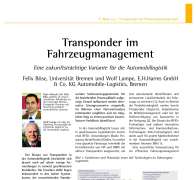
Assignment of Transponders in the Range of Automobile Management

Assignment of Transponders in the Range of Automobile Management

Eine zukunftsträchtige Variante für die Automobillogistik
Felix Böse, Wolf Lampe
The assignment of transponders in the field of automobile logistics is currently confined to few applications in closed circuits. The main reasons are high costs as well as insufficient standardisation and performance of RFID-systems. Combined with other new information and communication technologies RFID becomes increasingly important for positioning and communication tasks. Based on the processes of an idealised E.H.Harms Automobile-Logistics terminal this article describes the basic options of utilizing transponders in this specific industry and introduces a potential solution to cope with unsatisfactory cost-benefit ratios.
Industrie Management | Volume 21 | 2005 | Edition 5 | Pages 29-32
Autonomous Objects and Self-Organising Systems

Autonomous Objects and Self-Organising Systems

Application of New Control-Methods in Intralogistics
Michael ten Hompel, Dirk Liekenbrock
Transportation and sortation of bins and similar units in conveyor systems have reached a high level of automation. Nevertheless the combination of state-of-the-art technologies can breed innovative solutions for typical problems arising in planning and operation of such installations. The source of upcoming developments is an increasing distribution of control functionalities.
Industrie Management | Volume 21 | 2005 | Edition 4 | Pages 15-18
RFID: Technology and Logistics Applications

RFID: Technology and Logistics Applications

Peter Gabriel, Randolf Schließer
RFID systems are yet waiting for their breakthrough in logistics. Today, radio-based identification systems are restricted to closed-loop supply chains and selected high-value applications. Mass applications are still tested in first pilot projects. The article describes the state-of-art in RFID and the foreseeable technology roadmap. Today’s and future applications of RFID are discussed with a focus on retail and manufacturing logistics. Finally, the most important issues of standardization and privacy are addressed.
Industrie Management | Volume 20 | 2004 | Edition 3 | Pages 29.32
1 2 3 4