lean production

PPC Systems: The “Real” Needs of SMEs

PPC Systems: The “Real” Needs of SMEs

Teil 2
Markus Schneider, Michael Ettl, Alexander Schubel
For a sustained improvement in the logistic goals, such as the punctuality of delivery or cycle time, a consistent, process-oriented design, planning and execution of production systems is required. Besides the development of new methods, support by appropriate IT systems is necessary. Especially for SMEs, there are no solutions in this regard. Thereby first of all the existing MRP systems remain in the old thought patterns, to control and regulate the complexity of the real world through a detailed illustration as a model. For the development of a new ppc system the customer needs were determined apart from solutions of existing systems. The article shows the “real” needs in the environment of the factory structure design and production planning and control of SMEs by using innovation management according to Design for Six Sigma+Lean (DFSS+Lean).
Industrie Management | Volume 29 | 2013 | Edition 2 | Pages 43-48
Reference Production System for a Systematic Implementation of Lean Production

Reference Production System for a Systematic Implementation of Lean Production

Das Landshuter Produktionssystem (LPS): CLean Production Teil 1
Markus Schneider, Michael Ettl
Due to an increasing cost pressure especially big companies decided in recent years to implement a lean production system. However, the majority does not meet their expectations regarding the overall performance. An actual study confirms the companies´ dissatisfaction. There is a lack of structured and systematic approaches for lean production. Especially small and midsized companies ask for a systematic description for the concept in order to understand the context and to get a guideline for the implementation.
Industrie Management | Volume 29 | 2013 | Edition 1 | Pages 33-38
Sustainable Stock Management

Sustainable Stock Management

Fließende Fertigung mit dezentraler Fertigungsregelung
Boris Brinzer, Jens Kemkemer
Processing of the production orders in sync with customer demand, on schedule, at short notice, with constant machine utilization, is the vision of many a plant manager. Besides machine and personnel productivity, stock volume is for this the clearest performance indicator. In large-scale production, this vision has quite successfully been approached through assembly lines with a continuous, pulled material flow and one-piece production. Especially in series and small series production with high variety, however, the same concepts are not applicable or not very successful. A sustainable way to approach the vision in such a setting is described in this paper based on the practical example of TRUMPF Grüsch AG.
Industrie Management | Volume 28 | 2012 | Edition 1 | Pages 17-21
Skills Development and Leadership

Skills Development and Leadership

The continuous improving process in lean manufacturing systems
Eberhard Abele, Jan Cachay, Jan Wennemer
Sustainability in lean production systems arises when the relevant lean principles are addressed by preferably all stakeholders in the context of permanent improvement processes. For this purpose a skills development of all employees is necessary, even for managers, as they convey the CIP position by their people skills and set an example. If this succeeds, improvement processes will develop into a sustainable learning process, which in turn serves as a self-reinforcing factor for the further development of staff skills. An approach to skills development and to the corresponding leadership system for improvement processes is presented and supported by preliminary results of an empirical study.
Industrie Management | Volume 27 | 2011 | Edition 4 | Pages 14-18
Concept for an Organizational Structure for Lean Production

Concept for an Organizational Structure for Lean Production

Ansätze für eine angepasste Aufbauorganisation unter Anwendung von Lean-Grundsätzen
Katharina Bunse, Mario Schmuziger, Paul Schönsleben
„Lean Production“ is a known as successful production concept increasing productivity of a company in the long-term. Implementing lean principles in production can be challenging for the organizational structure of a company. Insufficient holistic process models, missing interface definitions and inflexible management structures can be major limitations. This article analyses - with the example of a Swiss production site of a company in the medical engineering sector - the challenges for the organization associated with the implementation of lean principles in operations. Requirements for an adapted organizational structure are highlighted and alternative organizational structures outlined. Advantages and disadvantages of these alternatives are presented and a solution for the case-study example developed. Companies in a similar environment can get suggestions for the adaption of their own organizational structure when implementing lean management principles in their production.
Industrie Management | Volume 26 | 2010 | Edition 2 | Pages 53-56
Application of MES for Generating Data

Application of MES for Generating Data

A study involving tact-oriented production systems
Dieter Specht, Renata Gruß, Thomas Schulz
Structures with historical background in industrial enterprises are often affected by a high degree of non-transparency and complexity. Reasons for this can be seen in heterogeneous processes and IT-environment. The adjustment of a tact-oriented project management system shows a possibility to achieve competitive advantages in the long-term. Other improvement potentials concerning the production process can be claimed by the application of a process-comprehensive Manufacturing Execution System (MES). Therefore an optimized adjustment of production should occur in two steps. On the one hand there has to be a tact-oriented restructuring of the production on the process level. On the other hand a MES solution, implemented on the system level, can operate as a support tool for the production.
Industrie Management | Volume 25 | 2009 | Edition 5 | Pages 51-56
Room for Improvement in Material Supply

Room for Improvement in Material Supply

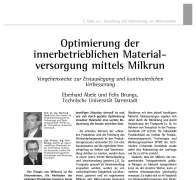
Design and Optimization of Milkrun Cycles
Eberhard Abele, Felix Brungs
Lean companies naturally use milkruns to improve their internal logistics. Approaches for the design of such milkrun cycles exist, but specific conditions of production are not accounted for. By showing typical development steps of the milkrun design, the correct design-approach for the specific situation becomes clear. Moreover the levers for further optimization and cost reduction are pointed out.
Industrie Management | Volume 25 | 2009 | Edition 5 | Pages 61-64
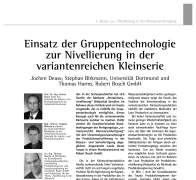
Using a Group Technology Approach to Level a Low Volume and High Mix Production

Using a Group Technology Approach to Level a Low Volume and High Mix Production

Jochen Deuse ORCID Icon, Stephan Birkmann, Thomas Harms
Regarding the optimisation of capacity utilisation the increasing product diversity has been an unsolved problem in job lot production for a long time. State of the art for solving such problems is the concept Heijunka, which means “levelled production”. The application of group technology offers the possibility to utilise this concept with regard to a low volume and high mixed production. In this context the characteristics of job lot production are investigated. Referring to these characteristics the concept Heijunka used in mass and serial production is adapted. The approach was applied in collaboration with Robert Bosch GmbH.
Industrie Management | Volume 23 | 2007 | Edition 6 | Pages 45-48
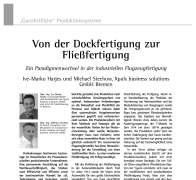
From Dock to Flow Line Production

From Dock to Flow Line Production

A Changing Paradigm in Industrial Production of Aircrafts
Ive-Marko Harjes, Michael Stechow
Changes within organisations and processes define the current processing landscapes of industrial companies. A permanent orientation to competitiveness, the aspiration to effectivity and efficiency as well as the continuous progress in technologies and systems, necessitates an overall coordination of relevant processes. Quite obviously this means today no longer to focus only on production and assembly processes. Only the exact interaction of involved areas - besides production/assembly even areas as logistics, quality and process planning - make a production economically ideal. A leading aircraft-producer realizes significant production-changes by modifying the static (dock-)manufacturing system into a trend-setting flow line-concept.
Industrie Management | Volume 23 | 2007 | Edition 3 | Pages 32-34
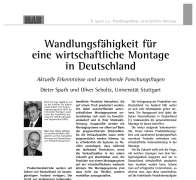
Mutability for a Profitable Assembly in Germany

Mutability for a Profitable Assembly in Germany

Aktuelle Erkenntnisse und anstehende Forschungsfragen
Dieter Spath, Oliver Scholtz
The trend of shifting abroad personnel-intensive mounting from Germany to foreign countries continues. The assembly systems widely differ in investment demand and in output. Since the sales figures can hardly be reliably forecasted any more, it is a necessity to construct extreme flexible systems which can be exchanged by more economical solutions, even when the production has already started and we know reliable sales figures and more reliable prognoses.
Industrie Management | Volume 23 | 2007 | Edition 2 | Pages 61-64
1 2 3