knowledge management

New Modes of Learning in Industrial Production

New Modes of Learning in Industrial Production

Personelle, technische und organisatorische Anforderungen an arbeitsplatzintegriertes Lernen mit digitalen Medien
Stefan Welling, Sebastian Freith, Carsten Ullrich, Glenn Schütze
Today’s in-house training faces the challenge an increasing demand for work expertise against the background of a continuing reduction of staff. This paper describes how companies can meet these challenges supported by a technology-enhanced approach. A central part of the solution is an intelligent-adaptive learning system that allows employees to create learning media while solving operational challenges and, at a later time to access these media, adapted to their individual needs. The article outlines the main human, technical and organizational requirements that an integration of such an adaptive digital learning and assistance system into a company faces.
Industrie 4.0 Management | Volume 32 | 2016 | Edition 3 | Pages 7-10
Knowledge and Competencies in a Digitalized Working Environment

Knowledge and Competencies in a Digitalized Working Environment

Herausforderungen und Unterstützungshilfen für kleine und mittlere Unternehmen
Theresa Myskovszky von Myrow, Gordon Lemme, Hendrieke Stiller, Oleg Cernavin
The increasing digitalization of the working environment has significantly influenced the dynamics of almost all sectors. It is responsible for fundamental changes of surrounding conditions and poses new challenges to organizations. New knowledge and new competencies have to be accumulated in ever shorter intervals. The directed selection, utilization and development of relevant knowledge and required competencies have to be planned and realized systematically. Within a research project, funded by the Federal Ministry for Labour and Social Affairs (BMAS), a self-assessment tool has been developed that is meant to support organizations in dealing with the critical success factors knowledge and competencies. The presentation of this tool is objective of the article at hand.
Industrie Management | Volume 31 | 2015 | Edition 3 | Pages 78-80
IT-Supported Knowledge Management in Global Engineering

IT-Supported Knowledge Management in Global Engineering

Herausforderung Engineer-to-Order
Olga Willner, Stefan Weber, Alexander Eck, Paul Schönsleben
As a consequence of globalized markets product development and engineering functions increasingly work in globally distributed teams. To overcome challenges of global engineering processes, leading companies employ IT applications for storing knowledge centrally and accessing it locally. Typical IT applications however are not sufficient for engineer-to-order products, i.e. products that are engineered and built to the particular specifications of a customer. This paper explores on the example of a large elevator manufacturer how knowledge-intensive tasks can be coordinated and executed globally, efficiently combining the distinct capabilities of distributed engineering sites.
Industrie Management | Volume 30 | 2014 | Edition 4 | Pages 49-52
Humans Develop Potential for New Technologies

Humans Develop Potential for New Technologies

30 Years History of Industry
Klaus Henning, Ursula Bach
Which sustainable industrial developments remain to having shaped and changed our work in industry and production? If we look back, experience has shown that it is neither possible to develop fully automated factories nor to conserve all human knowledge by means of huge databases. These formerly trendsetting ideas are now outdated. But what we have learned from the failure of these ideas is a useful concept of the so-called HOT approach: First Human, Second Organization and Third Technology. This way, human knowledge and potential in combination with adequate organization can lead to technical innovation. At present, the challenge is to transfer this concept to recent and future ideas, such as the fully automated car or the change to the use of renewable energy sources. Thus, it should be taken into account that technical innovation must always include human and organizational aspects to be truly sustainable.
Industrie Management | Volume 30 | 2014 | Edition 1 | Pages 19-21
Knowledge Management in Small and Medium-Sized Enterprises in Contract Logistics

Knowledge Management in Small and Medium-Sized Enterprises in Contract Logistics

Ouelid Ouyeder, Judith Arnold, Frank Straube
Knowledge management can be an important competitive advantage for many companies. Small and medium-sized enterprises (SMEs), which often have limited access to capital. The challenge in contract logistics is to identify an appropriate knowledge management approach. In particular, the process of proposal preparation is characterized by a high complexity and intensity of specific knowledge. This article presents a knowledge management approach for the tender preparation process of SME in contract logistics.
Industrie Management | Volume 29 | 2013 | Edition 3 | Pages 66-68
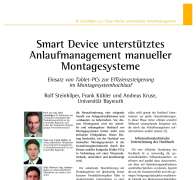
Smart Device Supported Ramp-Up Management in Assembly Systems with Versatile Production

Smart Device Supported Ramp-Up Management in Assembly Systems with Versatile Production

Rolf Steinhilper, Frank Kübler, Andreas Kruse Bayreuth
Due to a growing amount of complexity and variants as well as shrinking product life cycles industrial companies meet the challenge to handle a high number of production ramp-ups. Within this context, a fast and smooth ramp-up of assembly systems is becoming more and more a critical success factor. This article describes how smart devices combined with a predictive knowledge database can support and speed up the ramp-up of manual assembly systems in capital goods industries.
Industrie Management | Volume 28 | 2012 | Edition 4 | Pages 25-28
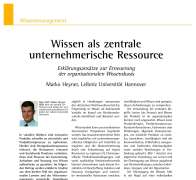
Knowledge as Focal Entrepreneurial Capabilities?

Knowledge as Focal Entrepreneurial Capabilities?

Marko Heyner
In volatile markets firms must be able to develop products faster and streamline production. Processes of reorganization to renew resources and routines are relevant, especially processes of knowledge generation, absorption and exploitation. Therefore this article develops wellestablished approaches to organizational learning and knowledge management. The foundations and commonalities of these approaches are presented and practical implications are discussed.
Industrie Management | Volume 28 | 2012 | Edition 3 | Pages 30-34
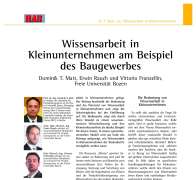
Knowledge Work in Small Enter-prises of the Building Sector

Knowledge Work in Small Enter-prises of the Building Sector

Dominik T. Matt, Erwin Rauch, Vittorio Franzellin
The rising demand and availability of knowledge contributes to the change away from an industrial society towards a more knowledge oriented society. This article focuses on knowledge work in small enterprises. The article describes the importance and the potential of know-ledge work in small enterprises and demonstrates the difficulties in the implementation. The small structured building industry with its change towards a more and more knowledge intensive branch of business over the last years was chosen as an example to explain this approach. In a systems-theoretical model the authors describe an approach to make the application of knowledge work in small enterprises of the building sector possible.
Industrie Management | Volume 28 | 2012 | Edition 3 | Pages 21-24
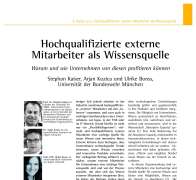
High-Qualified Contractors as Knowledge Source

High-Qualified Contractors as Knowledge Source

Why and how firms can profit from them
Stephan Kaiser, Arjan Kozica, Ulrike Bonss
If you met an engineer in a R&D department some years ago, he was supposed to be an employee of the firm. However, today, as firms have started to contract out there is an increasing number of high-skilled contractors working side by side with employees in core areas of the firm, e.g. in R&D. A reason which is often cited for this development is the flexibility advantage of using contractors. However, high-skilled contractors can also be a valuable source of new know-ledge and innovation. They can support a firm by recognizing technological trends, absorbing new knowledge and generating innovative products. In this paper we would like to illustrate how contractors can be an important knowledge source and what processes underlie the integration of the contractors’ knowledge. Our paper is based on empirical studies from a long-term research project funded by the German Federal Ministry of Research and Education.
Industrie Management | Volume 28 | 2012 | Edition 3 | Pages 79-82
Assistant for Reliable Configurations of Robot Units

Assistant for Reliable Configurations of Robot Units

Christian Peemöller, Roman Korf, Gerd Grube, Christian Mankopf
The rise of the complexity of products and the product development process in addition to shorter development cycles and the customers’ high demands on quality, increase the pressure on producing as accurately and economically as possible. Hence, it is necessary to avoid errors in the early phases of development instead of fixing them at a later stage, which can be costly. This article uses the product configuration of milling robot units to show an innovative solution for the early development phase. This approach uses established technologies from the area of semantic technologies and problem solving methods. It also shows how to improve the reliability of product configuration by making use of the expertise from later phases in the development.
Industrie Management | Volume 27 | 2011 | Edition 5 | Pages 37-40
1 2 3 6