Fabrikplanung

Energy Efficiency as a Premise for Planning

Energy Efficiency as a Premise for Planning

Ressourcen- und Kostenoptimierung durch eine energieeffizienzorientierte Fabrikplanung
Jörg Engelmann, Jörg Strauch, Egon Müller
The article presents an approach for the integration of the energy efficiency in factory planning processes. The main focus is not on the constructional hull but rather on the energy-efficient designing of production processes and production plants. The approach is of general validity but in the present example it is applied to the automotive industry. Main contents of the approach are aimed at the life cycle consideration of production plants.
Industrie Management | Volume 24 | 2008 | Edition 3 | Pages 61-63
Digital Factory Supports Planning of Final Assembly

Digital Factory Supports Planning of Final Assembly

Thorsten Vollstedt, Steffen Körner
Production planning within the Mercedes Car Group is challenged by reduction of development times while increasing the product portfolio and quality. New approaches were necessary to implement the factorys needs into the product development as early as possible. 5 Years ago the Digital Factory was founded to secure that no production is started without a digital validation of product, production process and tools. Today the final assembly planning at DaimlerChrysler follows an integrated workflow of final assembly, Logistics and facility planning.
Industrie Management | Volume 23 | 2007 | Edition 5 | Pages 60-62
Mutability for a Profitable Assembly in Germany

Mutability for a Profitable Assembly in Germany

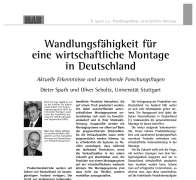
Aktuelle Erkenntnisse und anstehende Forschungsfragen
Dieter Spath, Oliver Scholtz
The trend of shifting abroad personnel-intensive mounting from Germany to foreign countries continues. The assembly systems widely differ in investment demand and in output. Since the sales figures can hardly be reliably forecasted any more, it is a necessity to construct extreme flexible systems which can be exchanged by more economical solutions, even when the production has already started and we know reliable sales figures and more reliable prognoses.
Industrie Management | Volume 23 | 2007 | Edition 2 | Pages 61-64
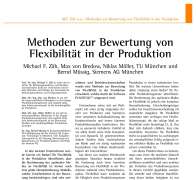
Methods for Flexibility Evaluation in Production

Methods for Flexibility Evaluation in Production

Michael F. Zäh, Max von Bredow, Niklas Möller, Bernd Müssig
Most enterprises have identified the need for flexibility, but the selection of the right degree of flexibility is a complex task. Sophisticated methods, which consider uncertainties in the valuation model, are time consuming and require a supporting software tool. The existing ones are applicable for very specific planning tasks only. In this paper, a methodology to support the valuation of manufacturing flexibility and PLANTCALC™, a supporting software tool, are presented. Both have been developed in a joint research project of the Institute for Machine Tools and Industrial Management and the Siemens AG.
Industrie Management | Volume 22 | 2006 | Edition 4 | Pages 29-32
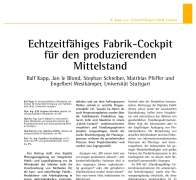
Real Time Factory Cockpit for Medium-Sized Businesses

Real Time Factory Cockpit for Medium-Sized Businesses

Ralf Kapp, Jan le Blond, Stephan Schreiber, Matthias Pfeffer, Engelbert Westkämper
This technical contribution presents a digital planning environment for an integrated facility layout and logistics planning. The aim is a noticeable reduction of time and effort for middle- and long-term facility planning and production planning. Therefore current data from the shop floor and order management are provided in an object-oriented consistent digital structure. This data is used to forecast the need for action and to deduct alternative solutions. Planning becomes more effective, long-term planning tasks become day-to-day activities so that the flexibility of the enterprise increases.
Industrie Management | Volume 22 | 2006 | Edition 2 | Pages 49-52
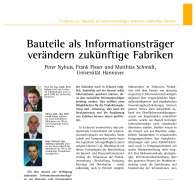
Components as an Information Carrier Change Future Factories

Components as an Information Carrier Change Future Factories

Peter Nyhuis ORCID Icon, Frank Fisser, Matthias Schmidt
Current information technologies like bar codes or transponders offer an enormous potential to logistics of producing companies. But with these technologies the provision of information on processes or components along the value-adding chain is neither possible in real-time nor consistently. Future components should be able to store information on themselves, so that additional transponders are no longer required. This opens up new possibilities for a real-time production planning and control as well as for the segmentation and planning of factories.
Industrie Management | Volume 22 | 2006 | Edition 1 | Pages 19-22
Market Survey of Consulting Firms Specialized in Factory Planning

Market Survey of Consulting Firms Specialized in Factory Planning

Katja Andresen, Norbert Gronau ORCID Icon
The article highlights the current challenges factory planning is facing in the realm of changeability and the creation of flexible structures, which adapt to changing market environments. IM has conducted a survey among factory planning companies and provides the results as well as annotating remarks in this report.
Industrie Management | Volume 20 | 2004 | Edition 4 | Pages 61-69
1 3 4