electric vehicles

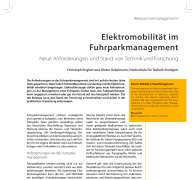
Electric Mobility in Fleet Management

Electric Mobility in Fleet Management

New requirements and state of the art in technology and research
Christoph Englert, Dieter Uckelmann ORCID Icon
The requirements for fleet management have grown significantly over the last few years due to the development of telematics systems, car sharing and electric. Especially electric vehicles add new requirements for the management of a fleet. Therefore, fleet management needs to be adjusted, extended, or even re-designed.
Industrie Management | Volume 31 | 2015 | Edition 4 | Pages 21-24
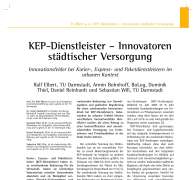
CEP Service Providers – Innovators of Urban Supply

CEP Service Providers - Innovators of Urban Supply

Innovationsfelder bei Kurier-, Express- und Paketdienstleistern im urbanen Kontext
Ralf Elbert, Armin Bohnhoff, Dominik Thiel, Daniel Reinhardt, Sebastian Will
Courier, express and parcel service providers (CEP service providers) have a crucial importance for the economy by handling flows of goods between businesses and private households. Challenges such as the increasing online sales, tighter delivery time requirements and growing competition along with the higher importance of environmental issues and political regulation result in an increased pressure to innovate in the CEP industry. Especially in urban areas various fields of innovation can be identified which can contribute to a more cost-efficient and environmentally friendly supply of companies and households in the city.
Industrie Management | Volume 30 | 2014 | Edition 4 | Pages 21-24
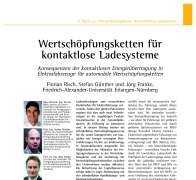
Value Chains for Wireless Charging Systems

Value Chains for Wireless Charging Systems

Konsequenzen der kontaktlosen Energieübertragung in Elektrofahrzeuge für automobile Wertschöpfungsketten
Florian Risch, Stefan Günther, Jörg Franke
Due to their considerable advantages, wireless charging systems have the potential of becoming the key market driver for electric vehicles. In addition to their large potentials there are new demands concerning cost reduction of the necessary components and the associated production networks in the automotive industry which must be addressed early on. Therefore, it is the aim of this paper to present the value chains for the new components from suppliers to final assembly lines. The possibilities of allocating the manufacturing processes in the supply chain and the interfaces between the companies are discussed. The consideration of the logistics processes is also done with regards to the appropriate handling and assembly technology.
Industrie Management | Volume 28 | 2012 | Edition 5 | Pages 45-48
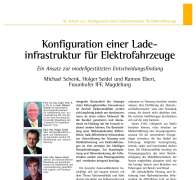
Configuration of  a Charging Infrastructure for Electric Vehicles

Configuration of a Charging Infrastructure for Electric Vehicles

Ein Ansatz zur modellgestützten Entscheidungsfindung
Michael Schenk, Holger Seidel, Ramon Ebert
Drive-train electrification intended to create sustainable mobility by enhancing efficiency and identifying supplements and alternatives to crude oil is integral to many vehicle manufacturers’ strategies. However, innovations in the field of electromobility, i.e. mobility rendered possible by electrically powered vehicles, will only establish themselves when they generate genuine value added for customers and are environmentally compatible. Thus, cost effective configuration of a ubiquitous (public, semi-public) infrastructure that supports the use and market launch of electric vehicles constitutes one of the key challenges and will necessitate support from new planning approaches and models.
Industrie Management | Volume 26 | 2010 | Edition 6 | Pages 53-56