efficiency

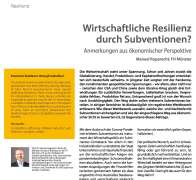
Wirtschaftliche Resilienz durch Subventionen?

Wirtschaftliche Resilienz durch Subventionen?

Anmerkungen aus ökonomischer Perspektive
Manuel Rupprecht
The world economy is under tension. For years now, globalization has been faltering, moving sideways at best. Recent developments have caused additional distortions. There is now a strong desire for independence. In many places, subsidies are supposed to pave the way for this. In some areas, a veritable competition has broken out in this regard. Even if this is understandable from a political point of view, from an economic perspective the disadvantages of such a competition outweigh the benefits.
Industrie 4.0 Management | Volume 39 | 2023 | Edition 4 | Pages 16-20 | DOI 10.30844/IM_23-4_16-20
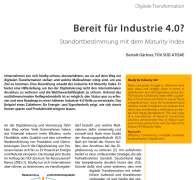
Ready for Industry 4.0?

Ready for Industry 4.0?

Standortbestimmung mit dem Maturity Index
Bertolt Gärtner
Many companies struggle to determine their own status and strategy when it comes to digitalization and self-organizing production. The Industry 4.0 Maturity Index offers a guideline in this process and helps to ensure future competitiveness. Using the multidimensional maturity model, companies can evaluate their status-quo and develop a roadmap to accelerate their digital development. The case study of a manufacturer of electrical connectivity solutions demonstrates how to reduce costs and increase productivity with the help of the Industry 4.0 Maturity Index.
Industrie 4.0 Management | Volume 34 | 2018 | Edition 1 | Pages 59-62
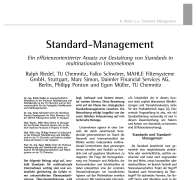
Standard-Management – An Efficiency-Oriented Approach for the Design and Control of Standards in Multinational Enterprises

Standard-Management - An Efficiency-Oriented Approach for the Design and Control of Standards in Multinational Enterprises

Ein effizienzorientierter Ansatz zur Gestaltung von Standards in multinationalen Unternehmen
Ralph Riedel ORCID Icon, Falko Schwörer, Marc Simon, Philipp Ponton, Egon Müller
The paper highlights the importance of standards and standardisation especially for multinational enterprises. At the same time the threat of a not adequately reflected over-standardisation is recognised which is tied to risks like transaction costs and “idle power”. In the paper it is discussed to what extend it is possible to evaluate standards and standardisation in multinational enter- prises in terms of effort and benefits. This evaluation is anchored within a concept of standard management at a strategic level.
Industrie Management | Volume 25 | 2009 | Edition 4 | Pages 61-64
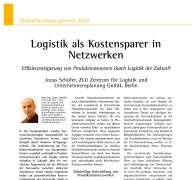
Increasing Efficiency in Production Networks with Future Logistics

Increasing Efficiency in Production Networks with Future Logistics

Effizienzsteigerung von Produktionsnetzen durch Logistik der Zukunft
Jonas Schöfer
Industrial companies as well as small and medium sized enterprises engage themselves more and more in international production networks. Each networkpartner aims on building and maintaining business relationships to the best partner for any specific task. This leads to an increasing amount of goods being transported from partner to partner and leads to an immense logistics effort. These logistics tasks are responsible for major cost blocks in most companies. Organisations will have to react to the increasing demand for on time delivery with organisational as well as technological solutions to maintain their competitive advantage.
Industrie Management | Volume 22 | 2006 | Edition 1 | Pages 44-46
Value Added Management in a Virtual Supply Chain Organization (VISCO)

Value Added Management in a Virtual Supply Chain Organization (VISCO)

Herwig Dullnig
Planning and organising of value added processes can be optimized by supply chain management. Therefore, creating a virtual supply chain organization (VISCO) is suggested. The main tasks are building up a specific organization for the collaboration, applying modern information and communication technologies, and implementing innovative logistics systems in the VISCO. Furthermore, it is necessary to harmonize the different plans of the companies involved. With the help of a special value added management in the VISCO it is possible to improve the effectiveness and efficiency of the value added process significantly.
Industrie Management | Volume 20 | 2004 | Edition 5 | Pages 51-54