Cyber-Physical Systems

Functions of Production Planning in the Context of Industrie 4.0

Functions of Production Planning in the Context of Industrie 4.0

Thorben Kuprat, Jonas Mayer, Peter Nyhuis ORCID Icon
In today’s production systems the functions of production planning and control (PPC) have a significant impact on an efficient performance of production processes. The decisive interface between the prognosis based planning and its operative realization can be seen in the exchange of plan data and production feedback data. It is to be expected that developments in the context of Industrie 4.0 lead to an increase in data quality and actuality. Based on these improvements improved production planning results can be achieved. In the present paper the main functions of production planning will be discussed in detail and their development potential with regard to Industrie 4.0 will be pointed out.
Industrie Management | Volume 31 | 2015 | Edition 2 | Pages 11-14
Intelligent Controlling of Logistics Networks

Intelligent Controlling of Logistics Networks

Frank Straube, Daniel Roy, Jan Reipert
Cyber-Physical Systems and the internet of things change the way we see management, production and even logistics processes. The research project “Smart Logistic Grids” uses a decentralized cloud-based management concept to reduce the risk of disruptions in logistics networks.
Industrie Management | Volume 30 | 2014 | Edition 6 | Pages 39-42
Supporting Maintenance with Socio-Cyber-Physical Systems

Supporting Maintenance with Socio-Cyber-Physical Systems

„Ressourcen-Cockpit für Sozio-Cyber-Physische Systeme“ vernetzt den mobilen Mitarbeiter in der Instandhaltung
Ullrich Trommler, Sebastian Horbach, Angelika C. Bullinger-Hoffmann, Thomas Löffler, Egon Müller, Hendrik Hopf
Maintenance is an important factor for the effectiveness of production processes. As the degree of automation and interoperation of production equipment is increasing, the significance of equipment availability and thus of maintenance is increasing. At the moment, maintenance and service engineers spend a lot of time in retrieving and preparing information. In many cases the data of business information systems is not or only partly available to maintenance engineers. In the future, resource-cockpits on mobile devices will provide maintenance and service engineers with all necessary information in situ. This will be realised interactively, with little effort and in the right context.
Industrie Management | Volume 30 | 2014 | Edition 6 | Pages 51-54
Value-Oriented Information Flows for Industry 4.0

Value-Oriented Information Flows for Industry 4.0

Kernprozesse und Gestaltungsvariablen
Dieter Uckelmann ORCID Icon
Value Stream Mapping has been applied successfully in production and logistics scenarios. With the rise of Cyber-Physical Systems (CPS) in the context of Industry 4.0, the value-contribution of information itself is gaining importance. Therefore, the concept of Value Stream Mapping is extended to the field of information logistics. Key-processes and design variables are defined.
Industrie Management | Volume 30 | 2014 | Edition 6 | Pages 13-16
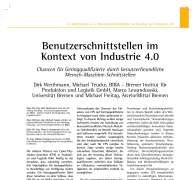
Human Machine Interfaces in the Context of Industrie 4.0

Human Machine Interfaces in the Context of Industrie 4.0

Chancen für Geringqualifizierte durch benutzerfreundliche Mensch-Maschine-Schnittstellen
Dirk Werthmann, Michael Teucke, Marco Lewandowski, Michael Freitag ORCID Icon
The number of cyber-physical systems (CPS) in industrial environments is growing based on the effort of projects like Industrie 4.0. CPS offer the potential to improve processes in modern value networks. By improving processes, especially jobs with no demand for qualified workers can be dispensed. Another effect are jobs being standardised, that they become very monotonous for the workers. For providing satisfying jobs especially for low qualified workers in future working environments some opportunities CPS offer were presented. First opportunities consumer devices offer were presented, second concepts for user-friendly human machine interfaces were illustrated.
Industrie Management | Volume 30 | 2014 | Edition 4 | Pages 39-44
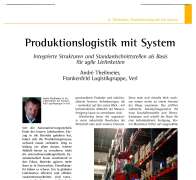
Systematic Logistics for Production

Systematic Logistics for Production

Integrierte Strukturen und Standardschnittstellen als Basis für agile Lieferketten
André Theilmeier
Automation technology moved into factories by the end of last century. Since then, production processes have changed dramatically worldwide. While companies first focused on optimizing interdepartmental collaboration, today the cross-company collaboration increasingly comes into focus. After all, in a globalized economy companies need to operate in networks. In order to cooperate efficiently and effectively in global supply chains, transparent structures and standards are indispensable. This applies first and foremost to the logistics.
Industrie Management | Volume 30 | 2014 | Edition 1 | Pages 59-62
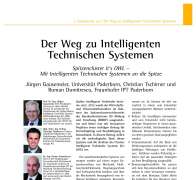
Intelligent Technical Systems OstWestfalenLippe

Intelligent Technical Systems OstWestfalenLippe

Mit Intelligenten Technischen Systemen an die Spitze
Jürgen Gausemeier, Christian Tschirner, Roman Dumitrescu ORCID Icon
The leading-edge Cluster Intelligent Technical Systems OstWestfalenLippe (it’s OWL) focuses on the innovation leap from mechatronics to systems with inherent intelligence. Within this paper we explain the technological evolution and its drivers for such intelligent technical systems. This leads to a technological concept which has been chosen as basis for the leading-edge cluster’s technology platform. Finally we present the cluster’s structure and its projects.
Industrie Management | Volume 29 | 2013 | Edition 1 | Pages 49-52
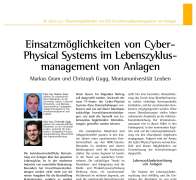
Life Cycle Management of Physical Assets

Life Cycle Management of Physical Assets

Possible applications of cyber-physical systems
Markus Gram, Christoph Gugg
The economic analysis of physical assets over the entire life cycle is essential in modern industry. Particularly, in investment decisions, not only the pure expenditure for the procurement is used. Life cycle costing considers the required investments of a production site’s life cycle as a whole. In order to reduce the life cycle costs it is necessary to identify, analyze and derive corresponding measures. In practice, the data tracking over several periods is challenging. The following paper shows how the new IT approach of cyber-physical systems can improve such data collection. Furthermore, it will be shown how this database supports future investment decisions as well as the selection of life cycle support services.
Industrie Management | Volume 29 | 2013 | Edition 1 | Pages 39-43
Development of a Cyber-Physical Logistics System

Development of a Cyber-Physical Logistics System

Marius Veigt, Dennis Lappe, Karl Hribernik, Bernd Scholz-Reiter ORCID Icon
Along with increasing complexity and dynamics the importance of cyber-physical systems in production and logistics also increases. Hence, the BIBA - Bremer Institut für Produktion und Logistik GmbH at the University of Bremen considers the application of cyber-physical systems in logistics. This paper presents the approach for the development of a cyber-physical logistics system. To start we describe the fundamental terms cyber-physical system and cyber-physical production system. Following these definitions we explain the term cyber-physical logistics system. Afterwards we describe the course of action; in particular necessary steps within the development of a cyber-physical logistics system are explained. In detail we present the procedure consisting of requirements analysis, conception and simulation-based evaluation.
Industrie Management | Volume 29 | 2013 | Edition 1 | Pages 15-18
Software Platforms for the Upcoming Industry 4.0

Software Platforms for the Upcoming Industry 4.0

Requirements and Challenges
Arne Schuldt, Jan Gehrke
The fourth industrial revolution promises a further automation of process control by cyber-physical systems. The individual products gain the ability for controlling their production and logistics themselves. By coordinating themselves they can jointly achieve business objectives. This logical decomposition reduces the complexity of cross-company process control significantly. Thus, even exceptions on short notice can be dealt with in real-time. In operation, the required artificial intelligence will usually not be implemented on the active objects. Instead, adequate software platforms for the so-called Industry 4.0 are required. This article investigates the requirements for such platforms and describes how they can be implemented.
Industrie Management | Volume 29 | 2013 | Edition 1 | Pages 29-32
1 2 3