Cyber-Physical Systems

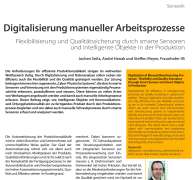
Digitization of Manual Manufacturing Processes

Digitization of Manual Manufacturing Processes

Flexibility and Quality Assurance through Smart Sensors and Smart Objects in Production
Jochen Seitz, André Hanak, Steffen Meyer
Requirements for efficiency in manufacturing processes are steadily increasing in global competition. Through digitization and data analytics, not only efficiency but also flexibility and quality are to be increased. Cyber-physical systems, which use smart sensors and communication with manufacturing systems to independently identify, document and control process steps, can help solve this problem. These can be attached to many types of tools and thus also capture manual work processes. This article shows how a smart object with communication and positioning functionality accompanies a product to be manufactured through the manufacturing process and how e.g. manual screwing processes are recorded and analyzed by smart sensors.
Industrie 4.0 Management | Volume 34 | 2018 | Edition 4 | Pages 19-22
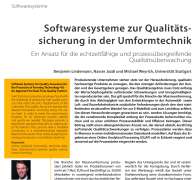
Real-Time Quality Control

Real-Time Quality Control

Software systems for quality assurance for the processes of forming technology 4.0
Benjamin Lindemann, Nasser Jazdi, Michael Weyrich
Solid forming companies are always faced with the challenge of producing high-quality products that meet the strict requirements of the customers. The quality has to be reproducible despite fluctuations occurring along the value chain. In order to meet the requirements, solutions for an improved process stability and quality are needed. This paper presents a data-driven approach that aims to adapt quality fluctuations. Thus, process data is modeled in-memory in a multidimensional database. Based on the results of an online analytical processing, the process is controlled in real-time.
Industrie 4.0 Management | Volume 33 | 2017 | Edition 6 | Pages 20-24
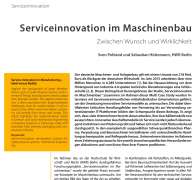
Service-Innovation in Manufacturing

Service-Innovation in Manufacturing

Ideal versus Reality
Sven Pohland, Sebastian Hüttemann
Against the background of latest developments such as Cyber-Physical Systems and Internet of Things, manufacturers need to adapt their business models. This digital transformation is often associated with implementation challenges, even for market leaders. It will require further efforts and time before customers will benefit from these new trends. This article highlights the implementation reality in German and Swiss mechanical engineering companies, based on a multi-case study with examples from pharma, packaging and construction industry.
Industrie 4.0 Management | Volume 33 | 2017 | Edition 4 | Pages 48-52
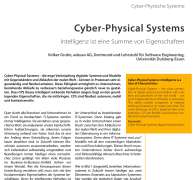
Cyber-Physical Systems: Intelligence is a Sum of Characteristics

Cyber-Physical Systems: Intelligence is a Sum of Characteristics

Intelligenz ist eine Summe von Eigenschaften
Volker Gruhn
Cyber-Physical Systems - the close connection of digital systems and models with subjects and processes of the real world - can work independently and flexibly in processes. This ability enables companies to improve existing processes or to create new ones. The smart behaviour of CPS is based on their characteristics. CPS are flexible, autonomous, mobile and context-sensitive.
Industrie 4.0 Management | Volume 32 | 2016 | Edition 6 | Pages 7-11
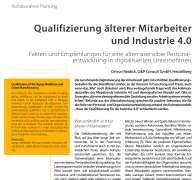
Qualification of the Aging Workforce and Smart Manufacturing

Qualification of the Aging Workforce and Smart Manufacturing

Fakten und Empfehlungen für eine alternssensible Personal-entwicklung in digitalisierten Unternehmen
Ortrun Reidick
According to the competency model of aging, aging workforces can be considered an asset that needs to be addressed with a life-span oriented human resources development. Correspondingly, qualification of older workers for cyber-physical systems is not a contradiction if relevant topics such as an approving organizational culture of age diversity, age management leadership skills and the specific learning conditions are considered. The possible win-win effects of older workers in a smart manufacturing setting are discussed and embedded in a framework model for smart learning.
Industrie 4.0 Management | Volume 32 | 2016 | Edition 3 | Pages 58-61
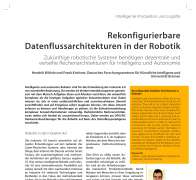
Reconfigurable Dataflow Architectures in Robotics

Reconfigurable Dataflow Architectures in Robotics

Zukünftige robotische Systeme benötigen dezentrale und verteilte Rechenarchitekturen für Intelligenz und Autonomie
Hendrik Wöhrle, Frank Kirchner
Intelligent and autonomous robots are an essential part of the development of industry 4.0 solutions. They will act as a direct interaction partner to humans together in teams and perform works that are much more complex than today‘s typical tasks for industrial robots. Such robots need to deal with a confusing and unpredictable environment and have to react to unforeseeable events. In order to capture this environment and to plan actions, real-time processing of complex sensor information is necessary. Conventional computer architectures appear to be insufficient for such kind of tasks. To solve this problem, hardware accelerators for robotics based on the dataflow paradigm are developed at the Robotics Innovation Center of the German Research Center for Artificial Intelligence.
Industrie 4.0 Management | Volume 32 | 2016 | Edition 2 | Pages 25-28
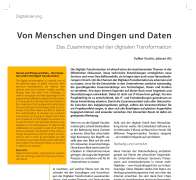
Human and Things and Data – the Interaction within the Digital Transformation

Human and Things and Data - the Interaction within the Digital Transformation

Das Zusammenspiel der digitalen Transformation
Volker Gruhn
The digital transformation is currently one of the defining topics in public discourse. New technical developments are making new services and new business models possible, though they also entail new challenges. In order to recognize and take advantage of the opportunities offered by digital transformation, it is necessary for corporate decision-makers to first understand the fundamental relationships that exist between technologies, data and customers. Only then experts are able to build on this understanding to develop new products and services. Such projects require more than just IT expertise. For the project to succeed, it is crucial that the IT and specialist divisions work together on this development. In order for the collaboration to succeed in spite of all the differences between the divisions’ remits, those in charge should ensure that the project environment is one in which all participants are able to interact on an equal footing and understand one another. The ...
Industrie 4.0 Management | Volume 32 | 2016 | Edition 2 | Pages 62-65
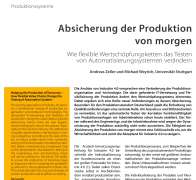
Hedging the Production of Tomorrow

Hedging the Production of Tomorrow

How Flexible Value Chains Change the Testing of Automation Systems
Andreas Zeller, Michael Weyrich
The existing approaches of Industry 4.0 promise a fundamental change of production organisation and production technologies. The demanded IT-networking and flexibility of production change the value creation process elementary. Hence, there are new requirements emerging to ensure the process. Especially, for the German industry, the adherence of quality requirements is the key factor in being competitive. According to the state of the art, to reduce system down time, systematic testing of the functionality of production facilities before commissioning is employed. Due to the dynamization of production, testing in the engineering and commissioning phase will not be sufficient in the future. The ability to ensure the production of tomorrow plays an important role in increasing the profitability, and with it, the acceptance for Industry 4.0. This article describes the structural changes of a smart production and its effects on testing.
Industrie Management | Volume 31 | 2015 | Edition 6 | Pages 36-38
Flexible Production Systems in Practice

Flexible Production Systems in Practice

Ulrich Berger, Thomas Creutznacher, Raffaello Lepratti, Steffen Lamparter
Germany is known to have a very powerful and highly competitive industrial sector. In this context, the manufacturing sector accounts for around 50 % of German exports and is facing a variety of new challenges like an increasing international competitive pressure, more complex value adding networks and more volatile markets [1]. Constant innovation is going to be required and therefore flexible production systems are increasingly gaining in importance. This article discusses the results of a collaborative industry survey about flexible production systems, which have been conducted in the context of the European research project cPAS. On this basis, requirements and potential of an increasing horizontal integration between companies and production planning / runtime systems are discussed.
Industrie Management | Volume 31 | 2015 | Edition 6 | Pages 24-27
Labour Organization of Maintenance in Cyber-Physical Systems

Labour Organization of Maintenance in Cyber-Physical Systems

Hubert Biedermann
The increased application of Cyber-Physical Systems (CPS) in production and manufacturing sector increases the demand on functional safety and reliability. Maintenance is responsible to ensure the availability of resources. In this context the question is, which Labour Organization and maintenance philosophy can be achieved in economic terms. It is important to know what type of four typical organization variants are to be preferred in short, medium and long term. The relative comparison is carried out taking into account different organization forms to the achievement of objectives. The selected set of objectives is taken into account for CPS typical effectiveness and efficiency dimensions.
Industrie Management | Volume 31 | 2015 | Edition 3 | Pages 45-48
1 2 3