customer integration

Transforming Customer Impulse into Procurement Action

Transforming Customer Impulse into Procurement Action

How digital twins strengthen customer orientation in supply management
Dominik Oehlschläger, Andreas H. Glas, Michael Eßig
Supply management provides an organization with the resources that it needs but does not produce itself. However, intraorganizational needs are not isolated. They ultimately serve to fulfill the demands of external (end) customers. Traditionally, supply management receives information from its internal customers, i.e. from other functional areas such as production planning, logistics, or marketing. Information on (end) customer demands reaches supply management, if at all, indirectly via these other functional areas, which often pass on information after interpreting it. This article discusses how digital twins of (end) customer demands can provide all functional areas with precise, near-real-time data.
Industry 4.0 Science | Volume 41 | Edition 3 | Pages 118-124
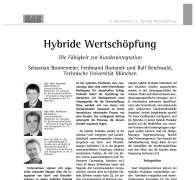
Hybrid Value Creation  The Capability for Customer Integration

Hybrid Value Creation The Capability for Customer Integration

Sebastian Bonnemeier, Ferdinand Burianek, Ralf Reichwald
Integrating products and services to customized hybrid products can help firms to differentiate from their competitors. The essential value proposition of such bundled offerings can comprise usage-based selling (e.g. of machines) combined with guaranteed availability or the operation of customers’ complex production factors such as a complete assembly line. Operational efficiency is no longer sufficient for achieving long term success with hybrid products. Rather it is the way of interaction with customers which provides new opportunities for value creation. In the context of hybrid products the way of creating value for customers changes from a purely transactional view to a relational process. Accordingly, this paper addresses this change from a process-oriented perspective.
Industrie Management | Volume 25 | 2009 | Edition 2 | Pages 29-32
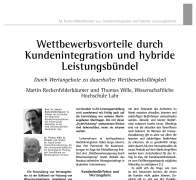
Customer Integration and Hybrid Products

Customer Integration and Hybrid Products

Durch Wertangebote zu dauerhafter Wettbewerbsfähigkeit
Martin Reckenfelderbäumer, Thomas Wille
The development of value propositions is key for leverage technological intelligence. Meaningful and sustaining attributes for differentiation are able to contribute significantly to long term growth if they are based on a value oriented business model. Well known from Service Industries, customer integration could be applied to other industries for product development, too. Associated risks can be detected and subsequently managed.
Industrie Management | Volume 24 | 2008 | Edition 5 | Pages 29-32
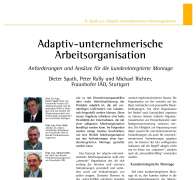
Customer-Integrated Assembly

Customer-Integrated Assembly

Requirements of an adaptive-business work organization
Dieter Spath, Peter Rally, Michael Richter
The reduction in staff (production jobs) in Germany must lead to new concepts. It must be possible to built economic production at the “location D”. This can be new offers for customers, how it is possible with more individualizing products, which can be manufactured with reasonable delivery times only near the customer. Or the upgrading of products by linkage with services, how e.g. some service models try it. All these new offers require however a high flexibility of the enterprises, which can be mastered only with an adequate work organization. In the following some methods and ideas are described, how a flexible work organization from the requirements of a customer-integrated assembly can be arranged.
Industrie Management | Volume 22 | 2006 | Edition 1 | Pages 27-30