configuration

Assistant for Reliable Configurations of Robot Units

Assistant for Reliable Configurations of Robot Units

Christian Peemöller, Roman Korf, Gerd Grube, Christian Mankopf
The rise of the complexity of products and the product development process in addition to shorter development cycles and the customers’ high demands on quality, increase the pressure on producing as accurately and economically as possible. Hence, it is necessary to avoid errors in the early phases of development instead of fixing them at a later stage, which can be costly. This article uses the product configuration of milling robot units to show an innovative solution for the early development phase. This approach uses established technologies from the area of semantic technologies and problem solving methods. It also shows how to improve the reliability of product configuration by making use of the expertise from later phases in the development.
Industrie Management | Volume 27 | 2011 | Edition 5 | Pages 37-40
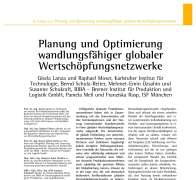
Planning and Optimization of Changeable Global Value Added Networks

Planning and Optimization of Changeable Global Value Added Networks

Gisela Lanza ORCID Icon, Raphael Moser, Bernd Scholz-Reiter ORCID Icon, Mehmet-Emin Özsahin, Susanne Schukraft, Pamela Meil, Franziska Rasp
Due to the concentration of core competences and the utilisation of international location advantages successful German production companies face a situation with globally dispersed sites in global value added networks. The ongoing globalisation, which includes the integration of external sites, suppliers and partners, leads to complex interactions within networks. However, these interactions are not or are simply partially known and not predictable so far. Being able to control dramatic dynamics in the behaviour of global value added networks, German production companies will be positively affected by globalisation in the future. Therefore, changeable global value added networks which can be quickly adjusted to dynamics become crucial. The paper on hand describes an approach for the planning and optimization of adaptable global value added networks. Background is the approach of the research project “planning and optimization of changeable global value added networks” (POWer.net) ...
Industrie Management | Volume 27 | 2011 | Edition 3 | Pages 57-60
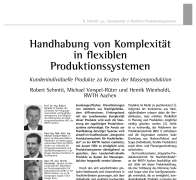
Dealing with Complexity in Flexible Production Systems

Dealing with Complexity in Flexible Production Systems

Customer specific products at mass production costs
Robert Schmitt ORCID Icon, Michael Vorspel-Rüter, Henrik Wienholdt
To compete in the global environment companies in high wage countries have to separate themselves from competitors from low wage countries by offering customer specific products and services. Due to the rising complexity of these products the steering of the corresponding production systems is getting more and more resource consuming. One way to handle this aspect is developed within the Excellence Cluster “Integrative production technology for High-wage countries” at RWTH Aachen University. Objective is the set up of production systems that are able to produce customer specific products at mass production costs.
Industrie Management | Volume 26 | 2010 | Edition 1 | Pages 53-56
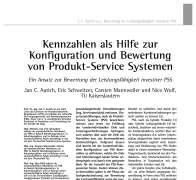
Key Figures for Configuration and Evaluation of Product-Service Systems

Key Figures for Configuration and Evaluation of Product-Service Systems

Ein Ansatz zur Bewertung der Leistungsfähigkeit investiver PSS
Jan C. Aurich, Eric Schweitzer, Carsten Mannweiler, Nico Wolf
Industrial customers are increasingly expecting to be provided with integrated solutions that in addition to a decent physical product comprise diverse services as well. Such solutions, called product-service systems (PSS), have to fulfil both customer individual targets and manufacturer targets. Due to this, manufacturer have to define key figures, which allow to choose the specific configuration of PSS and to measure the performance while it is used. This paper presents an approach for generating key figures for selecting PSS and controlling their performance.
Industrie Management | Volume 24 | 2008 | Edition 5 | Pages 57-60
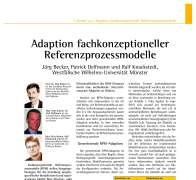
Adaptation of Conceptual Reference Process Models

Adaptation of Conceptual Reference Process Models

Jörg Becker ORCID Icon, Patrick Delfmann, Ralf Knackstedt
Conceptual reference process models (RPM) are used as a basis for the construction of project-specific models and can be seen as best-practice or common-practice solutions of a particular scope. The project specific adaptation of RPM is usually a very complex and costly task. In recent years, different reference modelling methods have been developed that focus on increasing the efficiency of the use of RPM by providing methodical support. Integrating and applying the different concepts of these methods can accomplish these objectives.
Industrie Management | Volume 20 | 2004 | Edition 1 | Pages 19-22
The Digital Product as a Basis for the IT-supported Sales- and Logistic-Process

The Digital Product as a Basis for the IT-supported Sales- and Logistic-Process

Luca Bongulielmi, Patrick Henseler, Ekkehard Zwicker
In the last decade, many factors have changed in the enterprise-environment due to the diversification of the market demand. Enterprises react to the changing situation by offering an increasing number of variants of existing products. A proven valuable attempt is not to deal with short-term measures like designing very customized modules, but to consider the eventual customer requirements already in the first stages of the engineering design process. More- over the engineering design process have to be supported by adaquate IT-tools, in order to manage the data during the development process as well as later during the product life-cycle. This approach can be realised with the Digital Product. This contribution presents the Digital Product and shows the prerequirement of the Digital Product to be fulfiled in the context of the sales process and the product configuration.
Industrie Management | Volume 19 | 2003 | Edition 1 | Pages 17-20