business models

Federated Service Engineering

Federated Service Engineering

A development methodology for the realization of mobility applications in the Gaia-X decentralized data ecosystem
Christoph Heinbach, Michael Pahl, Oliver Thomas
The decentralized data ecosystem Gaia-X, which is currently under development, supports the future viability of the digital data economy in Europe. But how can relevant use cases be realized in Gaia-X from a service-oriented perspective? To answer this question, this article presents a methodology that describes a structured and interdisciplinary approach to service development in the ongoing Gaia-X 4 ROMS consortium research project [1]. In this project, federated services are realized in five processing steps on the basis of use cases. IT experts, software developers and industry users can leverage the model to efficiently coordinate the joint realization of use cases with Gaia-X and the goal of sovereign data exchange.
Industry 4.0 Science | Volume 40 | 2024 | Edition 2 | Pages 40-47
The Next Revolution: Open-Source Hardware?

The Next Revolution: Open-Source Hardware?

Opportunities and challenges of open-source business models
Anna-Kristin Behnert, Melanie Kessler ORCID Icon, Julia Arlinghaus ORCID Icon
Open-source hardware (OSH) is on its way from a grassroots movement to a major social and industrial development. Open product development processes and products promise innovations for new markets and new customers. OSH could be the answer to the question of how the shift to local and sustainable production could look like. To make this possible, essential core questions need to be answered. How can a business model based on openness and exchange make money at all? (Only in German)
Industrie 4.0 Management | Volume 38 | 2022 | Edition 6 | Pages 24-28
Artificial Intelligence for the Future Economy

Artificial Intelligence for the Future Economy

How to develop competitive business models from data
Johannes Winter
Artificial intelligence (AI) and self-learning systems have immense economic potential and are a driving force for digitalisation. Artificial Intelligence is radically changing value chains, business models, and employment in industry. Data-driven services are added to traditional products in almost all industries. Integrating Artificial Intelligence in products and services as well as using data from the production process provides opportunities for new business models in an increasing competitive international environment.
Industrie 4.0 Management | Volume 36 | 2020 | Edition 2 | Pages 43-46
Blockchain Technology and the Internet of Things: Short-Term Hype or a Symbiosis for Novel IoT Business Models?

Blockchain Technology and the Internet of Things: Short-Term Hype or a Symbiosis for Novel IoT Business Models?

Kurzfristiger Hype oder eine Symbiose für neue IoT-Geschäftsmodelle?
Andranik Tumasjan
Blockchain technology - a distributed ledger in which transactions of all kinds of values can be carried out securely, transparently and consensually without trust in a central authority - is a socio-technical innovation that has the potential to enable new business models and make existing business models obsolete. While most applications today exist in the financial sector (e.g., payment processing), the technology is suitable for various industrial applications, especially in the area of Internet of Things (IoT) applications. This article uses three propositions and various concrete examples to shed light on the possible applications of blockchain technology for new IoT business models.
Industrie 4.0 Management | Volume 34 | 2018 | Edition 2 | Pages 29-32
Innovations in the Age of Digitization

Innovations in the Age of Digitization

Roman Dumitrescu ORCID Icon, Jürgen Gausemeier
Digitization creates fascinating opportunities. However, we have to recognize that Germany needs more than the technology leadership in order to succeed in the long term. We must be able to transform the technology leadership we take in the field of industry 4.0 for example into added value, entrepreneurial success and employment. Essential levers to success are data based services, business models, positioning in platform economy, foundation culture, shaping the digitized working environment and, last but not least, Systems Engineering. In any case, our success will be a matter of strategic operation and systemic thinking and acting.
Industrie 4.0 Management | Volume 34 | 2018 | Edition 2 | Pages 7-11
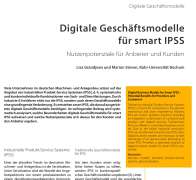
Digital Business Models for Smart IPSS

Digital Business Models for Smart IPSS

Potential Benefits for Providers and Customers
Lisa Grandjean, Marion Steven
Delivering industrial Product-Service Systems (IPSS) is a trend for companies in the german mechanical and plant engineering industry. IPSS are holistic problem solutions including an integrative combination of a physical core product and related services. Furthermore, IPSS are offered in customised business models. Due to the fourth industrial revolution, IPSS are transformed towards smart IPSS. Here, digital business models are necessary to take advantage of all opportunities belonging to smart IPSS. Therefore, a systematic analysis of digital business models for smart IPSS is presented.
Industrie 4.0 Management | Volume 33 | 2017 | Edition 5 | Pages 7-11
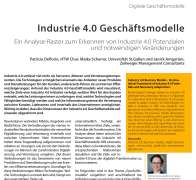
Industry 4.0 Business Models

Industry 4.0 Business Models

An analytical framework of Industry 4.0 potentials and necessary adaptations
Patricia Deflorin, Maike Scherrer, Janick Amgarten
Technological changes related to Industry 4.0 generate new potentials. Hence, it is important to understand which dimensions of a business model to adapt. Industry 4.0 technologies enable a company to offer new products, new services or to achieve efficiency improvements. The Industry 4.0 business model decomposition allows visualising which goal the initiative has, what the value offering is and which processes, technologies and capabilities are needed. As connectivity is a key dimension of Industry 4.0, technologies and systems are needed to connect internal and external processes.
Industrie 4.0 Management | Volume 33 | 2017 | Edition 5 | Pages 21-24
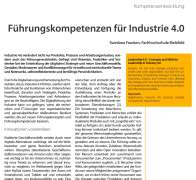
Leadership 4.0 – Concepts and Skills for Leadership in Industry 4.0

Leadership 4.0 - Concepts and Skills for Leadership in Industry 4.0

Swetlana Franken ORCID Icon
Industry 4.0 not only changes products, processes and work organisation, but also the understanding of leadership. Manager in future are visionaries, analysts and mentors who develop the strategy and new business models, designer and moderators for virtual and intercultural teams, self-reflected personalities..
Industrie 4.0 Management | Volume 32 | 2016 | Edition 3 | Pages 55-57
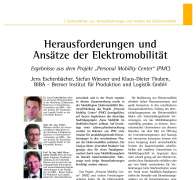
Electric Mobility from an Extended Products Perspective

Electric Mobility from an Extended Products Perspective

Ergebnisse aus dem Projekt „Personal Mobility Center“ (PMC)
Jens Eschenbächer, Stefan Wiesner, Klaus-Dieter Thoben ORCID Icon
Electric mobility is currently subject to intensive discussions. New business models, products and services, as well as innovation concepts are developed by R&D and tested in real-life. In this context, the project “Personal Mobility Center” has been carried out in the Bremen/Oldenburg model region for electric mobility. On the basis of the Product Life-Cycle, first approaches for product-related services in the different phases of electric mobility have been worked out. Analysis of these “Extended Products” has shown that battery electric vehicles have to overcome several challenges before new mobility offers based on them can compete on the market.
Industrie Management | Volume 28 | 2012 | Edition 5 | Pages 25-28
Co-operative Grid Solutions for Industrial Applications

Co-operative Grid Solutions for Industrial Applications

Anette Weisbecker, Oliver Strauß
Grid and cloud computing open up new possibilities for small and medium sized companies. On the basis of two use cases from the fields of deep drawing and casting process simulations we show different ways to utilize grid and cloud technology to enable the companies to offer new services and to employ new business models.
Industrie Management | Volume 26 | 2010 | Edition 3 | Pages 64-66
1 2