autonomous control

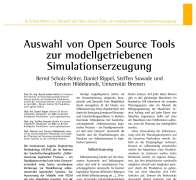
Selecting Open Source Software for the Model Driven Generation of Simulations

Selecting Open Source Software for the Model Driven Generation of Simulations

Bernd Scholz-Reiter ORCID Icon, Daniel Rippel, Steffen Sowade, Torsten Hildebrandt
The Autonomous Logistic Engineering Methodology (ALEM), which is developed within the Collaborative Research Center 637, provides several tools for creating models of autonomously controlled logistic systems. To evaluate such models, the ALEM framework is extended to include a simulation component. As the ALEM Models cannot run directly within simulation software, they are transformed using principles of the Model Driven Architecture. To enable the transformation several open source tools can be applied. This article evaluates a selection of such tools with the aim of integrating them into ALEM.
Industrie Management | Volume 26 | 2010 | Edition 3 | Pages 25-28
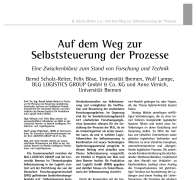
On The Way to Autonomous Control

On The Way to Autonomous Control

Eine Zwischenbilanz zum Stand von Forschung und Technik
Bernd Scholz-Reiter ORCID Icon, Felix Böse, Wolf Lampe, Anne Virnich
The cooperation between BLG LOGISTICS GROUP and the UNIVERSITY of BREMEN by the topic self-motoring in logistics exists since the composition of the collaborative research centre 637 “autonomous cooperating logistic processes - a paradigm shift and its limitations”. This research centre was founded by the “Deutschen Forschungsgemeinschaft (DFG)” in 2004. Since then the BLG provides the research case studies and real data from the industry. This builds the basis of the research analysis in the form of autonomous cooperating processes and simulation studies and allows the verification and evaluation of the complied work results. On the other hand are the results of the collaborative research centre 637 case studies very important for the development of the processes at the BLG. This article presents the contemporary issue of autonomous control, the insight of projects between BLG and Bremer Institut für Produktion und Logistik GmbH (BIBA) and moreover a future scenario of ...
Industrie Management | Volume 25 | 2009 | Edition 6 | Pages 21-26
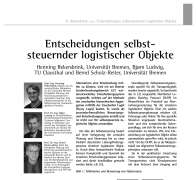
Decisions of Autonomously Controlled Logistic Objects

Decisions of Autonomously Controlled Logistic Objects

Henning Rekersbrink, Bjørn Ludwig, Bernd Scholz-Reiter ORCID Icon
Autonomously controlled transportation processes require decision making of logistic objects regarding routing alternatives. In this contribution a multicriterial evaluation assessment procedure is introduced basing on the fuzzy hierarchical aggregation, adapted and further developed at the CRC 637 “Autonomous Control of Logistic Processes” at Bremen University. The main design focus was user-friendliness within autonomous control and other fields of application. The example of use is a hierarchical structure of the subcriteria characterising the routing alternatives of an autonomous package. It is shown that the procedure can consider unprecise and fuzzy formulated knowledge directly in the model, while parameter adjusting was reduced to a minimum. Different weightings and compensation effects of subcriteria are depicted. The contribution shows the evaluation on a two-subcriteria basis and the possibilities of multicriterial evaluation as well. The evaluation of hard and soft ...
Industrie Management | Volume 23 | 2007 | Edition 4 | Pages 25-30
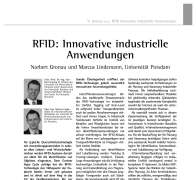
RFID: Cutting-edge Industrial Applications

RFID: Cutting-edge Industrial Applications

Norbert Gronau ORCID Icon, Marcus Lindemann
For simple industrial identification in many cases the traditional barcode systems are more profitable than applying RFID technology. But functional advantages in decentral data handling open up cutting-edge application potential. Improvements in component interoperability enable the implementation of robust and adaptable PPC concepts.
Industrie Management | Volume 23 | 2007 | Edition 4 | Pages 9-12
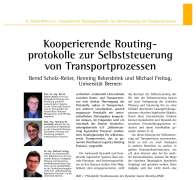
Cooperating Routing Protocols for Autonomous Controlled Transport Processes

Cooperating Routing Protocols for Autonomous Controlled Transport Processes

Bernd Scholz-Reiter ORCID Icon, Henning Rekersbrink, Michael Freitag ORCID Icon
For the implementation of autonomous control of transport processes it is tried to transfer well known and approved routing protocols from data communication to transport problems. Here structural differences between data and transportation networks prevent a direct transfer of the protocols, so that several different, particularly adapted protocols with different targets must cooperate in transportation networks. In the following a concept for autonomous controlled transport networks, called “Distributed Logistics Routing Protocol”, is introduced, developed at the CRC 637 “Autonomous Control of Logistic Processes” in Bremen.
Industrie Management | Volume 22 | 2006 | Edition 3 | Pages 7-10
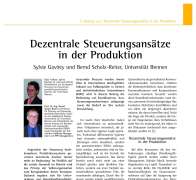
Decentralised Control Systems in Production

Decentralised Control Systems in Production

Sylvie Gavirey, Bernd Scholz-Reiter ORCID Icon
Incentives for self control in enterprises can only be successful when integrated by coordination. For this, harmonious concepts and “new” mechanisms of cooperation have to be developed. That topic is discussed in this article.
Industrie Management | Volume 22 | 2006 | Edition 1 | Pages 11-14
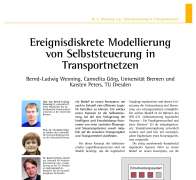
Discrete-Event Modelling of Autonomous Control in Transport Networks

Discrete-Event Modelling of Autonomous Control in Transport Networks

Bernd-Ludwig Wenning, Carmelita Görg, Karsten Peters
In current logistics systems, there is a trend towards more and more smaller and smaller transport positions (atomisation of load). This increases the complexity of planning and control. Therefore, there is a need for new concepts to be able to still have efficient logistics in the future. Such a new concept is the autonomous control where intelligence and decision autonomy are moved as far as possible from a central control instance towards the individual vehicles and goods. For this concept of autonomously controlled logistics components, a model is needed to represent the logistics processes and to enable the investigation and evaluation of solution approaches. Such a model has been developed in the CRC 637 “Autonomous Controlled Logistics Processes - A Paradigm Shift and its Limitations" [1] as a discrete-event simulation platform and is presented here with exemplary results of a control algorithm.
Industrie Management | Volume 21 | 2005 | Edition 5 | Pages 53-56
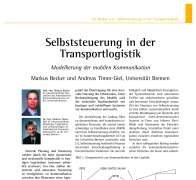
Autonomous Control in Transport Logistics: Modelling Communication

Autonomous Control in Transport Logistics: Modelling Communication

Modellierung der mobilen Kommunikation
Markus Becker, Andreas Timm-Giel
High dynamics and structural complexity in current and future logistic systems are complicating central planning and control. For enabling a more decentralised and autonomous control, communication between the elements of the logistical network are necessary for the provisioning of the information needed. This article details the modelling of the communication between the components. This modelling contains source and sink of the information as well as the amount of data, frequency of transmission, quality of service and the moment of transmission for a reasonable usage of the information. The technical feasibility with current and upcoming communication systems is evaluated under consideration of the model.
Industrie Management | Volume 21 | 2005 | Edition 5 | Pages 71-74
1 2