autonomous control

Autonomous Control for Automobile Terminals

Autonomous Control for Automobile Terminals

Potenziale selbststeuernder logistischer Prozesse zur Flexibilisierung der Flächenmasterplanung
Michael Görges, Michael Freitag ORCID Icon
The yard assignment in automobile terminals plays an essential role for the entire planning process. Due to short planning cycles and volatile planning information, the yard assignment determines the planning performance. This article analyses the effects and interdependencies of yard assignment planning. On this basis, this paper presents an approach for deriving and evaluating autonomous control methods for a dynamic the yard assignment planning to improve the terminal’s overall performance.
Industrie 4.0 Management | Volume 35 | 2019 | Edition 1 | Pages 23-26
Progressive Implementation of Autonomous Control

Progressive Implementation of Autonomous Control

Till Becker, Darja Wagner
The use of cyber-physical systems in production and logistics is an important component of Industry 4.0. The merger of production and logistics systems with information technology facilitates the transition from centralized to decentralized production planning and control. However, the need to equip logistic objects with the necessary technology is associated with high investment costs for production companies. This paper presents a method using dynamic clustering, which is suitable for identifying those parts of the production system, where an investment in technology for autonomous control leads to the largest increase in performance of the overall system.
Industrie Management | Volume 31 | 2015 | Edition 2 | Pages 28.32
On the Way to Industry 4.0

On the Way to Industry 4.0

Christian Gorldt, Alexander Pflaum
The development of information and communication technologies (ICT) is progressing rapidly and is seen in today‘s economic action as a key driver of innovation. Future industrial production is characterized by a high degree of customization of products and a strong production flexibility. The rapid development of the Internet has contributed especially in recent years in the private life of merging the real with the virtual world and will get stronger in the future of industrial sector. This paradigm shift is referred to as Industry 4.0. This paper gives an overview of the Industry 4.0 and represents the potential of the transformation process.
Industrie Management | Volume 30 | 2014 | Edition 1 | Pages 15-18
Autonomously Controlled Route Planning for Rental Articles

Autonomously Controlled Route Planning for Rental Articles

Florian Harjes, Bernd Scholz-Reiter ORCID Icon
In general, rental articles circulate in closed logistic systems, where the order parameters determine the material flow. As the planning horizon often comprises several subsequent orders at different locations, the corresponding transport and route planning is a complex task. Additionally, dynamic effects, such as thefts, damages, rush orders as well as new orders or order changes complicate the proceeding. This paper introduces the concept of an autonomously controlled route planning for rental articles that bases on the Distributed Logistics Routing Protocol (DLRP). At this, an example from the field of event logistics illustrates the concept.
Industrie Management | Volume 29 | 2013 | Edition 6 | Pages 44-48
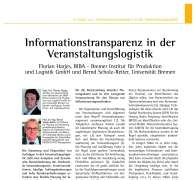
Information Transparency in Event Logistics

Information Transparency in Event Logistics

Florian Harjes, Bernd Scholz-Reiter ORCID Icon
The disposition and control of orders in the field of event logistics constitutes a complex and dynamic challenge. Changing venues, temporal restrictions as well as order changes and high customer demands require a flexible planning of the related logistic processes. Methods from the field of autonomous control offer a promising approach to cope with these problems. This contribution deals with the design of a special module for the information acquisition within the related logistic processes, as the provision of actual planning data is an indispensable prerequisite for the application of autonomous control.
Industrie Management | Volume 29 | 2013 | Edition 5 | Pages 39-42
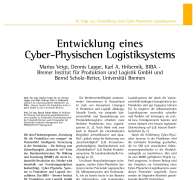
Development of a Cyber-Physical Logistics System

Development of a Cyber-Physical Logistics System

Marius Veigt, Dennis Lappe, Karl Hribernik, Bernd Scholz-Reiter ORCID Icon
Along with increasing complexity and dynamics the importance of cyber-physical systems in production and logistics also increases. Hence, the BIBA - Bremer Institut für Produktion und Logistik GmbH at the University of Bremen considers the application of cyber-physical systems in logistics. This paper presents the approach for the development of a cyber-physical logistics system. To start we describe the fundamental terms cyber-physical system and cyber-physical production system. Following these definitions we explain the term cyber-physical logistics system. Afterwards we describe the course of action; in particular necessary steps within the development of a cyber-physical logistics system are explained. In detail we present the procedure consisting of requirements analysis, conception and simulation-based evaluation.
Industrie Management | Volume 29 | 2013 | Edition 1 | Pages 15-18
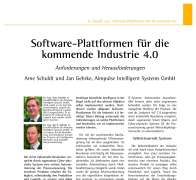
Software Platforms for the Upcoming Industry 4.0

Software Platforms for the Upcoming Industry 4.0

Requirements and Challenges
Arne Schuldt, Jan Gehrke
The fourth industrial revolution promises a further automation of process control by cyber-physical systems. The individual products gain the ability for controlling their production and logistics themselves. By coordinating themselves they can jointly achieve business objectives. This logical decomposition reduces the complexity of cross-company process control significantly. Thus, even exceptions on short notice can be dealt with in real-time. In operation, the required artificial intelligence will usually not be implemented on the active objects. Instead, adequate software platforms for the so-called Industry 4.0 are required. This article investigates the requirements for such platforms and describes how they can be implemented.
Industrie Management | Volume 29 | 2013 | Edition 1 | Pages 29-32
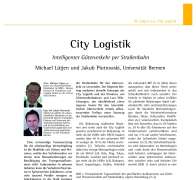
City Logistics

City Logistics

Michael Lütjen ORCID Icon, Jakub Piotrowski
One of the main challenges in urban logistic is the collaborated handling of freight transportation and urban public transport. Especially during peak periods, e.g. when commuters travel between their place of residence and place of work, the urban infrastructure for car traffic and public transport risks to collapse. In addition, often the freight transportation in urban areas competes with the public transport because of the use of the same road infrastructure. Therefore, it would make sense also to use free capacities of public transportations like trams for freight transports. First, this paper analyzes current concepts of urban logistics and concepts for the use of freight trams. Second, a new approach for the use of autonomous trolleys combined with the use of public trams will be introduced by the authors.
Industrie Management | Volume 28 | 2012 | Edition 2 | Pages 47-50
Construction Management Over the Internet

Construction Management Over the Internet

Networking excavators, caterpillars, etc. into a team
Carsten Frantzen, Uwe Rickers
A research project sponsored by Germany‘s Ministry of Economics and Technology is concerned with how modern Internet technologies can enable more efficient use of machinery in road and civil engineering. The idea of the AutoBauLog project - Autonomous Control in Construction Site Logistics - is to integrate all planning and construction processes of a civil engineering project from start to finish. It is based on a five-dimensional construction model that combines 3D geometry data, time and cost information. This technology is to keep project accountants and controllers up-to-date on changes on a construction site and on the impact of these changes on the cost and time schedule. Problems can thus be actively and promptly tackled before they influence the overall process.
Industrie Management | Volume 27 | 2011 | Edition 1 | Pages 51-54
Autonomous Control in Transport Logistics

Autonomous Control in Transport Logistics

Evaluation of an Autonomous Control Method with Dynamic Pickup and Delivery Problems
Henning Rekersbrink, Bernd-Ludwig Wenning
The traditional approach of transport logistic challenges is based on a central and static viewpoint. A given scenario is tried to be solved in an optimal way. Examples of established and well investigated scenarios in this area are the Vehicle Routing Problem (VRP) and the Pickup and Delivery Problem (PDP). The algorithms for these traditional points of view are pushed to their limits when applied on dynamically changing and close to reality scenarios. By contrast, the introduced autonomous control concept Distributed Logistics Routing Protocol (DLRP) was developed to act within a dynamic environment and to enable logistic objects to make own decisions. A comparison of the DLRP and a traditional algorithm will be presented as an evaluation study of the autonomous control concept.
Industrie Management | Volume 27 | 2011 | Edition 1 | Pages 30-34
1 2