Profitability

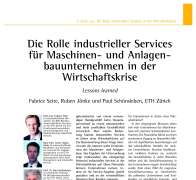
The Role of Industrial Services in Manufacturing

The Role of Industrial Services in Manufacturing

Lessons learned from the economic crisis
Fabrice Seite, Ruben Jönke, Paul Schönsleben
For many companies from the investment goods industry industrial services have evolved from a necessary prerequisite for selling a core product to a very important source of turnover and profit. But what role do industrial services play for the providing company during an economical crisis? To answer this question, the authors conducted interviews with six Swiss companies from machining and plant industry. The results of the research especially highlight the unique economic potential of industrial services. Companies may use the highlighted potential by adapting their service offering according to their customer’s economic situation.
Industrie Management | Volume 26 | 2010 | Edition 6 | Pages 57-61
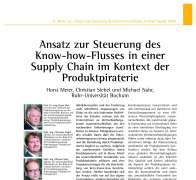
Contolling Know-How Flow in Supply Chains in the Context of Product Piracy

Contolling Know-How Flow in Supply Chains in the Context of Product Piracy

Horst Meier, Christian Siebel, Michael Nahr
Companies of the capital goods industry are more and more confronted with an increasing global competition. Furthermore the demand for a faster customisation of customers’ goods is accompanied by a decreasing product lifecycle. This circumstances lead to an uniting of companies to a value added chain which can more resist the increasing requirements of the industry. Sensitive data is consequently changed beyond the enterprise limits and the threat of product piracy is increasing to a higher level. Due to the increasing problem of product piracy this article describes the different comprehension of product piracy and explains a procedure strategy for providing of central knowledge. This described approach is not only limited to the enterprise limits. It can be used for the entire value added chain.
Industrie Management | Volume 26 | 2010 | Edition 5 | Pages 61-64
Sustainable Supply Chain Management

Sustainable Supply Chain Management

Assessment of the Sustainable Application of Logistic Concepts in Corporate Networks
Jan Helmig, Jerome Quick, Henrik Wienholdt, Kerem Oflazgil
Since the turn of the millennium companies are confronted with a tightly interwoven network consisting of changed framework conditions. Thus, for many companies it is necessary to form a network, together with a simultaneous securing of liquidity. Additionally, it is important to consider ecological values. The selection of adequate concepts in the supply chain management in combination with the right extent in logistic services poses a major challenge. However the dynamic assessment and selection of logistic concepts is quite possible. This article presents such an approach.
Industrie Management | Volume 26 | 2010 | Edition 5 | Pages 58-60
Outsourcing Spare Part Distribution Activities

Outsourcing Spare Part Distribution Activities

Tobias Held, Dirk Stegelmeyer
A lot of logistic activities are outsourced to focus on core competencies and to utilize the special know-how of service providers. This is especially valid for the outsourcing of packaging and international shipping processes. While several research studies cover the areas of make-or-buy and outsourcing in general only few publications deal with controlling of the implementation processes after the decision to outsource spare part logistics has been taken. Using the example of an outsourcing project of the Schleifring-Group, the success factors are analyzed. It is demonstrated how to implement an effective realization controlling and how planned improvements can be ensured.
Industrie Management | Volume 26 | 2010 | Edition 5 | Pages 47-50
Business Process Analysis and Knowledge Management using Social Networks

Business Process Analysis and Knowledge Management using Social Networks

Edzard Weber, Christian Scharff
This article describes an opportunity to model actors and systems in various business processes into an overall model by using the technique of networking. To achieve this goal, an algorithm is introduced. Next, different metrics based on social network analysis, are described. These metrics are able to expose parts of the network which have a huge utilization and therefore the underlying process itself. With this technique it is possible for project leaders, managers and decision makers to analyze the processes for flaws, finding out capacities and to build new project teams together (staffing).
Industrie Management | Volume 26 | 2010 | Edition 1 | Pages 13-16
Integrating Production and Transportation Systems Along Global Supply Chains

Integrating Production and Transportation Systems Along Global Supply Chains

Bernd Scholz-Reiter ORCID Icon, Enzo M. Frazzon, Thomas Makuschewitz
Global supply chains source raw material around the world, make use of local cost advantages for production and utilise the expertise of excellent partners. They aim at the creation of a sustainable competitive network. In order to benefit from the locally obtained advantages the processes of the partners have to be synchronised. This is a classic task of advanced planning systems. However operational planning and control is quite often conducted in a decentralised, function and department oriented way. This paper presents a framework for an integrated scheduling of production and transportation systems along a global supply chain on the operational level. The framework enhances the synchronisation of material flows and increases the competitiveness of the supply chain.
Industrie Management | Volume 25 | 2009 | Edition 6 | Pages 31-34
An Embarrassment of Riches: A Methodology for Evaluating Industrial Operator Models.

An Embarrassment of Riches: A Methodology for Evaluating Industrial Operator Models.

Thomas Dengler, Jörg von Garrel, Stephan Scheuner
Change processes in industrial manufacturing have spurred an intensified dissemination of business models based on “classic operator models” in the capital goods industry in recent years. Such industrial operator models (IOM) are characterized by their redistribution of responsibilities among suppliers and consumers aimed at expanding suppliers’ responsibilities from merely providing capital goods to financing and operating them as well. Providers are increasingly becoming project sponsors and being compelled assume a substantial share of the responsibility (and thus ultimately the risk too) for complex, long-range and occasionally high investment projects. Structured examination of and deliberations on IOM are extremely important before a supplier assumes the role of a project sponsor.
Industrie Management | Volume 25 | 2009 | Edition 5 | Pages 39-42
Implementing the Production Operating Curves into Production Controlling of an Electronics Manufacturing Plant

Implementing the Production Operating Curves into Production Controlling of an Electronics Manufacturing Plant

Implementierung der Produktionskennlinien in das laufende Produktionscontrolling eines Elektronikwerks
Ben Münzberg, Tim D. Busse, Alexander van Bebber
Today, the logistics performance especially of manufacturing companies is becoming a distinctive success factor in the marketplace. Perceiving this development Siemens’ Electronics Manufacturing plant in Amberg (EWA) implemented a comprehensive logistics KPI system supporting the controlling of production processes. The tools used, however, fall short of considering the interdependencies between different logistics KPIs. The article reports on a project conducted in cooperation between EWA and the Institute for Production Systems and Logistics of Leibniz University at Hannover. Presenting the project’s approach, conclusions and resulting experiences, the theoretical background as well as the fundamental impact production operating curves can offer for the competitiveness of a manufacturing company are outlined.
Industrie Management | Volume 25 | 2009 | Edition 5 | Pages 43-46
Total Cost and Benefit of Ownership

Total Cost and Benefit of Ownership

Technology assessment in terms of life cycle costs and benefits
Berend Denkena, Holger Rudzio, Mark Eikötter, Peter Blümel
Plant operators are getting more and more aware that operating costs are usually exceeding acquisition costs. For that reason there is an increased interest in methods like Life Cycle Costing (LCC) and Total Cost of Ownership (TCO). Weakness of these methods is their exclusive focus on costs. Because they do not allow differentiating benefits of various machines and plants, a holistic evaluation is difficult. The concept developed by the Institute of Production Engineering and Machine Tools (IFW) is concentrating on that issue, extending the Life Cycle Costing by a benefit assessment of investments.
Industrie Management | Volume 25 | 2009 | Edition 5 | Pages 35-38
Different Views on Waste

Different Views on Waste

Georg Möller, Michael Wesoly
Waste - being everything that adds no value towards the fulfillment of customer needs - has various effects on a company. In this article, different views on waste (employee, management and kaizen expert) are presented and compared. A recommendation for the goal oriented usage of these approaches concludes this article.
Industrie Management | Volume 25 | 2009 | Edition 3 | Pages 45-48
1 8 9 10 14