Manufacturing Systems

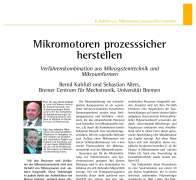
Reliable Manufacturing of Micro Motors

Reliable Manufacturing of Micro Motors

Verfahrenskombination aus Mikrosystemtechnik und Mikroumformen
Bernd Kuhfuß, Sebastian Allers
A huge variety of micro-sized sensors and actuators are created using methods of Micro Systems Technology (MST). The limitation of this technology is the use of stacked layers so that no real 3D-structures can be created. This barrier can be overcome by combining MST-processes with subsequent forming-processes to transform the flat structures into 3D objects. This is demonstrated with the forming of a planar coil arrangement into a cylindrical micro motor.
Industrie Management | Volume 26 | 2010 | Edition 6 | Pages 41-43
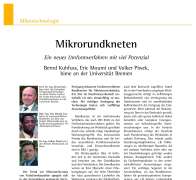
Micro Rotary Swaging – a New Effective Production Technology

Micro Rotary Swaging - a New Effective Production Technology

Ein neues Umformverfahren mit viel Potenzial
Bernd Kuhfuß, Eric Moumi, Volker Piwek
Micro rotary swaging is introduced as micro forming process for homogenous and compound parts. Application fields are seen within surgery, mechatronics, micro drives etc. The specific process limits are addressed. Demonstrator parts are shown to give an impression of the process capabilities. These are a combined laser melt/plunge swaged ball geometry and joined parts of different materials. The use of micro rotary swaging offers mostly the same advantages that are known from the macro world. Keywords:
Industrie Management | Volume 26 | 2010 | Edition 6 | Pages 14-16
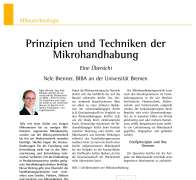
Principles and Technologies for Micro Handling

Principles and Technologies for Micro Handling

Eine Übersicht
Nele Brenner
Micro technological areas such as micro system or medical technology generate an increasing demand for micro parts. Besides high precision manufacturing processes for parts with a size of a few micrometers to millimetres, their production and assembly needs suitable handling technologies. This paper addresses these handling technologies and describes the principles and boundaries for gripping, conveyance, separation and sorting of micro objects.
Industrie Management | Volume 26 | 2010 | Edition 6 | Pages 20-24
Digital Human Models – Tools of Virtual Ergonomics

Digital Human Models - Tools of Virtual Ergonomics

Ergebnisse einer empirischen Studie
Birgit Spanner-Ulmer, Jens Mühlstedt
More and more virtual tools are used for issues of product ergonomics and human factors in production. This article describes the use of digital human models as virtual tools used in CAx systems, PLM systems and in the digital factory. An empirical study with users of these systems shows the benefits working with these systems and the problems, which have to be solved in the future. The main question, answered by the article, is: Will virtual ergonomic tools be used by experts in the future or will these tools become a standard for constructing engineers and production planners?
Industrie Management | Volume 26 | 2010 | Edition 4 | Pages 69-72
Logistic Quality Control in Micro Forming

Logistic Quality Control in Micro Forming

Einsatz von Fuzzy-Regelung zur Optimierung von Stichprobenintervallen
Bernd Scholz-Reiter ORCID Icon, Michael Lütjen ORCID Icon, Dennis Lappe, Hendrik Thamer, Nele Brenner
Due to the increased product miniaturization, a number of new applications and market opportunities open up for mechanical micro-manufacturing. In the manufacturing process with part dimensions less than one millimeter and tolerances in the micrometer range occur so-called “size effects”. These prevent a simple scaling of processes known methods from the macro level and lead to an increased occurrence of quality deviations. In conclusion, the process capability according to ISO 21747 is affected and therefore the application of statistical process control (SPC) is more difficult. In this paper, the interaction between technical and logistical quality objectives in terms of logistical quality control are analyzed at the example of micro cold forming. Thereby, methods of statistical process control and fuzzy control are used.
Industrie Management | Volume 26 | 2010 | Edition 4 | Pages 13-16
Surface Inspection of Micro Parts

Surface Inspection of Micro Parts

Bernd Scholz-Reiter ORCID Icon, Michael Lütjen ORCID Icon, Hendrik Thamer
Due to the increasing miniaturization in all areas, mechanical manufacturing processes of micro-components become more important. The combination of high production cycles and low manu-facturing tolerances in the micrometer range requires a comprehensive quality management, which seeks efficient processes with low quality costs. Because of the small component sizes and the difficulties associated with the handling process, the classic visual inspection retires as testing procedure. In combination with a customized micro-manufacturing surface metrology, an efficient image processing system is needed to identify surface imperfections such as cracks, dents and scratches. This paper presents different standards and applications on the basis of quality management that affect the surface inspection of micro components. By reference to a micro-thermoformed component from the Collaborative Research Centre (CRC) 747, the prototypical implementation of an automated image processing system is ...
Industrie Management | Volume 26 | 2010 | Edition 3 | Pages 43-46
Lean Production Systems for Logistics Service Providers

Lean Production Systems for Logistics Service Providers

An Empirial Analysis
Yilmaz Uygun, Stephan Keßler, Markus Droste
In this paper we present a short summary of the empirical studie we conducted among German logistics service providers in order to derive the diffusion of methods of Lean Production Systems in this industry. The study sheds light on the extent of the latent application of some methods so as to evaluate the preconditions of the development of a „Lean Production System” for logistics service providers.
Industrie Management | Volume 26 | 2010 | Edition 1 | Pages 45-48
Dealing with Complexity in Flexible Production Systems

Dealing with Complexity in Flexible Production Systems

Customer specific products at mass production costs
Robert Schmitt ORCID Icon, Michael Vorspel-Rüter, Henrik Wienholdt
To compete in the global environment companies in high wage countries have to separate themselves from competitors from low wage countries by offering customer specific products and services. Due to the rising complexity of these products the steering of the corresponding production systems is getting more and more resource consuming. One way to handle this aspect is developed within the Excellence Cluster “Integrative production technology for High-wage countries” at RWTH Aachen University. Objective is the set up of production systems that are able to produce customer specific products at mass production costs.
Industrie Management | Volume 26 | 2010 | Edition 1 | Pages 53-56
Strategic Planning in Production Networks

Strategic Planning in Production Networks

Die langfristige Wettbewerbsfähigkeit von Netzwerken sichern
Heiko Duin, Jens Eschenbächer, Klaus-Dieter Thoben ORCID Icon
The continuing change of producer markets towards buyer markets has a strong impact on the competition between manufacturing enterprises. As a strategic answer collaborative networks such as virtual corporations, virtual enterprises or virtual factories have been discussed since the beginning of the 90ies of last century. Many models and concepts supporting the life cycle of such organisations - consisting of the creation, operation and dissolution phases - have been presented. An important aspect in the creation phase is strategic planning. This phase is supported by concepts of long-term networks like industrial clusters or regional networks which act as a virtual breeding environment and which enable the short-term creation of virtual organisations. Especially this phase needs support of strategic planning which can be seen as a part of the strategic management process. This paper shows that such virtual breeding environments can be seen as complex systems and how system oriented ...
Industrie Management | Volume 25 | 2009 | Edition 4 | Pages 9-12
Manufacturing Adaptability – from Flexibility to Agility

Manufacturing Adaptability - from Flexibility to Agility

von der Flexibilität zur Zukunftsfähigkeit
Norbert Gronau ORCID Icon, Marcus Lindemann
Beginning with planning and control of traditional manufacturing systems and covering new goals of manufacturing strategy requirements like complexity management, adaptability and robustness are articulated. The paradigms of bionic, holonic and fractal systems seem to fulfill these requirements and allow the creation of new production systems.
Industrie Management | Volume 25 | 2009 | Edition 3 | Pages 20-24
1 16 17 18 23