Manufacturing Systems

Knowledge Based Engineering- Applications of Engineering Methods and Tools

Knowledge Based Engineering- Applications of Engineering Methods and Tools

Anwendungen und Trends wissensbasierter Engineeringmethoden und Werkzeuge
Michael Weyrich, Philipp Klein, Ulrich Löwen, Thomas Schäffler, Jan Vollmar
Knowledge-Based Engineering (KBE) is the overall integration of knowledge, rules and process operation in the engineering process. It helps implanting the interdisciplinary know-how in product- and process development. The resulting effects are mainly time- and cost-cutting, which can be assigned as relevant competitive advantages against competitors. The importance of this field of study for industries like the automotive, ship-building, process engineering, plant manufacturing and machine-building industry was the significant reason for starting this research. At the very beginning, the focus was on the identification of certain descriptors through analyzing almost 100 scientific articles, books and dissertations about KBE. On the one hand this approach gives a deeper look into the state of the art and on the other hand it provides the possibility of ordering these articles in a certain hierarchy of relevance. The frequencies of indications of the given descriptors within the ...
Industrie Management | Volume 28 | 2012 | Edition 3 | Pages 39-42
Integrating Order Sequencing- and Transport Planning

Integrating Order Sequencing- and Transport Planning

An Example of Comprehensive Planning Transcending Functional Borders Using Logistic Assistance Systems
Christian Schwede, Michael Toth, Axel Wagenitz
Handling complexity is one of the key topics of producing enterprises worldwide. It can be noted that enterprises are indeed able to coop with the complexity of single processes due to a function-oriented organisation, yet the same organisational paradigm leads to local objective systems that in many cases are contrary to the global goals of the enterprise. The same problem is reflected and supported by the enterprise’s IT systems. Thus, in this paper we present an approach to convert the inflexible function oriented operations into comprehensive processes by introducing special IT systems, so-called logistic assistance systems. To illustrate the approach we introduce the problem of integrated order sequencing and transport planning in the automotive industry and present a prototypical solution.
Industrie Management | Volume 28 | 2012 | Edition 3 | Pages 25-29
Approaches to Support Discrete-event Simulation as a Knowledge-intensive Process

Approaches to Support Discrete-event Simulation as a Knowledge-intensive Process

Dennis Abel, Markus Schmitz, Sigrid Wenzel ORCID Icon
Planning, design and continuous improvement of today’s complex corporate structures and technical systems require a sophisticated level of extensive know-ledge of technology, processes and IT. To apply planning and simulation tools effectively and efficiently engineers and plant operators have to rise to the challenge to use their knowledge in a goal-oriented way and to expand it within creative processes. Consequently, knowledge is more than ever a key productivity factor and an important component of corporate capital. Against this background, the article discusses possibilities for systematization and standardization in simulation studies and especially approaches to increase productivity in simulation studies by supplying assistance functions as well as systematic evaluation methodologies.
Industrie Management | Volume 28 | 2012 | Edition 3 | Pages 7-11
Designing Changeable Production Systems

Designing Changeable Production Systems

Holistic Identification and Analysis of Change Factors
Horst Meier, Dieter Kreimeier, Julia Velkova, Stefan Schröder
Internal and external influences of change plus the steady examination with continuous as well as discontinuous change constitute a great challenge for industrial companies to be mastered. The improvement of production systems towards variable and unpredictable requirements caused by a variety of company-specific impacts will be increasingly focused. In this article a concept will be introduced which helps to identify and analyze company-specific change factors systematically.
Industrie Management | Volume 28 | 2012 | Edition 2 | Pages 55-58
Sustainable Stock Management

Sustainable Stock Management

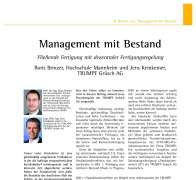
Fließende Fertigung mit dezentraler Fertigungsregelung
Boris Brinzer, Jens Kemkemer
Processing of the production orders in sync with customer demand, on schedule, at short notice, with constant machine utilization, is the vision of many a plant manager. Besides machine and personnel productivity, stock volume is for this the clearest performance indicator. In large-scale production, this vision has quite successfully been approached through assembly lines with a continuous, pulled material flow and one-piece production. Especially in series and small series production with high variety, however, the same concepts are not applicable or not very successful. A sustainable way to approach the vision in such a setting is described in this paper based on the practical example of TRUMPF Grüsch AG.
Industrie Management | Volume 28 | 2012 | Edition 1 | Pages 17-21
Discussing Lot Sizing Approaches

Discussing Lot Sizing Approaches

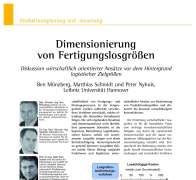
Their influence on economic production
Ben Münzberg, Matthias Schmidt, Peter Nyhuis ORCID Icon
Lot sizing is a substantial factor of economic production. There are various lot sizing approaches considering the same cost factors in different ways. Their results are usually quite similar. A common weakness of all lot sizing approaches is the limited consideration of relevant cost factors. The costs which are neglected usually rise with increasing lot sizes. This leads to illusory exact results because too large lots are calculated generally. This paper compares functions and results of different lot sizing approaches and discusses neglected cost factors.
Industrie Management | Volume 27 | 2011 | Edition 5 | Pages 22-26
Transfer of the LPS-Principles to the Development Process

Transfer of the LPS-Principles to the Development Process

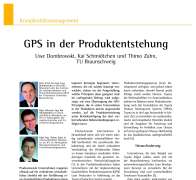
Uwe Dombrowski, Kai Schmidtchen, Thimo Zahn
In today’s business environment enterprises react to changing conditions with the implementation of Lean Production Systems (LPS). But changing conditions are not only effecting the production. The role of product development is becoming increasingly important to the overall business success. Many enterprises react by designing specific Lean Development concepts. As there are different approaches to design concepts, enterprises have to decide which approach to follow. This paper presents the approach, which takes LPS as the basis, considering the circumstances of the development process and transfers it to the development process to design a Lean Development concept. It is demonstrated how the transfer of the LPS-principles based on VDI 2870 would affect the development process.
Industrie Management | Volume 27 | 2011 | Edition 5 | Pages 72-76
Intuitive Programming of Robots

Intuitive Programming of Robots

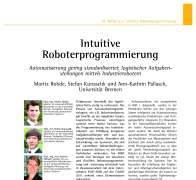
Automatisierung gering standardisierter, logistischer Aufgaben-stellungen mittels Industrierobotern
Moritz Rohde, Stefan Kunaschk, Ann-Kathrin Pallasch
In the field of automobile production, automation has been implemented since the nineteen-seventies. In logistics, however, robotics has only been used to automate logistics processes with low complexity. These include processes with a high repetition rate and a highly standardized goods portfolio. In cooperation with EASY-ROB, BIBA has developed a new strategy for an intuitive programming of robotics that might be used to fulfill rather complex tasks. The operator defines the process type and important parameters via a common tracking system. Based on this data, a simulation tool calculates the movement of the robot and executes a collision control. Finally, the simulation tool generates the corresponding machine code and the robot starts its process. The intuitive programming excels at a favorably cost-benefit ratio. A demonstrator, focusing on the unloading of pallets has been presented on the CeMAT 2011. After a very brief introduction, interested visitors were able to operate the ...
Industrie Management | Volume 27 | 2011 | Edition 5 | Pages 55-58
Skills Development and Leadership

Skills Development and Leadership

The continuous improving process in lean manufacturing systems
Eberhard Abele, Jan Cachay, Jan Wennemer
Sustainability in lean production systems arises when the relevant lean principles are addressed by preferably all stakeholders in the context of permanent improvement processes. For this purpose a skills development of all employees is necessary, even for managers, as they convey the CIP position by their people skills and set an example. If this succeeds, improvement processes will develop into a sustainable learning process, which in turn serves as a self-reinforcing factor for the further development of staff skills. An approach to skills development and to the corresponding leadership system for improvement processes is presented and supported by preliminary results of an empirical study.
Industrie Management | Volume 27 | 2011 | Edition 4 | Pages 14-18
Plant Efficiency as an Essential Component of Agile Production Systems

Plant Efficiency as an Essential Component of Agile Production Systems

Hubert Biedermann, Markus Gram
For the design of an agile production system in addition to the holistic view of production and its internal and external links, a detailed analysis of individual components is necessary. These elements are general manufacturing equipment in various types of expression. To investigate and valuate the properties of these components primarily key figures and indicators are used. In the field of facility and maintenance management the Overall Equipment Effectiveness (OEE) parameter is widely used to determine the equipment efficiency. This indicator is an integral part of a holistic maintenance management. Recent developments use the OEE value as a basis to evaluate the whole value chain to get a holistic view of the included equipment. This integrated approach is an essential component for assessing the flexibility of production systems, which presents itself in three different dimensions.
Industrie Management | Volume 27 | 2011 | Edition 3 | Pages 16-20
1 14 15 16 23