Adaptability

Ways to Simplicity

Ways to Simplicity

Vier Vorschläge zur Vereinfachung der Produktion
Herbert Jodlbauer
A simple production system enables to customer oriented manufacturing with low cost and high costumer service. The most four important ways to a simple production are covered by: • Reduction of the number of items (finished goods, intermediate as well as purchasing parts) • Setting of clear and non-conflicting objectives as well as prioritizing measurements needed • Organizing of a continuous production flow and • Applying monitoring instruments instead of detailed planning and scheduling tools
Industrie Management | Volume 24 | 2008 | Edition 3 | Pages 17-19
IT-Business Alignment and Adaptability of Information systems

IT-Business Alignment and Adaptability of Information systems

Norbert Gronau ORCID Icon
Adaptability helps to process the necessary alignment between IT architecture and busuness world. The paper describes the concept of adaptability and declares when companies need adaptability and how it can be measured.
Industrie Management | Volume 24 | 2008 | Edition 2 | Pages 11-13
Adaptability Through Organisation

Adaptability Through Organisation

Utilisation and Effects of Flexibility-Oriented Organisational Concepts
Steffen Kinkel ORCID Icon, Gunter Lay, Angela Jäger
More than a fourth of German companies regard flexibility as their main competitive edge. Companies set great store by delivering customized solutions to the customer or to be able to deliver swiftly and on time. Thus the diffusion of organisational concepts which are suited to support adaptability of companies and to realise flexibility advan-tages is increasingly getting into the focus of attention. However, German industry has not yet fully exploited the potential these enablers might have on companies’ flexibility. The development of customized organisational concepts for improving the flexibility might help to further increase companies’ competitive edge.
Industrie Management | Volume 24 | 2008 | Edition 2 | Pages 78-82
Continuous Improvement – Transparency of Variety

Continuous Improvement - Transparency of Variety

Klaus Hense, Robert Schmitt ORCID Icon
The laboratory for machine tools WZL of RWTH Aachen University and Scheidt & Bachmann have jointly developed a methodology for product structure oriented continuous improvement of products and processes. The staff members’ manifold experience with complex products is used effectively by a combination of a product structure oriented assessment and a production portfolio oriented interpretation. Hence, experiences are quantified by the metric “additional effort of time per single use”. This additional effort addresses the coordination and correction expenses, which are typically not quantified and handled by variety-neutral surcharges in the calculation scheme. The methodology is working on the basis of “As-Is” data and not as usual on the basis of planning data like in conventional approaches of variant management. The factual composition of the products is used instead. By applying the methodology for several product families, latent optimization potential could be determined ...
Industrie Management | Volume 23 | 2007 | Edition 6 | Pages 56-58
Modularisation of Logistics Systems

Modularisation of Logistics Systems

A Contribution to Complexity Management
Frank Straube, Axel Mayer
Complexity of industrial enterprises increases. Responsible for this trend are external drivers like the individualisation of products, the fierce global competition and the speed of technological developments which lead to reduced product life and innovation cycles. Companies react to external complexity by building internal complexity, logistics as a cross functional unit is especially affected. For example, a great number of different customers demand a heterogenic product program which results in operating an increasing quantity of variants. Because of the growing internal complexity a lot of promising logistical solutions are not realised. This article shows an approach how to create an organisational framework - based on the formal principle “Modularisation” - which allows logistics to regain adaptability and mutability by reducing internal complexity.
Industrie Management | Volume 23 | 2007 | Edition 6 | Pages 53-55
Autonomous Control of Production Systems using Honey-Bee-Algorithms

Autonomous Control of Production Systems using Honey-Bee-Algorithms

Bernd Scholz-Reiter ORCID Icon, Thomas Jagalski, Julia Bendul
This paper focuses on the application of a bee-like autonomous control method to a matrix-like shop floor model with setup times.Apparently present planning and control systems are unable to cope with the new needs for flexiblity and process reliability resulting from dynamics and complexity in the environment. Autonomous control means de-centralized coordination of intelligent logistic objects in a dynamically changing environment. By the aid of a continuous flow simulation the system’s performance will be analyzed in regard to the application effect on throughput times and inventory levels.
Industrie Management | Volume 23 | 2007 | Edition 5 | Pages 7-10
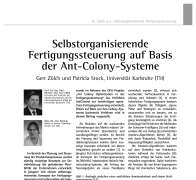
Self-Organizing Manufacturing Control Using Ant Colony Systems

Self-Organizing Manufacturing Control Using Ant Colony Systems

Gert Zülch, Patricia Stock
As a reaction to the growing demands of the market on enterprises, ever more complex procedures for production control are being developed. Most recently, self-organising procedures, which often mimic the behaviour of natu­ral systems (e.g. evolutionary or genetic algorithms), have come to the fore. The methods of Swarm Intelligence and, in particular, the Ant Colony Optimi­zation (ACO), which are characterised by their flexibility and adaptability, could serve as a basis for this. The ifab-Institute has developed a pro­cedure for the short-term, operative manufacturing control based on this approach, which will be presented in this article.
Industrie Management | Volume 23 | 2007 | Edition 5 | Pages 67-70
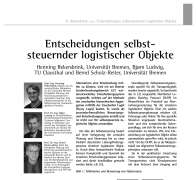
Decisions of Autonomously Controlled Logistic Objects

Decisions of Autonomously Controlled Logistic Objects

Henning Rekersbrink, Bjørn Ludwig, Bernd Scholz-Reiter ORCID Icon
Autonomously controlled transportation processes require decision making of logistic objects regarding routing alternatives. In this contribution a multicriterial evaluation assessment procedure is introduced basing on the fuzzy hierarchical aggregation, adapted and further developed at the CRC 637 “Autonomous Control of Logistic Processes” at Bremen University. The main design focus was user-friendliness within autonomous control and other fields of application. The example of use is a hierarchical structure of the subcriteria characterising the routing alternatives of an autonomous package. It is shown that the procedure can consider unprecise and fuzzy formulated knowledge directly in the model, while parameter adjusting was reduced to a minimum. Different weightings and compensation effects of subcriteria are depicted. The contribution shows the evaluation on a two-subcriteria basis and the possibilities of multicriterial evaluation as well. The evaluation of hard and soft ...
Industrie Management | Volume 23 | 2007 | Edition 4 | Pages 25-30
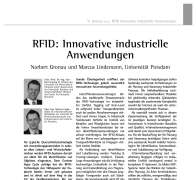
RFID: Cutting-edge Industrial Applications

RFID: Cutting-edge Industrial Applications

Norbert Gronau ORCID Icon, Marcus Lindemann
For simple industrial identification in many cases the traditional barcode systems are more profitable than applying RFID technology. But functional advantages in decentral data handling open up cutting-edge application potential. Improvements in component interoperability enable the implementation of robust and adaptable PPC concepts.
Industrie Management | Volume 23 | 2007 | Edition 4 | Pages 9-12
Strategic Flexibility and Technology Planning in the Automotive Production

Strategic Flexibility and Technology Planning in the Automotive Production

Heinrich Kuhn, Thomas Schmaußer
Manufacturing flexibility is currently one of the key trends within the automotive industry. In this context, the determination of the optimal degree of flexibility represents a complex decision problem. First of all this article clarifies chances and modes of operation of flexibility in the automotive production. Manufacturing flexibility can be used both to counter short- and medium-term market fluctuations and as a strategic approach to realize long-term costs advantages. Subsequently different aspects which have to be considered within the strategic planning are commented on in detail. The contribution clarifies that the planning of optimal flexibility requires an integrated planning approach.
Industrie Management | Volume 23 | 2007 | Edition 3 | Pages 39-42
1 16 17 18 21