Adaptability

Reconfigurable Production Systems in the IBF-Lab

Reconfigurable Production Systems in the IBF-Lab

Considering interdependencies between human beings, technology and organization
Birgit Spanner-Ulmer, Egon Müller, Stev Glöckner, Jörg Ackermann, Mathias Keil, Frank Börner
Companies are constantly exposed to radical change. One approach to addressing these challenges is changeable production systems. Changeable production systems can only be as adaptable as the human being who is working in them. An integrated view of the dimensions of human beings, technology and organization is essential in this context. The Institute of Industrial Management and Factory Systems has wide experience and competences in the field of research of adaptable production. This is supported by the lab area of the IBF, called IBF-Lab, which allows interdisciplinary research. Practical application is demonstrated using an example of a research project.
Industrie Management | Volume 27 | 2011 | Edition 3 | Pages 69-72
Fit for Change: Manage the Dynamics of Complexity in Production Systems

Fit for Change: Manage the Dynamics of Complexity in Production Systems

Dominik T. Matt
Against the background of today’s highly competitive and dynamic market environment, the concept of changeability of producing gets increasingly important for producing companies in order to maintain or even enhance their survivability. The necessity for change in a production system is determined by the time-dependent complexity of the production tasks which change dynamically with the system’s environment. Most research in this area focuses on the approach to achieve a better changeability by the production system’s design. This paper puts another viewpoint on changeability: best way to achieve an enhanced and sustainable survivability of a production system can be achieved by an early and focused determination of the right time and amplitude of change.
Industrie Management | Volume 27 | 2011 | Edition 3 | Pages 29-32
Flexibility Quantification of Production Systems in Light of Demographic Change

Flexibility Quantification of Production Systems in Light of Demographic Change

Gert Zülch, Martin Waldherr
In turbulent and innovative markets it is important for any production enterprise to have a high level of robustness within a specific range of output quantities vis-à-vis any changes it will be affected by. In fact, it is necessary to provide a planning routine for the adaptability of production systems as early as during the planning stage. In this way it will be able to respond to unforeseeable developments. Due to the demographic development in particular, it is no longer appropriate to consider the staff structure after the configuration of the machinery equipment has been planned. It is much more important to design manufacturing systems to be productive during the whole usage phase of the production system without a change of the permanent staff. The aim is to enhance the planning task in such a way that the production system can be adapted technically and organisationally as well as in a personnel-oriented manner to a changing performance of an ageing workforce.
Industrie Management | Volume 27 | 2011 | Edition 3 | Pages 65-68
Professional Management of Complexity as a Basis for Agile Production Systems

Professional Management of Complexity as a Basis for Agile Production Systems

Leitbilder, Prinzipien und Werkzeuge
Michael Reiss
Although all approaches to proactive change management of production systems emphasize the relevance of complexity, an integrated building block “management of complexity” is not available. Based on a specification of the domains and dimensions of production complexity a framework for handling complexity is outlined. It covers guidelines, principles and tools for coping with the multiplicity, diversity, ambiguity and dynamics of production systems.
Industrie Management | Volume 27 | 2011 | Edition 3 | Pages 77-81
Planning and Optimization of Changeable Global Value Added Networks

Planning and Optimization of Changeable Global Value Added Networks

Gisela Lanza ORCID Icon, Raphael Moser, Bernd Scholz-Reiter ORCID Icon, Mehmet-Emin Özsahin, Susanne Schukraft, Pamela Meil, Franziska Rasp
Due to the concentration of core competences and the utilisation of international location advantages successful German production companies face a situation with globally dispersed sites in global value added networks. The ongoing globalisation, which includes the integration of external sites, suppliers and partners, leads to complex interactions within networks. However, these interactions are not or are simply partially known and not predictable so far. Being able to control dramatic dynamics in the behaviour of global value added networks, German production companies will be positively affected by globalisation in the future. Therefore, changeable global value added networks which can be quickly adjusted to dynamics become crucial. The paper on hand describes an approach for the planning and optimization of adaptable global value added networks. Background is the approach of the research project “planning and optimization of changeable global value added networks” (POWer.net) ...
Industrie Management | Volume 27 | 2011 | Edition 3 | Pages 57-60
Cognitive Production Metrology

Cognitive Production Metrology

Ein neues Konzept zur qualitativen Absicherung der Kleinserienproduktion
Robert Schmitt ORCID Icon, Tilo Pfeifer, Alberto Pavim
The trend for product individualization results in a demand for small and more flexible production series with a considerable diversity of components. The improvement of manufacturing and assembly flexibility has a direct impact on the control complexity of the manufacturing tasks leading to big challenges for the quality assurance systems. The quality assurance strategy that is nowadays used for mass production is unable to cope with the inspection flexibility needed among small series production. The major challenge faced by a quality assurance system applied to small series production is to guarantee the needed quality level already at the first run (“first time right on time”). This demands a constant adaption of the quality assurance system behavior according to the dynamic manufacturing conditions, which can be achieved by the improvement of cognitive and autonomy aspects of the manufacturing systems. This work introduces the concept of Cognitive Production Metrology as an ...
Industrie Management | Volume 27 | 2011 | Edition 2 | Pages 13-18
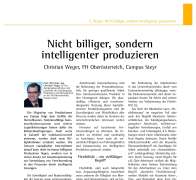
Intelligent rather than Cheap Manufacturing

Intelligent rather than Cheap Manufacturing

Christian Weger
The migration of production sites out of Europe is primarily based on manufacturing costs. Therefore, perfectly functioning communication systems and reliable logistic services are needed. Although the advantage of lower labor costs will decrease in the future, more low-wage countries will be discovered. The answer cannot be found in low-cost production but in an approach which optimizes processes in a holistic way avoiding waste through intelligent solutions.
Industrie Management | Volume 27 | 2011 | Edition 2 | Pages 47-50
Construction Management Over the Internet

Construction Management Over the Internet

Networking excavators, caterpillars, etc. into a team
Carsten Frantzen, Uwe Rickers
A research project sponsored by Germany‘s Ministry of Economics and Technology is concerned with how modern Internet technologies can enable more efficient use of machinery in road and civil engineering. The idea of the AutoBauLog project - Autonomous Control in Construction Site Logistics - is to integrate all planning and construction processes of a civil engineering project from start to finish. It is based on a five-dimensional construction model that combines 3D geometry data, time and cost information. This technology is to keep project accountants and controllers up-to-date on changes on a construction site and on the impact of these changes on the cost and time schedule. Problems can thus be actively and promptly tackled before they influence the overall process.
Industrie Management | Volume 27 | 2011 | Edition 1 | Pages 51-54
Modelling and Measurement of Flexibility

Modelling and Measurement of Flexibility

Wiebke Hartmann, Tim D. Busse, Peter Nyhuis ORCID Icon, Sebastian Beck
In an increasingly turbulent environment, today enterprises are confronted with the challenge of aligning available capacities with the capacities required using targeted measures. An approach is presented to support the selection of measures quantitatively.
Industrie Management | Volume 27 | 2011 | Edition 1 | Pages 62-64
Autonomous Control in Transport Logistics

Autonomous Control in Transport Logistics

Evaluation of an Autonomous Control Method with Dynamic Pickup and Delivery Problems
Henning Rekersbrink, Bernd-Ludwig Wenning
The traditional approach of transport logistic challenges is based on a central and static viewpoint. A given scenario is tried to be solved in an optimal way. Examples of established and well investigated scenarios in this area are the Vehicle Routing Problem (VRP) and the Pickup and Delivery Problem (PDP). The algorithms for these traditional points of view are pushed to their limits when applied on dynamically changing and close to reality scenarios. By contrast, the introduced autonomous control concept Distributed Logistics Routing Protocol (DLRP) was developed to act within a dynamic environment and to enable logistic objects to make own decisions. A comparison of the DLRP and a traditional algorithm will be presented as an evaluation study of the autonomous control concept.
Industrie Management | Volume 27 | 2011 | Edition 1 | Pages 30-34
1 13 14 15 21